
![Report of the Special Mission to Egypt under Lord Milner, and related papers [‎216r] (434/473)](https://iiif.qdl.qa/iiif/images/81055/vdc_100000001491.0x000295/Mss Eur F112_260_0434.jp2/full/!1200,1200/0/default.jpg "Report of the Special Mission to Egypt under Lord Milner, and related papers [‎216r] (434/473)")
Report of the Special Mission to Egypt under Lord Milner, and related papers [216r] (434/473)
The record is made up of 1 file (237 folios). It was created in 15 May 1920-14 Oct 1921. It was written in English. The original is part of the British Library: India Office The department of the British Government to which the Government of India reported between 1858 and 1947. The successor to the Court of Directors. Records and Private Papers Documents collected in a private capacity. .
Transcription
This transcription is created automatically. It may contain errors.
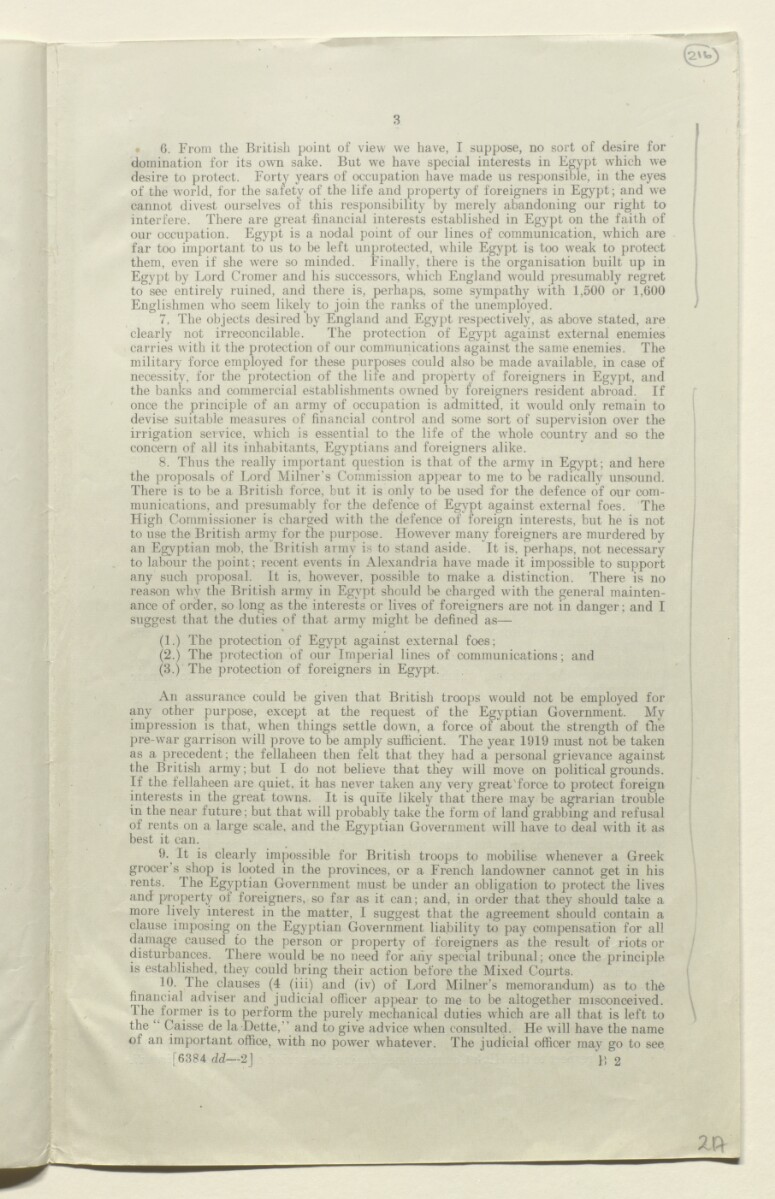
6 . From the British point of view we have, I suppose, no sort of desire for
domination for its own sake. But we have special interests in Egypt which we
desire to protect. Forty years of occupation have made us responsible, in the eyes
of the world, for the safety of the life and property of foreigners in Egypt; and we
cannot divest ourselves of this responsibility by merely abandoning our right to
interfere. There are great financial interests established in Egypt on the faith of
our occupation. Egypt is a nodal point of our lines of communication, which are
far too important to us to be left unprotected, while Egypt is too weak to protect
them, even if she were so minded. Finally, there is the organisation built up in
Egypt by Lord Cromer and his successors, which England would presumably regret
to see entirely ruined, and there is, perhaps, some sympathy with 1,500 or 1,600
Englishmen who seem likely to join the ranks of the unemployed.
7. The objects desired by England and Egypt respectively, as above stated, are
clearly not irreconcilable. The protection of Egypt against external enemies
carries with it the protection of our communications against the same enemies. The
military force employed for these purposes could also be made available, in case of
necessity, for the protection of the life and property of foreigners in Egypt, and
the banks and commercial establishments owned by foreigners resident abroad. If
once the principle of an army of occupation is admitted, it would only remain to
devise suitable measures of financial control and some sort of supervision over the
irrigation service, which is essential to the life of the whole country and so the
concern of ail its inhabitants, Egyptians and foreigners alike.
8 . Thus the really important question is that of the army in Egypt; and here
the proposals of Lord Milner's Commission appear to me to be radically unsound.
There is to be a British force, but it is only to be used for the defence of our com
munications, and presumably for the defence of Egypt against external foes. The
High Commissioner is charged with the defence of foreign interests, but he is not
to use the British army for the purpose. However many foreigners are murdered by
an Egyptian mob, the British army is to stand aside. It is, perhaps, not necessary
to labour the point; recent events in Alexandria have made it impossible to support
any such proposal. It is, however, possible to make a distinction. There is no
reason why the British army in Egypt should be charged wdth the general mainten
ance of order, so long as the interests or lives of foreigners are not in danger; and I
suggest that the duties of that army might be defined as—
(1.) The protection of Egypt against external foes;
(2.) The protection of our Imperial lines of communications; and
(3.) The protection of foreigners in Egypt.
An assurance could be given that British troops would not be employed for
any other purpose, except at the request of the Egyptian Government. My
impression is that, when things settle down, a force of about the strength of the
pre-war garrison will prove to be amply sufficient. The year 1919 must not be taken
as a precedent; the
fellaheen
Arabic for ‘peasant’. It was used by British officials to refer to agricultural workers or to members of a social class employed primarily in agricultural labour.
then felt that they had a personal grievance against
the British army; but I do not believe that they will move on political grounds.
If the
fellaheen
Arabic for ‘peasant’. It was used by British officials to refer to agricultural workers or to members of a social class employed primarily in agricultural labour.
are quiet, it has never taken any very great'force to protect foreign
interests in the great towns. It is quite likely that there may be agrarian trouble
in the near future; but that will probably take the form of land grabbing and refusal
of rents on a large scale, and the Egyptian Government will have to deal with it as
best it can.
9. It is clearly impossible for British troops to mobilise whenever a Greek
grocer s shop is looted in the provinces, or a French landowner cannot get in his
rents. The Egyptian Government must be under an obligation to protect the lives
and property of foreigners, so far as it can; and, in order that they should take a
more lively interest in the matter, I suggest that the agreement should contain a
clause imposing on the Egyptian Government liability to pay compensation for all
damage caused to the person or property of foreigners as the result of riots or
disturbances. There would be no need for any special tribunal; once the principle
is established, they could bring their action before the Mixed Courts.
10. I he clauses (4 (iii) and (iv) of Lord Milner’s memorandum) as to th 6
financial adviser and judicial officer appear to me to be altogether misconceived.
1 he former is to perform the purely mechanical duties which are all that is left to
the “ Caisse de la -Dette," and to give advice when consulted. He will have the name
of an important office, with no power whatever. The judicial officer may go to see
| 6384 dd —2J p, 2
About this item
- Content
The file contains official correspondence, memoranda, and reports relating to political affairs in Egypt. The correspondents and authors are officials at the Foreign Office (Lord Curzon was Secretary of State for Foreign Affairs at the time), War Office, Air Ministry, Admiralty, Colonial Office, Board of Trade, Board of Education, as well as those within the Egyptian civil service.
The file contains copies of reports of the Special Mission to Egypt (folios 1-7, 75-93, and 175-194), led by Lord Alfred Milner, whose purpose was to investigate and advise following the Egyptian Revolution of 1919. Much of the content of the file is in response to the findings and recommendations of the Mission and discusses the possibilities of a political settlement with Egypt.
- Extent and format
- 1 file (237 folios)
- Arrangement
The file is arranged in chronological order, from the front to the rear.
- Physical characteristics
Foliation: the foliation sequence (used for referencing) commences at the front cover with 1, and terminates at the inside back cover with 235; these numbers are written in pencil, are circled, and are located in the top right corner of the recto The front of a sheet of paper or leaf, often abbreviated to 'r'. side of each folio. The file has one foliation anomaly, f 76a.
- Written in
- English in Latin script View the complete information for this record
Use and share this item
- Share this item
Report of the Special Mission to Egypt under Lord Milner, and related papers [216r] (434/473), British Library: India Office Records and Private Papers, Mss Eur F112/260, in Qatar Digital Library <https://www.qdl.qa/archive/81055/vdc_100080131821.0x000023> [accessed 30 July 2026]
https://www.qdl.qa/en/archive/81055/vdc_100080131821.0x000023
Copy and paste the code below into your web page where you would like to embed the image.
<meta charset="utf-8"><a href="https://www.qdl.qa/en/archive/81055/vdc_100080131821.0x000023">Report of the Special Mission to Egypt under Lord Milner, and related papers [‎216r] (434/473)</a> <a href="https://www.qdl.qa/en/archive/81055/vdc_100080131821.0x000023"> <img src="https://iiif.qdl.qa/iiif/images/81055/vdc_100000001491.0x000295/Mss Eur F112_260_0434.jp2/full/!280,240/0/default.jpg" alt="" /> </a>
This record has a IIIF manifest available as follows. If you have a compatible viewer you can drag the icon to load it.https://www.qdl.qa/en/iiif/81055/vdc_100000001491.0x000295/manifestOpen in Universal viewerOpen in Mirador viewerMore options for embedding images
Copyright: How to use this content
- Reference
- Mss Eur F112/260
- Title
- Report of the Special Mission to Egypt under Lord Milner, and related papers
- Pages
- front, front-i, 2r:39v, 42r:50v, 53r:76v, 76ar:76av, 77r:140v, 143r:143v, 144ar, 144r:235v
- Author
- East India Company, the Board of Control, the India Office, or other British Government Department
- Usage terms
- Open Government Licence