
![Report of the Special Mission to Egypt under Lord Milner, and related papers [‎193r] (388/473)](https://iiif.qdl.qa/iiif/images/81055/vdc_100000001491.0x000295/Mss Eur F112_260_0388.jp2/full/!1200,1200/0/default.jpg "Report of the Special Mission to Egypt under Lord Milner, and related papers [‎193r] (388/473)")
Report of the Special Mission to Egypt under Lord Milner, and related papers [193r] (388/473)
The record is made up of 1 file (237 folios). It was created in 15 May 1920-14 Oct 1921. It was written in English. The original is part of the British Library: India Office The department of the British Government to which the Government of India reported between 1858 and 1947. The successor to the Court of Directors. Records and Private Papers Documents collected in a private capacity. .
Transcription
This transcription is created automatically. It may contain errors.
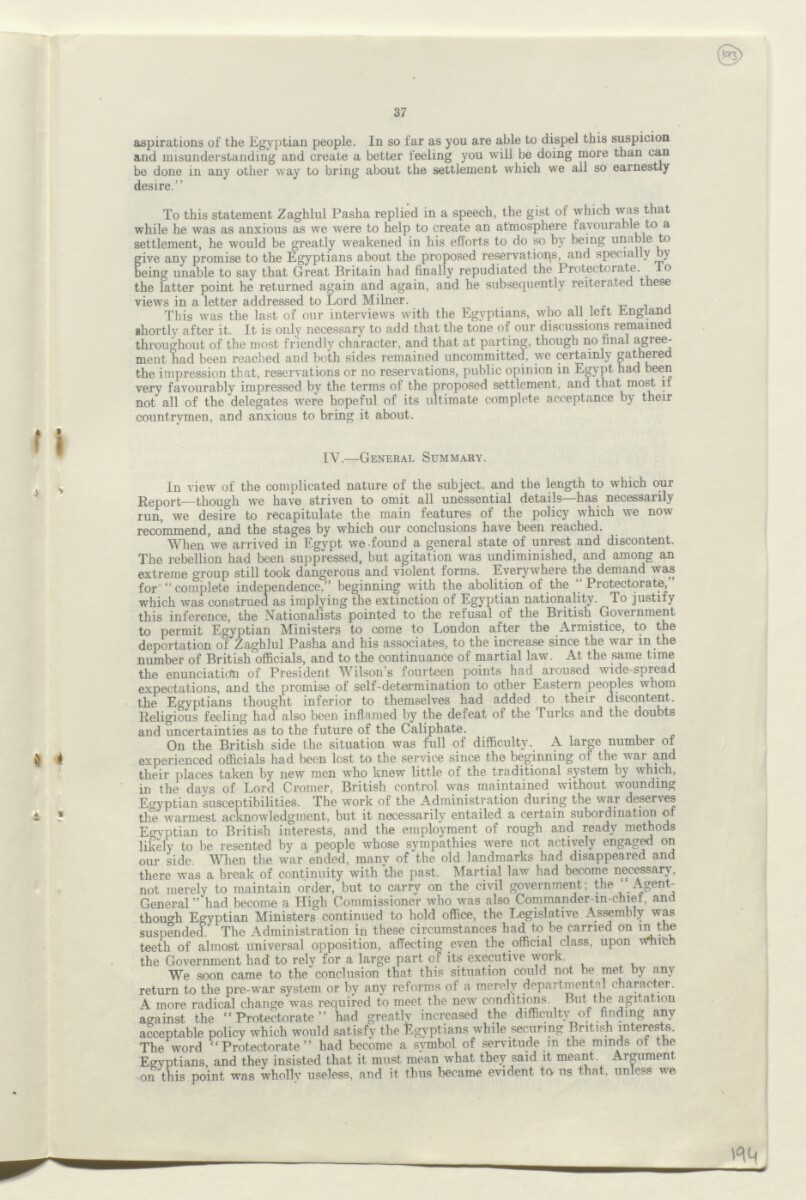
37
aspirations of the Egyptian people. In so far as you are able to dispel this suspicion
and misunderstanding and create a better feeling you will be doing more than can
be done in any other way to bring about the settlement which we all so earnestly
desire.”
To this statement Zaghlul
Pasha
An Ottoman title used after the names of certain provincial governors, high-ranking officials and military commanders.
replied in a speech, the gist of which was that
while he was as anxious as we were to help to create an atmosphere favourable to a
settlement, he would be greatly weakened in his efforts to do so by being unable to
give any promise to the Egyptians about the proposed reservations, and specially by
being unable to say that Great Britain had finally repudiated the Protectorate.
the latter point he returned again and again, and he subsequently reiterated these
views in a letter addressed to Lord Milner. .
This was the last of our interviews with the Egyptians, who all left England
shortly after it. It is only necessary to add that the tone of our discussions remained
throughout of the most friendly character, and that at parting, though no final agree
ment had been reached and both sides remained uncommitted, we certainly gathered
the impression that, reservations or no reservations, public opinion in Egypt had been
very favourably impressed by the terms of the proposed settlement, and that most if
not" all of the delegates were hopeful of its ultimate complete acceptance by their
countrvmen, and anxious to bring it about.
r i
IV.— General Summary.
^ In view of the complicated nature of the subject, and the length to which our
Report—though we have striven to omit all unessential details has necessarily
run, we desire to recapitulate the main features of the policy which we now
recommend, and the stages by which our conclusions have been reached.
When we arrived in Egypt we-found a general state of unrest and discontent.
The rebellion had been suppressed, but agitation was undiminished, and among an
extreme group still took dangerous and violent forms. Everywhere the demand was
for' “ complete independence,” beginning with the abolition of the “ Protectorate,”
which was construed as implying the extinction of Egyptian nationality. To justify
this inference, the Nationalists pointed to the refusal of the British Government
to permit Egyptian Ministers to come to London after the Armistice, to the
deportation of Zaghlul
Pasha
An Ottoman title used after the names of certain provincial governors, high-ranking officials and military commanders.
and his associates, to the increase since the war in the
number of British officials, and to the continuance of martial law. At the same time
the enunciaticfn of President Wilson s fourteen points had aroused wide-spread
expectations, and the promise of self-determination to other Eastern peoples whom
the Egyptians thought inferior to themselves had added to their discontent.
Religious feeling had also been inflamed by the defeat of the Turks and the doubts
and uncertainties as to the future of the Caliphate.
On the British side the situation was full of difficulty. A large number of
$ ♦ experienced officials had been lost to the service since the beginning of the ^\ar and
their places taken by new men who knew little of the traditional system by which,
in the days of Lord Cromer, British control was maintained without wounding
Egyptian susceptibilities. The work of the Administration during the war deserves
i * the warmest acknowledgment, but it necessarily entailed a certain subordination of
Egyptian to British interests, and the employment of rough and ready methods
likely to be resented by a people whose sympathies were not actively engaged on
our side. When the war ended, many of the old landmarks had disappeared and
there was a break of continuity with the past. Martial law had become necessary,
not merely to maintain order, but to carry on the civil government; the Agent-
General ” had become a High Commissioner who was also Commander-in-chief, and
though Egyptian Ministers continued to hold office, the Legislative Assembly was
suspended. The Administration in these circumstances had to be carried on id the
teeth of almost universal opposition, affecting even the official class, upon Which
the Government had to rely for a large part of its executive work.
We soon came to the conclusion that this situation could not be met by any
return to the pre-war system or by any reforms of a merely departmental character.
A more radical change was required to meet the new conditions But the agitation
against the “Protectorate” had greatly increased the difficulty of finding any
acceptable policy which would satisfy the Egyptians while securing British mteres s.
The word “Protectorate” had become a symbol of servitude m the minds ot the
Egyptians, and they insisted that it must mean what they said it meant. Argument
on this point was wholly useless, and it thus became evident to ns that, unless we
r-
About this item
- Content
The file contains official correspondence, memoranda, and reports relating to political affairs in Egypt. The correspondents and authors are officials at the Foreign Office (Lord Curzon was Secretary of State for Foreign Affairs at the time), War Office, Air Ministry, Admiralty, Colonial Office, Board of Trade, Board of Education, as well as those within the Egyptian civil service.
The file contains copies of reports of the Special Mission to Egypt (folios 1-7, 75-93, and 175-194), led by Lord Alfred Milner, whose purpose was to investigate and advise following the Egyptian Revolution of 1919. Much of the content of the file is in response to the findings and recommendations of the Mission and discusses the possibilities of a political settlement with Egypt.
- Extent and format
- 1 file (237 folios)
- Arrangement
The file is arranged in chronological order, from the front to the rear.
- Physical characteristics
Foliation: the foliation sequence (used for referencing) commences at the front cover with 1, and terminates at the inside back cover with 235; these numbers are written in pencil, are circled, and are located in the top right corner of the recto The front of a sheet of paper or leaf, often abbreviated to 'r'. side of each folio. The file has one foliation anomaly, f 76a.
- Written in
- English in Latin script View the complete information for this record
Use and share this item
- Share this item
Report of the Special Mission to Egypt under Lord Milner, and related papers [193r] (388/473), British Library: India Office Records and Private Papers, Mss Eur F112/260, in Qatar Digital Library <https://www.qdl.qa/archive/81055/vdc_100080131820.0x0000bd> [accessed 7 August 2026]
https://www.qdl.qa/en/archive/81055/vdc_100080131820.0x0000bd
Copy and paste the code below into your web page where you would like to embed the image.
<meta charset="utf-8"><a href="https://www.qdl.qa/en/archive/81055/vdc_100080131820.0x0000bd">Report of the Special Mission to Egypt under Lord Milner, and related papers [‎193r] (388/473)</a> <a href="https://www.qdl.qa/en/archive/81055/vdc_100080131820.0x0000bd"> <img src="https://iiif.qdl.qa/iiif/images/81055/vdc_100000001491.0x000295/Mss Eur F112_260_0388.jp2/full/!280,240/0/default.jpg" alt="" /> </a>
This record has a IIIF manifest available as follows. If you have a compatible viewer you can drag the icon to load it.https://www.qdl.qa/en/iiif/81055/vdc_100000001491.0x000295/manifestOpen in Universal viewerOpen in Mirador viewerMore options for embedding images
Copyright: How to use this content
- Reference
- Mss Eur F112/260
- Title
- Report of the Special Mission to Egypt under Lord Milner, and related papers
- Pages
- front, front-i, 2r:39v, 42r:50v, 53r:76v, 76ar:76av, 77r:140v, 143r:143v, 144ar, 144r:235v
- Author
- East India Company, the Board of Control, the India Office, or other British Government Department
- Usage terms
- Open Government Licence