
![Report of the Special Mission to Egypt under Lord Milner, and related papers [‎184v] (371/473)](https://iiif.qdl.qa/iiif/images/81055/vdc_100000001491.0x000295/Mss Eur F112_260_0371.jp2/full/!1200,1200/0/default.jpg "Report of the Special Mission to Egypt under Lord Milner, and related papers [‎184v] (371/473)")
Report of the Special Mission to Egypt under Lord Milner, and related papers [184v] (371/473)
The record is made up of 1 file (237 folios). It was created in 15 May 1920-14 Oct 1921. It was written in English. The original is part of the British Library: India Office The department of the British Government to which the Government of India reported between 1858 and 1947. The successor to the Court of Directors. Records and Private Papers Documents collected in a private capacity. .
Transcription
This transcription is created automatically. It may contain errors.
20
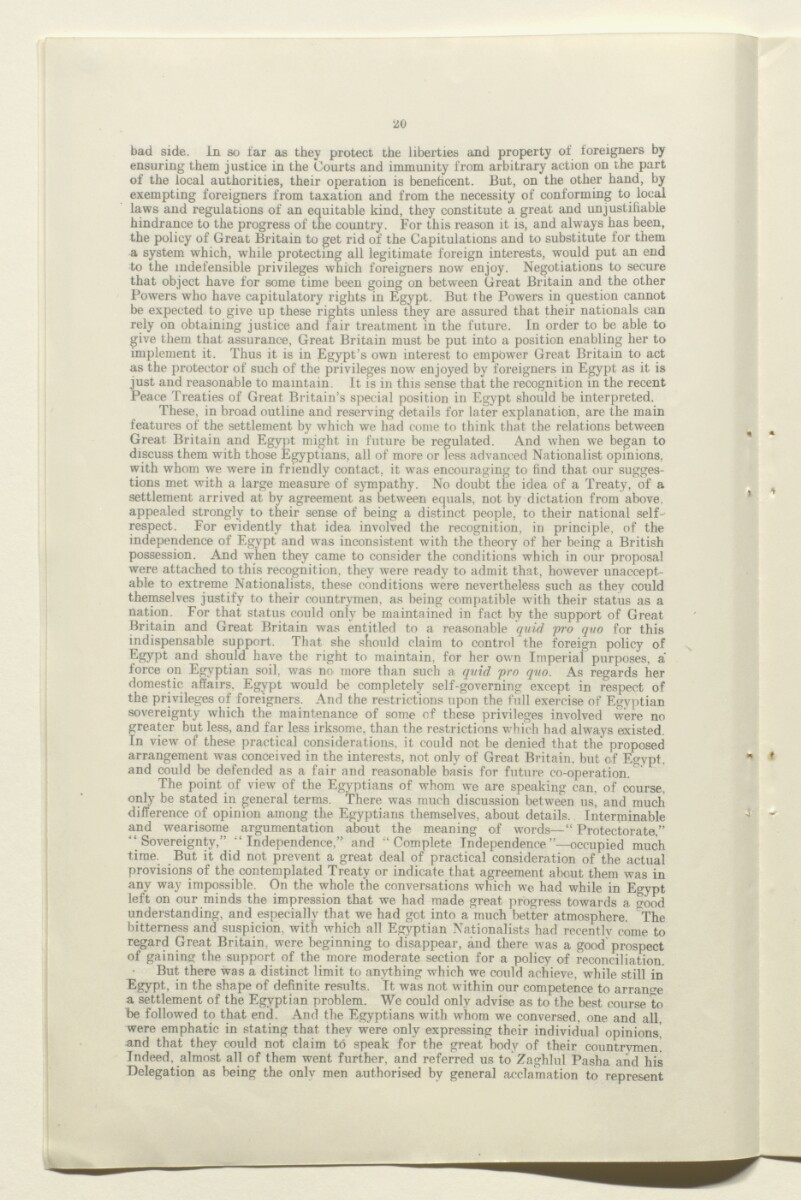
bad side. In so far as they protect the liberties and property of foreigners by
ensuring them justice in the Courts and immunity from arbitrary action on the part
of the local authorities, their operation is benehcent. But, on the other hand, by
exempting foreigners from taxation and from the necessity of conforming to local
laws and regulations of an equitable kind, they constitute a great and unjustiliable
hindrance to the progress of the country. For this reason it is, and always has been,
the policy of Great Britain to get rid of the Capitulations and to substitute for them
a system which, while protecting all legitimate foreign interests, would put an end
to the indefensible privileges which foreigners now enjoy. Negotiations to secure
that object have for some time been going on between Great Britain and the other
Powers who have capitulatory rights in Egypt. But the Powers in question cannot
be expected to give up these rights unless they are assured that their nationals can
rely on obtaining justice and fair treatment in the future. In order to be able to
give them that assurance, Great Britain must be put into a position enabling her to
implement it. Thus it is in Egypt’s own interest to empower Great Britain to act
as the protector of such of the privileges now enjoyed by foreigners in Egypt as it is
just and reasonable to maintain. It is in this sense that the recognition in the recent
Peace Treaties of Great Britain’s special position in Egypt should be interpreted.
These, in broad outline and reserving details for later explanation, are the main
features of the settlement by which we had come to think that the relations between
Great Britain and Egypt might in future be regulated. And when w^e began to
discuss them with those Egyptians, all of more or less advanced Nationalist opinions,
with whom we were in friendly contact, it was encouraging to find that our sugges
tions met with a large measure of sympathy. No doubt the idea of a Treaty, of a ^
settlement arrived at by agreement as between equals, not by dictation from above,
appealed strongly to their sense of being a distinct people, to their national self-
respect. For evidently that idea involved the recognition, in principle, of the
independence of Egypt and was inconsistent with the theory of her being a British
possession. And when they came to consider the conditions which in our proposal
were attached to this recognition, they were ready to admit that, however unaccept
able to extreme Nationalists, these conditions were nevertheless such as they could
themselves justify to their countrymen, as being compatible with their status as a
nation. For that status could only be maintained in fact by the support of Great
Britain and Great Britain was entitled to a reasonable quid pro quo for this
indispensable support. That she should claim to control the foreign policy of
Egypt and should have the right to maintain, for her own Imperial purposes, a
force on Egyptian soil, was no more than such a quid pro quo. As regards her
domestic affairs, Egypt would be completely self-governing except in respect of
the privileges of foreigners. And the restrictions upon the full exercise of Egyptian
sovereignty which the maintenance of some of these privileges involved were no
greater but less, and far less irksome, than the restrictions which had always existed.
In view of these practical considerations, it could not be denied that the proposed
arrangement was conceived in the interests, not only of Great Britain, but of Egypt. * 1
and could be defended as a fair and reasonable basis for future co-operation.^
The point of view of the Egyptians of whom we are speaking can, of course,
only be stated in general terms. There was much discussion between us, and much
difference of opinion among the Egyptians themselves, about details. Interminable -
and wearisome argumentation about the meaning of words—“ Protectorate,”
Sovereignty,” ‘ Independence,” and “Complete Independence”—occupied much
time. But it did not prevent a great deal of practical consideration of the actual
provisions of the contemplated Treaty or indicate that agreement about them was in
any way impossible. On the whole the conversations which we had while in Egypt
left on our minds the impression that we had made great progress towards a good
understanding, and especially that we had got into a'much better atmosphere. The
bitterness and suspicion, with which all Egyptian Nationalists had recently come to
regard Great Britain, were beginning to disappear, and there was a good prospect
of gaining the support of the more moderate section for a policy of reconciliation.
But there was a distinct limit to anything wdiich we could achieve, while still in
Egypt, in the shape of definite results. It was not within our competence to arrange
a settlement of the Egyptian problem. We could only advise as to the best course to
be followed to that end. And the Egyptians with whom we conversed, one and all,
were emphatic in stating that they were only expressing their individual opinions!
and that they could not claim to speak for the great body of their countrvmen.
Indeed, almost all of them went further, and referred us to Zaghlul
Pasha
An Ottoman title used after the names of certain provincial governors, high-ranking officials and military commanders.
and his
Delegation as being the onlv men authorised by general acclamation to represent
About this item
- Content
The file contains official correspondence, memoranda, and reports relating to political affairs in Egypt. The correspondents and authors are officials at the Foreign Office (Lord Curzon was Secretary of State for Foreign Affairs at the time), War Office, Air Ministry, Admiralty, Colonial Office, Board of Trade, Board of Education, as well as those within the Egyptian civil service.
The file contains copies of reports of the Special Mission to Egypt (folios 1-7, 75-93, and 175-194), led by Lord Alfred Milner, whose purpose was to investigate and advise following the Egyptian Revolution of 1919. Much of the content of the file is in response to the findings and recommendations of the Mission and discusses the possibilities of a political settlement with Egypt.
- Extent and format
- 1 file (237 folios)
- Arrangement
The file is arranged in chronological order, from the front to the rear.
- Physical characteristics
Foliation: the foliation sequence (used for referencing) commences at the front cover with 1, and terminates at the inside back cover with 235; these numbers are written in pencil, are circled, and are located in the top right corner of the recto The front of a sheet of paper or leaf, often abbreviated to 'r'. side of each folio. The file has one foliation anomaly, f 76a.
- Written in
- English in Latin script View the complete information for this record
Use and share this item
- Share this item
Report of the Special Mission to Egypt under Lord Milner, and related papers [184v] (371/473), British Library: India Office Records and Private Papers, Mss Eur F112/260, in Qatar Digital Library <https://www.qdl.qa/archive/81055/vdc_100080131820.0x0000ac> [accessed 18 July 2026]
https://www.qdl.qa/en/archive/81055/vdc_100080131820.0x0000ac
Copy and paste the code below into your web page where you would like to embed the image.
<meta charset="utf-8"><a href="https://www.qdl.qa/en/archive/81055/vdc_100080131820.0x0000ac">Report of the Special Mission to Egypt under Lord Milner, and related papers [‎184v] (371/473)</a> <a href="https://www.qdl.qa/en/archive/81055/vdc_100080131820.0x0000ac"> <img src="https://iiif.qdl.qa/iiif/images/81055/vdc_100000001491.0x000295/Mss Eur F112_260_0371.jp2/full/!280,240/0/default.jpg" alt="" /> </a>
This record has a IIIF manifest available as follows. If you have a compatible viewer you can drag the icon to load it.https://www.qdl.qa/en/iiif/81055/vdc_100000001491.0x000295/manifestOpen in Universal viewerOpen in Mirador viewerMore options for embedding images
Copyright: How to use this content
- Reference
- Mss Eur F112/260
- Title
- Report of the Special Mission to Egypt under Lord Milner, and related papers
- Pages
- front, front-i, 2r:39v, 42r:50v, 53r:76v, 76ar:76av, 77r:140v, 143r:143v, 144ar, 144r:235v
- Author
- East India Company, the Board of Control, the India Office, or other British Government Department
- Usage terms
- Open Government Licence