
![Report of the Special Mission to Egypt under Lord Milner, and related papers [‎178r] (358/473)](https://iiif.qdl.qa/iiif/images/81055/vdc_100000001491.0x000295/Mss Eur F112_260_0358.jp2/full/!1200,1200/0/default.jpg "Report of the Special Mission to Egypt under Lord Milner, and related papers [‎178r] (358/473)")
Report of the Special Mission to Egypt under Lord Milner, and related papers [178r] (358/473)
The record is made up of 1 file (237 folios). It was created in 15 May 1920-14 Oct 1921. It was written in English. The original is part of the British Library: India Office The department of the British Government to which the Government of India reported between 1858 and 1947. The successor to the Court of Directors. Records and Private Papers Documents collected in a private capacity. .
Transcription
This transcription is created automatically. It may contain errors.
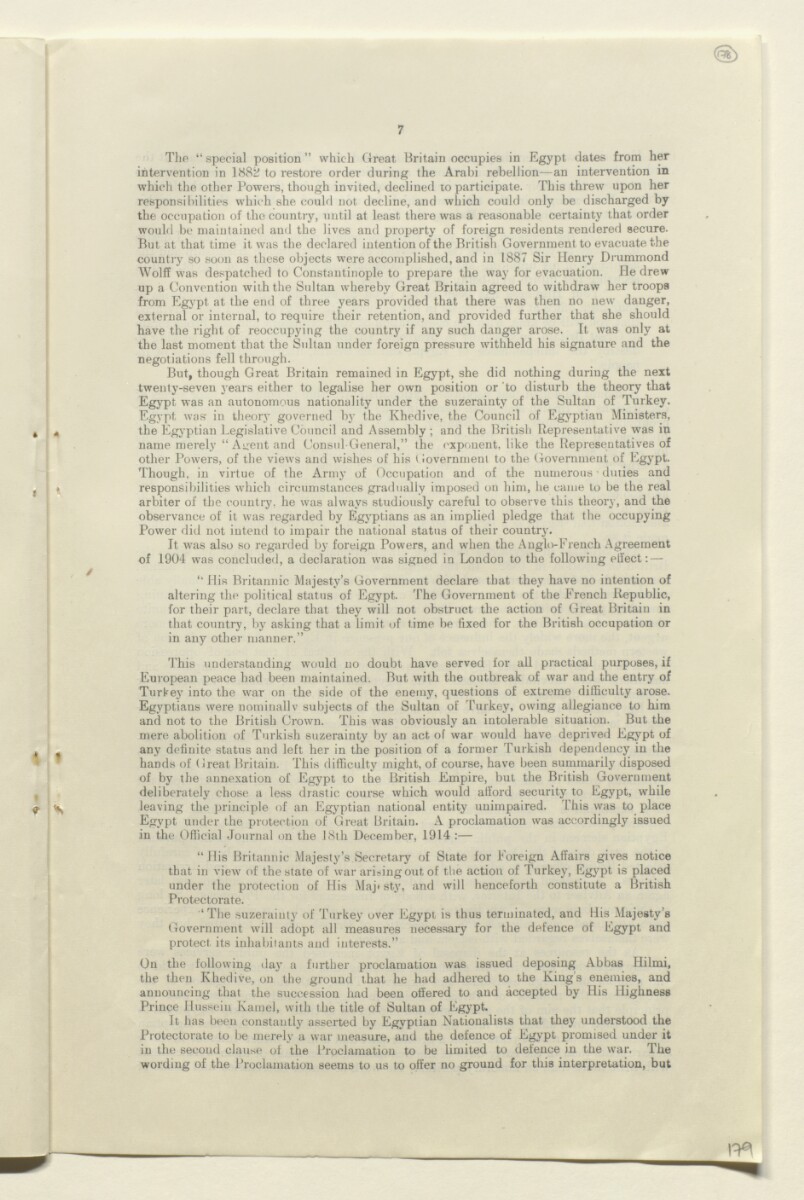
The “ special position ” which Great Britain occupies in Egypt dates from her
intervention in 188^ to restore order during the Arabi rebellion—an intervention in
which the other Powers, though invited, declined to participate. This threw upon her
responsibilities which she could not decline, and which could only be discharged by
the occupation of the country, until at least there was a reasonable certainty that order
would be maintained and the lives and property of foreign residents rendered secure.
But at that time it was the declared intention of the British Government to evacuate the
country so soon as these objects were accomplished, and in 1887 Sir Henry Drummond
Wolff was despatched to Constantinople to prepare the way for evacuation. He drew
up a Convention with the Sultan whereby Great Britain agreed to withdraw her troops
from Egypt at the end of three years provided that there was then no new danger,
external or internal, to require their retention, and provided further that she should
have the right of reoccupying the country if any such danger arose. It was only at
the last moment that the Sultan under foreign pressure withheld his signature and the
negotiations fell through.
But, though Great Britain remained in Egypt, she did nothing during the next
twenty-seven years either to legalise her own position or to disturb the theory that
Egypt was an autonomous nationality under the suzerainty of the Sultan of Turkey.
Egypt was - in theory governed by the Khedive, the Council of Egyptian Ministers,
the Egyptian Legislative Council and Assembly ; and the British Representative was in
name merely “Anentand Consul-General,” the exponent, like the Representatives of
other Powers, of the views and wishes of his t iovernment to the Government of Egypt.
Though, in virtue of the Army of Occupation and of the numerous duties and
responsibilities which circumstances gradually imposed on him, he came to be the real
arbiter of the country, he was always studiously careful to observe this theory, and the
observance of it was regarded by Egyptians as an implied pledge that the occupying
Power did not intend to impair the national status of their country.
It was also so regarded by foreign Powers, and when the Anglo-French Agreement
of 1904 was concluded, a declaration was signed in London to the following effect: —
‘‘ His Britannic Majesty’s Government declare that they have no intention of
altering the political status of Egypt. The Government of the French Republic,
for their part, declare that they will not obstruct the action of Great Britain in
that country, by asking that a limit of time be fixed for the British occupation or
in any other manner.”
This understanding would no doubt have served for all practical purposes, if
European peace had been maintained. But with the outbreak of war and the entry of
Turkey into the war on the side of the enemy, questions of extreme difficulty arose.
Egyptians were nominallv subjects of the Sultan of Turkey, owing allegiance to him
and not to the British Crown. This was obviously an intolerable situation. But the
mere abolition of Turkish suzerainty by an act of war would have deprived Egypt of
any definite status and left her in the position of a former Turkish dependency in the
hands of Great Britain. This difficulty might, of course, have been summarily disposed
of by the annexation of Egypt to the British Empire, but the British Government
deliberate^ chose a less drastic course which would afford security to Egypt, while
leaving the principle of an Egyptian national entity unimpaired. This was to place
Egypt under the protection of Great Britain. A proclamation was accordingly issued
in the Official Journal on the 18th December, 1914 :—
“His Britannic Majesty’s Secretary of State for Foreign Affairs gives notice
that in view of the state of war arising out of the action of Turkey, Egypt is placed
under the protection of His Majesty, and will henceforth constitute a British
Protectorate.
‘The suzerainty of Turkey over Egypi is thus terminated, and His Majesty’s
Government will adopt all measures necessary for the defence of Egypt and
protect its inhabitants and interests.”
On the following day a further proclamation was issued deposing Abbas Hilmi,
the then Khedive, on the ground that he had adhered to the Kings enemies, and
announcing that the succession had been offered to and accepted by His Highness
Prince Hussein Kamel, with the title of Sultan of Egypt.
It has been constantly asserted by Egyptian Nationalists that they understood the
Protectorate to be merely a war measure, and the defence of Egypt promised under it
in the second clause of the Proclamation to be limited to defence in the war. The
wording of the Proclamation seems to us to offer no ground for this interpretation, but
About this item
- Content
The file contains official correspondence, memoranda, and reports relating to political affairs in Egypt. The correspondents and authors are officials at the Foreign Office (Lord Curzon was Secretary of State for Foreign Affairs at the time), War Office, Air Ministry, Admiralty, Colonial Office, Board of Trade, Board of Education, as well as those within the Egyptian civil service.
The file contains copies of reports of the Special Mission to Egypt (folios 1-7, 75-93, and 175-194), led by Lord Alfred Milner, whose purpose was to investigate and advise following the Egyptian Revolution of 1919. Much of the content of the file is in response to the findings and recommendations of the Mission and discusses the possibilities of a political settlement with Egypt.
- Extent and format
- 1 file (237 folios)
- Arrangement
The file is arranged in chronological order, from the front to the rear.
- Physical characteristics
Foliation: the foliation sequence (used for referencing) commences at the front cover with 1, and terminates at the inside back cover with 235; these numbers are written in pencil, are circled, and are located in the top right corner of the recto The front of a sheet of paper or leaf, often abbreviated to 'r'. side of each folio. The file has one foliation anomaly, f 76a.
- Written in
- English in Latin script View the complete information for this record
Use and share this item
- Share this item
Report of the Special Mission to Egypt under Lord Milner, and related papers [178r] (358/473), British Library: India Office Records and Private Papers, Mss Eur F112/260, in Qatar Digital Library <https://www.qdl.qa/archive/81055/vdc_100080131820.0x00009f> [accessed 25 July 2026]
https://www.qdl.qa/en/archive/81055/vdc_100080131820.0x00009f
Copy and paste the code below into your web page where you would like to embed the image.
<meta charset="utf-8"><a href="https://www.qdl.qa/en/archive/81055/vdc_100080131820.0x00009f">Report of the Special Mission to Egypt under Lord Milner, and related papers [‎178r] (358/473)</a> <a href="https://www.qdl.qa/en/archive/81055/vdc_100080131820.0x00009f"> <img src="https://iiif.qdl.qa/iiif/images/81055/vdc_100000001491.0x000295/Mss Eur F112_260_0358.jp2/full/!280,240/0/default.jpg" alt="" /> </a>
This record has a IIIF manifest available as follows. If you have a compatible viewer you can drag the icon to load it.https://www.qdl.qa/en/iiif/81055/vdc_100000001491.0x000295/manifestOpen in Universal viewerOpen in Mirador viewerMore options for embedding images
Copyright: How to use this content
- Reference
- Mss Eur F112/260
- Title
- Report of the Special Mission to Egypt under Lord Milner, and related papers
- Pages
- front, front-i, 2r:39v, 42r:50v, 53r:76v, 76ar:76av, 77r:140v, 143r:143v, 144ar, 144r:235v
- Author
- East India Company, the Board of Control, the India Office, or other British Government Department
- Usage terms
- Open Government Licence