
![Report of the Special Mission to Egypt under Lord Milner, and related papers [‎81v] (164/473)](https://iiif.qdl.qa/iiif/images/81055/vdc_100000001491.0x000295/Mss Eur F112_260_0164.jp2/full/!1200,1200/0/default.jpg "Report of the Special Mission to Egypt under Lord Milner, and related papers [‎81v] (164/473)")
Report of the Special Mission to Egypt under Lord Milner, and related papers [81v] (164/473)
The record is made up of 1 file (237 folios). It was created in 15 May 1920-14 Oct 1921. It was written in English. The original is part of the British Library: India Office The department of the British Government to which the Government of India reported between 1858 and 1947. The successor to the Court of Directors. Records and Private Papers Documents collected in a private capacity. .
Transcription
This transcription is created automatically. It may contain errors.
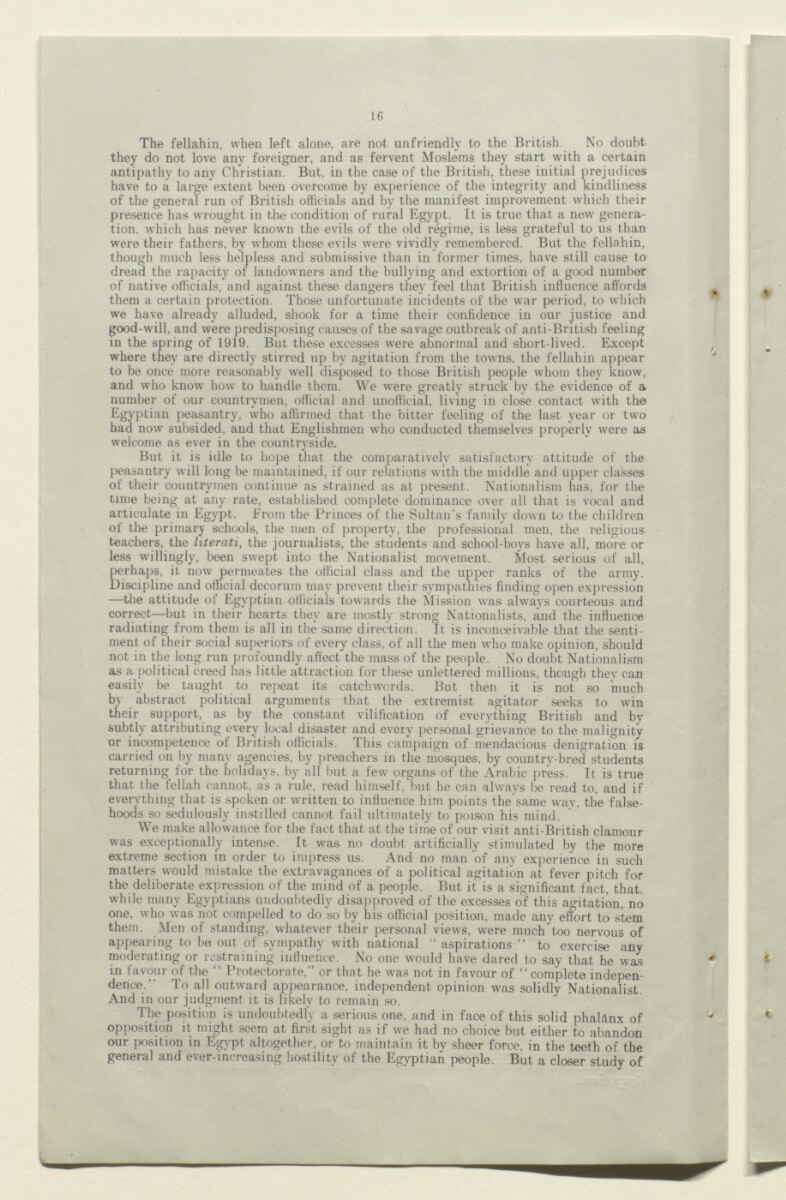
16
The
fellahin
Arabic for ‘peasant’. It was used by British officials to refer to agricultural workers or to members of a social class employed primarily in agricultural labour.
, when left alone, are not unfriendly to the British. No doubt
they do not love any foreigner, and as fervent Moslems they start with a certain
antipathy to any Christian. But, in the case of the British, these initial prejudices
have to a large extent been overcome by experience of the integrity and kindliness
of the general run of British officials and by the manifest improvement which their
presence has wrought in the condition of rural Egypt. It is true that a new genera
tion. which has never known the evils of the old regime, is less grateful to us than
were their fathers, by whom these evils were vividly remembered. But the
fellahin
Arabic for ‘peasant’. It was used by British officials to refer to agricultural workers or to members of a social class employed primarily in agricultural labour.
,
though much less helpless and submissive than in former times, have still cause to
dread the rapacity of landowners and the bullying and extortion of a good number
of native officials, and against these dangers they feel that British influence affords
them a certain protection. Those unfortunate incidents of the war period, to which
we have already alluded, shook for a time their confidence in our justice and
good-will, and were predisposing causes of the savage outbreak of anti-British feeling
in the spring of 1919. But these excesses were abnormal and short-lived. Except
where they are directly stirred up by agitation from the towns, the
fellahin
Arabic for ‘peasant’. It was used by British officials to refer to agricultural workers or to members of a social class employed primarily in agricultural labour.
appear
to be once more reasonably well disposed to those British people whom they know,
and who know how to handle them. We were greatly struck by the evidence of a
number of our countrymen, official and unofficial, living in close contact with the
Egyptian peasantry, wffio affirmed that the bitter feeling of the last year or two
had now subsided, and that Englishmen who conducted themselves properly were as
welcome as ever in the countryside.
But it is idle to hope that the comparatively satisfactory attitude of the
peasantry will long be maintained, if our relations with the middle and upper classes
of their countrymen continue as strained as at present. Nationalism has, for the
time being at any rate, established complete dominance over all that is vocal and
articulate in Egypt. From the Princes of the Sultan's family down to the children
of the primary schools, the men of property, the professional men, the religious
teachers, the literati, the journalists, the students and school-boys have all, more or
less willingly, been swept into the Nationalist movement. Most serious of all,
perhaps, it now permeates the official class and the upper ranks of the army.
Discipline and official decorum may prevent their sympathies finding open expression
—the attitude of Egyptian ofliciais towards the Mission was always courteous and
correct—but in their hearts they are mostly strong Nationalists, and the influence
radiating from them is all in the same direction. It is inconceivable that the senti
ment of their social superiors of every class, of all the men who make opinion, should
not in the long run profoundly affect the mass of the people. No doubt Nationalism
as a political creed has little attraction for these unlettered millions, though they can
easily be taught to repeat its catchwords. But then it is not so 'much
by abstract political arguments that the extremist agitator seeks to win
their support, as by the constant vilification of everything British and by
subtly attributing every local disaster and every personal grievance to the malignity
or incompetence of British officials. This campaign of mendacious denigration is
carried on by many agencies, by preachers in the mosques, by country-bred students
returning for the holidays, by all but a few organs of the Arabic press. It is true
that the
fellah
Arabic for ‘peasant’. It was used by British officials to refer to agricultural workers or to members of a social class employed primarily in agricultural labour.
cannot, as a rule, read himself, but he can always be read to, and if
everything that is spoken or written to influence him points the same wav, the false
hoods so sedulously instilled cannot fail ultimately to poison his mind.
We make allowance for the fact that at the time of our visit anti-British clamour
was exceptionally intense. It was no doubt artificially stimulated by the more
extreme section in order to impress us. And no man of any experience in such
matters would mistake the extravagances of a political agitation at fever pitch for
the deliberate expression of the mind of a people. But it is a significant fact, that,
while many Egyptians undoubtedly disapproved of the excesses of this agitation, no
one, who was not compelled to do so by his official position, made any effort to stem
them. Men of standing, whatever their personal views, were much too nervous of
appearing to be out of sympathy with national “ aspirations ” to exercise any
moderating or restraining influence. No one would have dared to say that he was *
in favour of the “ Protectorate,” or that he was not in favour of “complete indepen
dence.” To all outward appearance, independent opinion was solidly Nationalist
And in our judgment it is likely to remain so.
The position is undoubtedly a serious one, and in face of this solid phaUnx of
opposition it might seem at first sight as if we had no choice but either to abandon
our position in Egypt altogether, or to maintain it by sheer force, in the teeth of the
general and ever-increasing hostility of the Egyptian people. But a closer study of
About this item
- Content
The file contains official correspondence, memoranda, and reports relating to political affairs in Egypt. The correspondents and authors are officials at the Foreign Office (Lord Curzon was Secretary of State for Foreign Affairs at the time), War Office, Air Ministry, Admiralty, Colonial Office, Board of Trade, Board of Education, as well as those within the Egyptian civil service.
The file contains copies of reports of the Special Mission to Egypt (folios 1-7, 75-93, and 175-194), led by Lord Alfred Milner, whose purpose was to investigate and advise following the Egyptian Revolution of 1919. Much of the content of the file is in response to the findings and recommendations of the Mission and discusses the possibilities of a political settlement with Egypt.
- Extent and format
- 1 file (237 folios)
- Arrangement
The file is arranged in chronological order, from the front to the rear.
- Physical characteristics
Foliation: the foliation sequence (used for referencing) commences at the front cover with 1, and terminates at the inside back cover with 235; these numbers are written in pencil, are circled, and are located in the top right corner of the recto The front of a sheet of paper or leaf, often abbreviated to 'r'. side of each folio. The file has one foliation anomaly, f 76a.
- Written in
- English in Latin script View the complete information for this record
Use and share this item
- Share this item
Report of the Special Mission to Egypt under Lord Milner, and related papers [81v] (164/473), British Library: India Office Records and Private Papers, Mss Eur F112/260, in Qatar Digital Library <https://www.qdl.qa/archive/81055/vdc_100080131819.0x0000a5> [accessed 18 July 2026]
https://www.qdl.qa/en/archive/81055/vdc_100080131819.0x0000a5
Copy and paste the code below into your web page where you would like to embed the image.
<meta charset="utf-8"><a href="https://www.qdl.qa/en/archive/81055/vdc_100080131819.0x0000a5">Report of the Special Mission to Egypt under Lord Milner, and related papers [‎81v] (164/473)</a> <a href="https://www.qdl.qa/en/archive/81055/vdc_100080131819.0x0000a5"> <img src="https://iiif.qdl.qa/iiif/images/81055/vdc_100000001491.0x000295/Mss Eur F112_260_0164.jp2/full/!280,240/0/default.jpg" alt="" /> </a>
This record has a IIIF manifest available as follows. If you have a compatible viewer you can drag the icon to load it.https://www.qdl.qa/en/iiif/81055/vdc_100000001491.0x000295/manifestOpen in Universal viewerOpen in Mirador viewerMore options for embedding images
Copyright: How to use this content
- Reference
- Mss Eur F112/260
- Title
- Report of the Special Mission to Egypt under Lord Milner, and related papers
- Pages
- front, front-i, 2r:39v, 42r:50v, 53r:76v, 76ar:76av, 77r:140v, 143r:143v, 144ar, 144r:235v
- Author
- East India Company, the Board of Control, the India Office, or other British Government Department
- Usage terms
- Open Government Licence