
![Report of the Special Mission to Egypt under Lord Milner, and related papers [‎37r] (73/473)](https://iiif.qdl.qa/iiif/images/81055/vdc_100000001491.0x000295/Mss Eur F112_260_0073.jp2/full/!1200,1200/0/default.jpg "Report of the Special Mission to Egypt under Lord Milner, and related papers [‎37r] (73/473)")
Report of the Special Mission to Egypt under Lord Milner, and related papers [37r] (73/473)
The record is made up of 1 file (237 folios). It was created in 15 May 1920-14 Oct 1921. It was written in English. The original is part of the British Library: India Office The department of the British Government to which the Government of India reported between 1858 and 1947. The successor to the Court of Directors. Records and Private Papers Documents collected in a private capacity. .
Transcription
This transcription is created automatically. It may contain errors.
3
1
>
j
n
3*
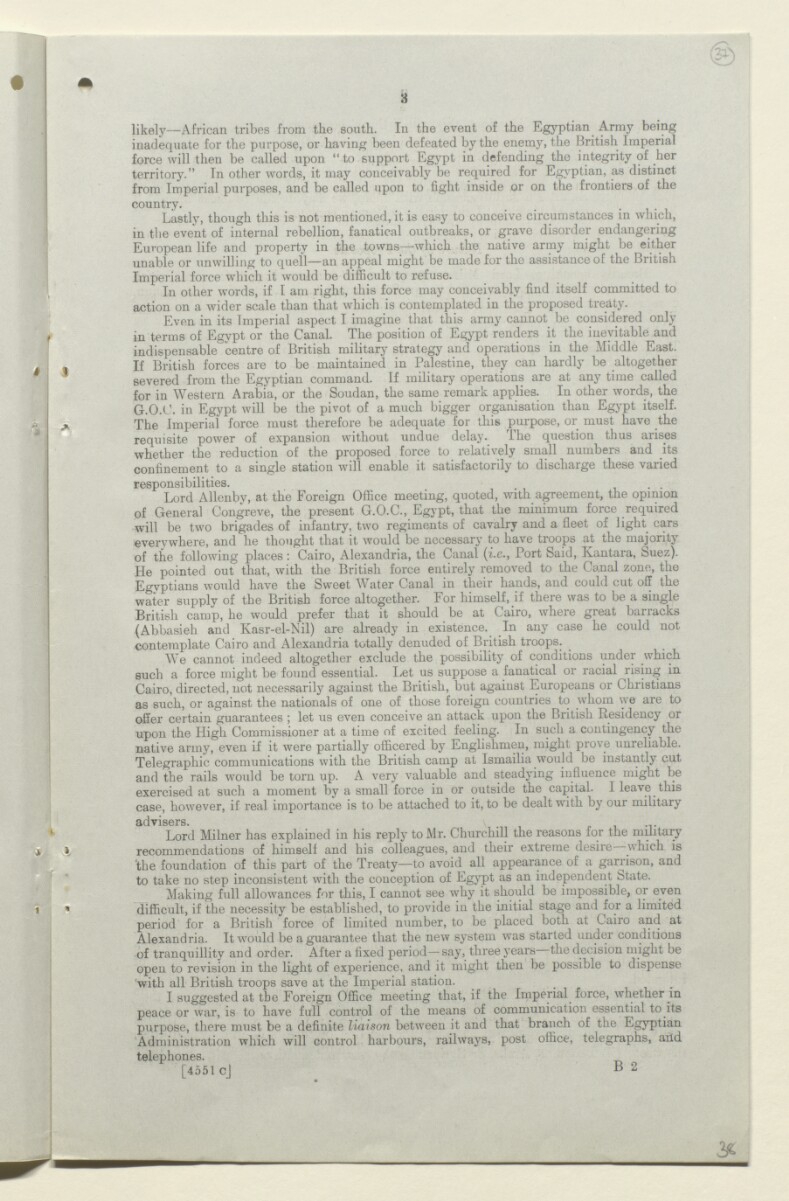
likely—African tribes from the south. In the event of the Egyptian Army being
inadequate for the purpose, or having been defeated by the enemy, the British Imperial
force will then be called upon “ to support Egypt in defending the integrity of her
territory.” In other words, it may conceivably be required for Egyptian, as distinct
from Imperial purposes, and be called upon to fight inside or on the frontiers of the
country.
Lastly, though this is not mentioned, it is easy to conceive circumstances in which,
in the event of internal rebellion, fanatical outbreaks, or grave disorder endangering
European life and property in the towns—which the native army might be either
unable or unwilling to quell—an appeal might be made for the assistance of the British
Imperial force which it would be difficult to refuse.
In other words, if l am right, this force may conceivably find itself committed to
action on a wider scale than that which is contemplated in the proposed treaty.
Even in its Imperial aspect I imagine that this army cannot be considered only
in terms of Egypt or the Canal. The position of Egypt renders it the inevitable and
indispensable centre of British military strategy and operations in the Middle East.
If British forces are to be maintained in Palestine, they can hardly be altogether
severed from the Egyptian command. If military operations are at any time called
for in Western Arabia, or the Soudan, the same remark applies. In other words, the
G.O.C. in Egypt will be the pivot of a much bigger organisation than Egypt itself.
The Imperial force must therefore be adequate for this purpose, or must have the
requisite power of expansion without undue delay. The question thus arises
whether the reduction of the proposed force to relatively small numbers and its
confinement to a single station will enable it satisfactorily to discharge these varied
responsibilities. _ ...
Lord Allenby, at the Foreign Office meeting, quoted, with agreement, the opinion
of General Congreve, the present G.O.C., Egypt, that the minimum force required
will be two brigades of infantry, two regiments of cavalry and a fleet of light cars
everywhere, and he thought that it would be necessary to have troops at the majority
of the following places: Cairo, Alexandria, the Canal (z.e., Port Said, Kantara, Suez).
He pointed out that, with the British force entirely removed to the Canal zone, the
Egyptians would have the Sweet Water Canal in their hands, and could cut off the
water supply of the British force altogether. For himself, if there was to be a single
British camp, he would prefer that it should be at Cairo, where great barracks
(Abbasieh and Kasr-el-Fil) are already in existence. In any case he could not
contemplate Cairo and Alexandria totally denuded of British troops. .
We cannot indeed altogether exclude the possibility of conditions under which
such a force might be found essential. Let us suppose a fanatical or racial rising in
Cairo, directed, not necessarily against the British, but against Europeans or Christians
as such, or against the nationals of one of those foreign countries to whom we are to
offer certain guarantees ; let us even conceive an attack upon the British
Residency
An office of the East India Company and, later, of the British Raj, established in the provinces and regions considered part of, or under the influence of, British India.
or
upon the High Commissioner at a time of excited feeling. In such a contingency the
native army, even if it were partially officered by Englishmen, might prove unreliable.
Telegraphic communications with the British camp at Ismailia would be instantly cut
and the rails w r ould be torn up. A very valuable and steadying influence might be
exercised at such a moment by a small force in or outside the capital. 1 leave. this
case, however, if real importance is to be attached to it, to be dealt wdth by our military
advisers
Lord Milner has explained in his reply to Mr. Churchill the reasons for the military
recommendations of himself and his colleagues, and their extreme desire which is
the foundation of this part of the T'reaty—to avoid all appearance of a garrison, and
to take no step inconsistent with the conception of Egypt as an independent btate.
Making full allowances for this, I cannot see why it should be impossible, or even
difficult, if the necessity be established, to provide in the initial stage and for a limited
period for a British force of limited number, to be placed both at Cairo and at
Alexandria. It would be a guarantee that the new system was started under conditions
of tranquillity and order. After a fixed period—say, three years the decision might be
open to revision in the light of experience, and it might then be possible to dispense
with all British troops save at the Imperial station.
I suggested at the Foreign Office meeting that, if the Imperial force, whether in
peace or war, is to have full control of the means of communication essential to its
purpose, there must be a definite liaison between it and that branch of the Egyptian
Administration which will control harbours, railways, post office, telegraphs, aild
telephones.
[4551 cj B2
About this item
- Content
The file contains official correspondence, memoranda, and reports relating to political affairs in Egypt. The correspondents and authors are officials at the Foreign Office (Lord Curzon was Secretary of State for Foreign Affairs at the time), War Office, Air Ministry, Admiralty, Colonial Office, Board of Trade, Board of Education, as well as those within the Egyptian civil service.
The file contains copies of reports of the Special Mission to Egypt (folios 1-7, 75-93, and 175-194), led by Lord Alfred Milner, whose purpose was to investigate and advise following the Egyptian Revolution of 1919. Much of the content of the file is in response to the findings and recommendations of the Mission and discusses the possibilities of a political settlement with Egypt.
- Extent and format
- 1 file (237 folios)
- Arrangement
The file is arranged in chronological order, from the front to the rear.
- Physical characteristics
Foliation: the foliation sequence (used for referencing) commences at the front cover with 1, and terminates at the inside back cover with 235; these numbers are written in pencil, are circled, and are located in the top right corner of the recto The front of a sheet of paper or leaf, often abbreviated to 'r'. side of each folio. The file has one foliation anomaly, f 76a.
- Written in
- English in Latin script View the complete information for this record
Use and share this item
- Share this item
Report of the Special Mission to Egypt under Lord Milner, and related papers [37r] (73/473), British Library: India Office Records and Private Papers, Mss Eur F112/260, in Qatar Digital Library <https://www.qdl.qa/archive/81055/vdc_100080131819.0x00004a> [accessed 29 July 2026]
https://www.qdl.qa/en/archive/81055/vdc_100080131819.0x00004a
Copy and paste the code below into your web page where you would like to embed the image.
<meta charset="utf-8"><a href="https://www.qdl.qa/en/archive/81055/vdc_100080131819.0x00004a">Report of the Special Mission to Egypt under Lord Milner, and related papers [‎37r] (73/473)</a> <a href="https://www.qdl.qa/en/archive/81055/vdc_100080131819.0x00004a"> <img src="https://iiif.qdl.qa/iiif/images/81055/vdc_100000001491.0x000295/Mss Eur F112_260_0073.jp2/full/!280,240/0/default.jpg" alt="" /> </a>
This record has a IIIF manifest available as follows. If you have a compatible viewer you can drag the icon to load it.https://www.qdl.qa/en/iiif/81055/vdc_100000001491.0x000295/manifestOpen in Universal viewerOpen in Mirador viewerMore options for embedding images
Copyright: How to use this content
- Reference
- Mss Eur F112/260
- Title
- Report of the Special Mission to Egypt under Lord Milner, and related papers
- Pages
- front, front-i, 2r:39v, 42r:50v, 53r:76v, 76ar:76av, 77r:140v, 143r:143v, 144ar, 144r:235v
- Author
- East India Company, the Board of Control, the India Office, or other British Government Department
- Usage terms
- Open Government Licence