
![Report of the Special Mission to Egypt under Lord Milner, and related papers [‎24r] (47/473)](https://iiif.qdl.qa/iiif/images/81055/vdc_100000001491.0x000295/Mss Eur F112_260_0047.jp2/full/!1200,1200/0/default.jpg "Report of the Special Mission to Egypt under Lord Milner, and related papers [‎24r] (47/473)")
Report of the Special Mission to Egypt under Lord Milner, and related papers [24r] (47/473)
The record is made up of 1 file (237 folios). It was created in 15 May 1920-14 Oct 1921. It was written in English. The original is part of the British Library: India Office The department of the British Government to which the Government of India reported between 1858 and 1947. The successor to the Court of Directors. Records and Private Papers Documents collected in a private capacity. .
Transcription
This transcription is created automatically. It may contain errors.
7
9
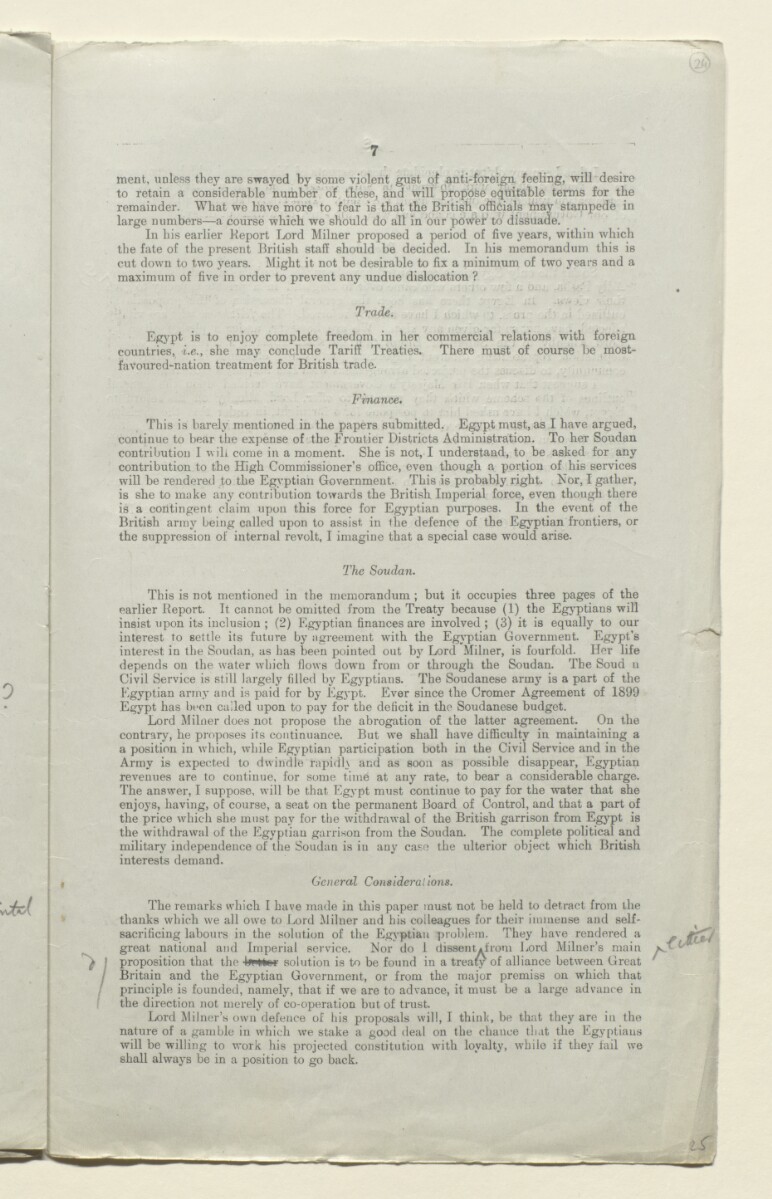
ment, unless they are swayed by some violent gust of anti-foreign, feeling, will desire
to retain a considerable number of these, and will propose equitable terms for the
remainder. What we have more to fear is that the British officials may stampede in
large numbers—a course which we should do all in our power to dissuade.
In his earlier Report Lord Milner proposed a period of five years, within which
the fate of the present British staff should be decided. In his memorandum this is
cut down to two years. Might it not be desirable to fix a minimum of two years and a
maximum of five in order to prevent any undue dislocation ?
, . /
Trade.
Egypt is to enjoy complete freedom in her commercial relations with foreign
countries, i.e., she may conclude Tariff Treaties. There must of course be most
favoured-nation treatment for British trade.
Finance.
This is barely mentioned in the papers submitted. Egypt must, as I have argued,
continue to bear the expense of the Frontier Districts Administration. To her Soudan
contribution I will come in a moment. She is not, I understand, to be asked for any
contribution to the High Commissioner’s office, even though a portion of his services
will be rendered to the Egyptian Government. This is probably right. Nor, I gather,
is she to make any contribution towards the British Imperial force, even though there
is a contingent claim upon this force for Egyptian purposes. In the event of the
British army being called upon to assist in the defence of the Egyptian frontiers, or
the suppression of internal revolt, I imagine that a special case would arise.
The Soudan.
This is not mentioned in the memorandum ; but it occupies three pages of the
earlier Report. It cannot be omitted from the Treaty because (1) the Egyptians will
insist upon its inclusion ; (2) Egyptian finances are involved ; (3) it is equally to our
interest to settle its future by agreement with the Egyptian Government. Egypt’s
interest in the Soudan, as has been pointed out by Lord Milner, is fourfold. Her life
depends on the water which flows down from or through the Soudan. The Soud n
Civil Service is still largely filled by Egyptians. The Soudanese army is a part of the
Egyptian army and is paid for by Egypt. Ever since the Cromer Agreement of 1899
Egypt has been called upon to pay for the deficit in the Soudanese budget.
Lord Milner does not propose the abrogation of the latter agreement. On the
contrary, he proposes its continuance. But we shall have difficulty in maintaining a
a position in which, while Egyptian participation both in the Civil Service and in the
Army is expected to dwindle rapidh and as soon as possible disappear, Egyptian
revenues are to continue, for some time at any rate, to bear a considerable charge.
The answer, I suppose, will be that Egypt must continue to pay for the water that she
enjoys, having, of course, a seat on the permanent
Board of Control
Formally known as the Board of Commissioners for the Affairs of India, it was established by an Act of Parliament in 1784 to supervise the activities of the East India Company.
, and that a part of
the price which she must pay for the withdrawal of the British garrison from Egypt is
the withdrawal of the Egyptian garrison from the Soudan. The complete political and
military independence of the Soudan is in any case the ulterior object which British
interests demand.
General Considerations.
The remarks which I have made in this paper must not be held to detract from the
thanks which we all owe to Lord Milner and his colleagues for their immense and self-
sacrificing labours in the solution of the Egyptian problem. They have rendered a _ ftJV
great national and Imperial service. Nor do 1 dissentHrom Lord Milner’s main kS ^
I proposition that the l-Wltor solution is to be found in a treaty of alliance between Great
Britain and the Egyptian Government, or from the major premiss on which that
principle is founded, namely, that if we are to advance, it must be a large advance in
the direction not merely of co-operation but of trust.
Lord Milner’s own defence of his proposals will, I think, be that they are in the
nature of a gamble in which we stake a good deal on the chance that the Egyptians
will be willing to work his projected constitution with loyalty, while if they fail we
shall always be in a position to go back.
About this item
- Content
The file contains official correspondence, memoranda, and reports relating to political affairs in Egypt. The correspondents and authors are officials at the Foreign Office (Lord Curzon was Secretary of State for Foreign Affairs at the time), War Office, Air Ministry, Admiralty, Colonial Office, Board of Trade, Board of Education, as well as those within the Egyptian civil service.
The file contains copies of reports of the Special Mission to Egypt (folios 1-7, 75-93, and 175-194), led by Lord Alfred Milner, whose purpose was to investigate and advise following the Egyptian Revolution of 1919. Much of the content of the file is in response to the findings and recommendations of the Mission and discusses the possibilities of a political settlement with Egypt.
- Extent and format
- 1 file (237 folios)
- Arrangement
The file is arranged in chronological order, from the front to the rear.
- Physical characteristics
Foliation: the foliation sequence (used for referencing) commences at the front cover with 1, and terminates at the inside back cover with 235; these numbers are written in pencil, are circled, and are located in the top right corner of the recto The front of a sheet of paper or leaf, often abbreviated to 'r'. side of each folio. The file has one foliation anomaly, f 76a.
- Written in
- English in Latin script View the complete information for this record
Use and share this item
- Share this item
Report of the Special Mission to Egypt under Lord Milner, and related papers [24r] (47/473), British Library: India Office Records and Private Papers, Mss Eur F112/260, in Qatar Digital Library <https://www.qdl.qa/archive/81055/vdc_100080131819.0x000030> [accessed 30 June 2026]
https://www.qdl.qa/en/archive/81055/vdc_100080131819.0x000030
Copy and paste the code below into your web page where you would like to embed the image.
<meta charset="utf-8"><a href="https://www.qdl.qa/en/archive/81055/vdc_100080131819.0x000030">Report of the Special Mission to Egypt under Lord Milner, and related papers [‎24r] (47/473)</a> <a href="https://www.qdl.qa/en/archive/81055/vdc_100080131819.0x000030"> <img src="https://iiif.qdl.qa/iiif/images/81055/vdc_100000001491.0x000295/Mss Eur F112_260_0047.jp2/full/!280,240/0/default.jpg" alt="" /> </a>
This record has a IIIF manifest available as follows. If you have a compatible viewer you can drag the icon to load it.https://www.qdl.qa/en/iiif/81055/vdc_100000001491.0x000295/manifestOpen in Universal viewerOpen in Mirador viewerMore options for embedding images
Copyright: How to use this content
- Reference
- Mss Eur F112/260
- Title
- Report of the Special Mission to Egypt under Lord Milner, and related papers
- Pages
- front, front-i, 2r:39v, 42r:50v, 53r:76v, 76ar:76av, 77r:140v, 143r:143v, 144ar, 144r:235v
- Author
- East India Company, the Board of Control, the India Office, or other British Government Department
- Usage terms
- Open Government Licence