
![Report of the Special Mission to Egypt under Lord Milner, and related papers [‎16v] (32/473)](https://iiif.qdl.qa/iiif/images/81055/vdc_100000001491.0x000295/Mss Eur F112_260_0032.jp2/full/!1200,1200/0/default.jpg "Report of the Special Mission to Egypt under Lord Milner, and related papers [‎16v] (32/473)")
Report of the Special Mission to Egypt under Lord Milner, and related papers [16v] (32/473)
The record is made up of 1 file (237 folios). It was created in 15 May 1920-14 Oct 1921. It was written in English. The original is part of the British Library: India Office The department of the British Government to which the Government of India reported between 1858 and 1947. The successor to the Court of Directors. Records and Private Papers Documents collected in a private capacity. .
Transcription
This transcription is created automatically. It may contain errors.
4
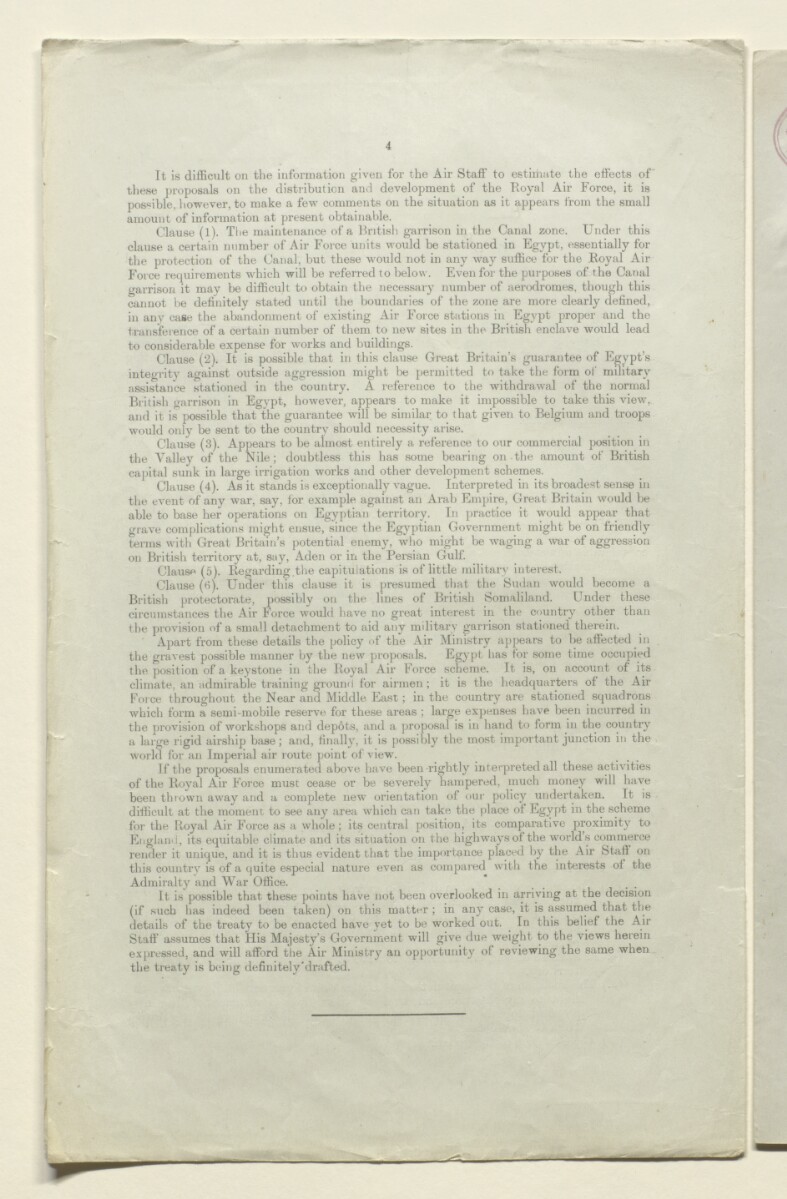
It is difficult on the information given for the Air Staff to estimate the effects of
these proposals on the distribution and development of the Royal Air Force, it is
possible, however, to make a few comments on the situation as it appears from the small
amount of information at present obtainable.
Clause (1). The maintenance of a British garrison in the Canal zone. Under this
clause a certain number of Air Force units would be stationed in Egypt, essentially for
the protection of the Canal, but these would not in any way suffice for the Royal Air
Force requirements which will be referred to below. Even for the purposes of the Canal
garrison it may be difficult to obtain the necessary number of aerodromes, though this
cannot be definitely stated until the boundaries of the zone are more clearly defined,
in any case the abandonment of existing Air Force stations in Egypt proper and the
transference of a certain number of them to new sites in the British
enclave
An area of land belonging to one country and entirely surrounded by land of just one other country.
would lead
to considerable expense for works and buildings.
Clause (2). It is possible that in this clause Great Britain’s guarantee of Egypt’s
integrity against outside aggression might be permitted to take the form of military
assistance stationed in the country. A reference to the withdrawal of the normal
British garrison in Egypt, however, appears to make it impossible to take this view,
and it is possible that the guarantee will be similar to that given to Belgium and troops
would only be sent to the country should necessity arise.
Clause (3). Appears to be almost entirely a reference to our commercial position in
the Valley of the Nile; doubtless this has some bearing on the amount of British
capital sunk in large irrigation works and other development schemes.
Clause (4). As it stands is exceptionally vague. Interpreted in its broadest sense in
the event of any war, say, for example against an Arab Empire, Great Britain would be
able to base her operations on Egyptian territory. In practice it would appear that
grave complications might ensue, since the Egyptian Government might be on friendly
terms with Great Britain’s potential enemy, who might be waging a war of aggression
on British territory at, say, Aden or in the
Persian Gulf
The historical term used to describe the body of water between the Arabian Peninsula and Iran.
.
Clause (5). Regarding the capitulations is of little military interest.
Clause (6). Under this clause it is presumed that the Sudan would become a
British protectorate, possibly on the lines of British Somaliland. Under these
circumstances the Air Force would have no great interest in the country other than
the provision of a small detachment to aid any military garrison stationed therein.
Apart from these details the policy of the Air Ministry appears to be affected in
the gravest possible manner by the new proposals. Egypt has for some time occupied
the position of a keystone in the Royal Air Force scheme. It is, on account of its
climate, an admirable training ground for airmen ; it is the headquarters of the Air
Force throughout the Near and Middle East ; in the country are stationed squadrons
which form a semi-mobile reserve for these areas ; large expenses have been incurred in
the provision of workshops and depots, and a proposal is in hand to form in the country
a large rigid airship base; and, finally, it is possibly the most important junction in the
world for an Imperial air route point of view .
If the proposals enumerated above have been rightly interpreted all these activities
of the Royal Air Force must cease or be severely hampered, much money will have
been thrown aw y ay and a complete new 7 orientation of our policy undertaken. It is
difficult at the moment to see any area which can take the place of Egypt in the scheme
for the Royal Air Force as a whole ; its central position, its comparative proximity to
England, its equitable climate and its situation on the highways of the worlds commerce
render it unique, and it is thus evident that the importance placed by the Air Staff on
this country is of a quite especial nature even as compared with the interests of the
Admiralty and War Office.
It is possible that these points have not been overlooked in arriving at the decision
(if such has indeed been taken) on this matter ; in any case, it is assumed, that the
details of the treaty to be enacted have yet to be worked out. In this belief the Air
Staff assumes that His Majesty’s Government will give due weight to the views herein
expressed, and will afford the Air Ministry an opportunity of reviewing the same when
the treaty is being definitely "drafted.
About this item
- Content
The file contains official correspondence, memoranda, and reports relating to political affairs in Egypt. The correspondents and authors are officials at the Foreign Office (Lord Curzon was Secretary of State for Foreign Affairs at the time), War Office, Air Ministry, Admiralty, Colonial Office, Board of Trade, Board of Education, as well as those within the Egyptian civil service.
The file contains copies of reports of the Special Mission to Egypt (folios 1-7, 75-93, and 175-194), led by Lord Alfred Milner, whose purpose was to investigate and advise following the Egyptian Revolution of 1919. Much of the content of the file is in response to the findings and recommendations of the Mission and discusses the possibilities of a political settlement with Egypt.
- Extent and format
- 1 file (237 folios)
- Arrangement
The file is arranged in chronological order, from the front to the rear.
- Physical characteristics
Foliation: the foliation sequence (used for referencing) commences at the front cover with 1, and terminates at the inside back cover with 235; these numbers are written in pencil, are circled, and are located in the top right corner of the recto The front of a sheet of paper or leaf, often abbreviated to 'r'. side of each folio. The file has one foliation anomaly, f 76a.
- Written in
- English in Latin script View the complete information for this record
Use and share this item
- Share this item
Report of the Special Mission to Egypt under Lord Milner, and related papers [16v] (32/473), British Library: India Office Records and Private Papers, Mss Eur F112/260, in Qatar Digital Library <https://www.qdl.qa/archive/81055/vdc_100080131819.0x000021> [accessed 4 June 2026]
https://www.qdl.qa/en/archive/81055/vdc_100080131819.0x000021
Copy and paste the code below into your web page where you would like to embed the image.
<meta charset="utf-8"><a href="https://www.qdl.qa/en/archive/81055/vdc_100080131819.0x000021">Report of the Special Mission to Egypt under Lord Milner, and related papers [‎16v] (32/473)</a> <a href="https://www.qdl.qa/en/archive/81055/vdc_100080131819.0x000021"> <img src="https://iiif.qdl.qa/iiif/images/81055/vdc_100000001491.0x000295/Mss Eur F112_260_0032.jp2/full/!280,240/0/default.jpg" alt="" /> </a>
This record has a IIIF manifest available as follows. If you have a compatible viewer you can drag the icon to load it.https://www.qdl.qa/en/iiif/81055/vdc_100000001491.0x000295/manifestOpen in Universal viewerOpen in Mirador viewerMore options for embedding images
Copyright: How to use this content
- Reference
- Mss Eur F112/260
- Title
- Report of the Special Mission to Egypt under Lord Milner, and related papers
- Pages
- front, front-i, 2r:39v, 42r:50v, 53r:76v, 76ar:76av, 77r:140v, 143r:143v, 144ar, 144r:235v
- Author
- East India Company, the Board of Control, the India Office, or other British Government Department
- Usage terms
- Open Government Licence