
![Typescript and printed cabinet papers and parliamentary papers on events in Egypt [‎93v] (186/520)](https://iiif.qdl.qa/iiif/images/81055/vdc_100000001491.0x000297/Mss Eur F112_262_0186.jp2/full/!1200,1200/0/default.jpg "Typescript and printed cabinet papers and parliamentary papers on events in Egypt [‎93v] (186/520)")
Typescript and printed cabinet papers and parliamentary papers on events in Egypt [93v] (186/520)
The record is made up of 1 file (260 folios). It was created in 10 Jul 1921-27 Feb 1922. It was written in English and French. The original is part of the British Library: India Office The department of the British Government to which the Government of India reported between 1858 and 1947. The successor to the Court of Directors. Records and Private Papers Documents collected in a private capacity. .
Transcription
This transcription is created automatically. It may contain errors.
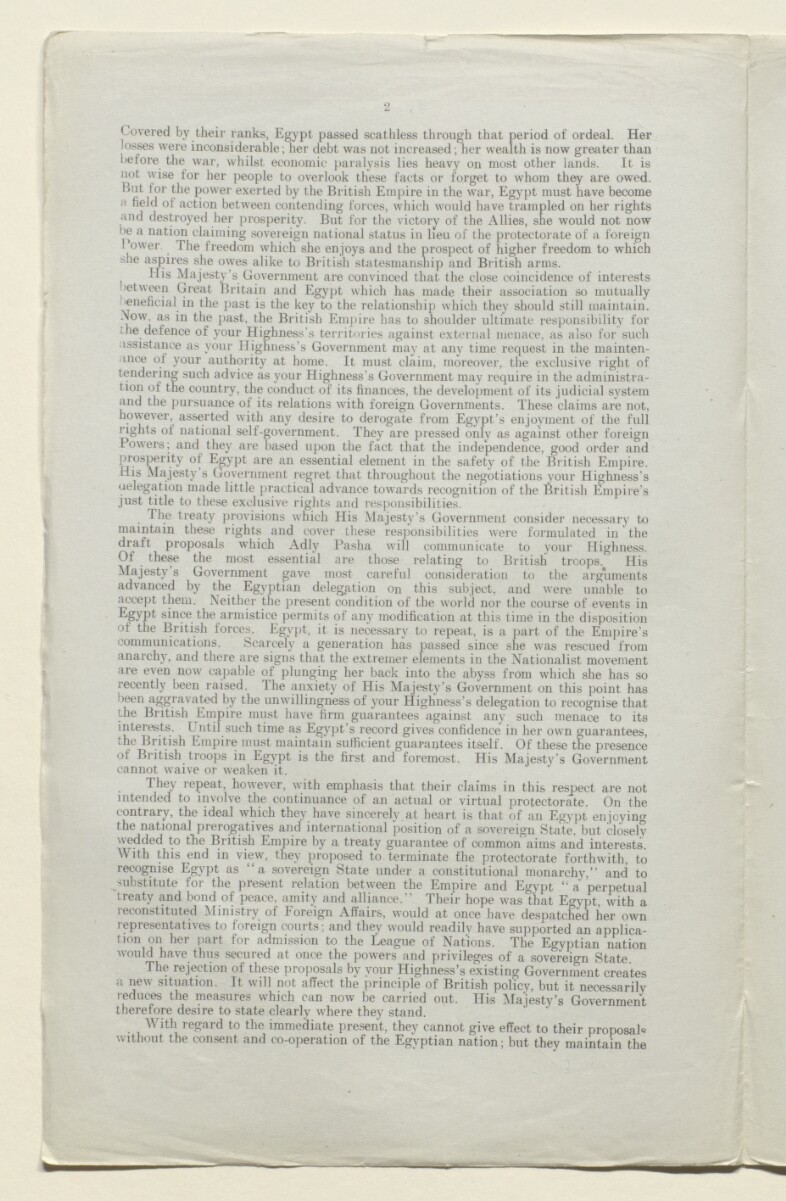
| overed by their ranks, Egypt passed scathless through that period of ordeal. Her
losses were inconsiderable; her debt was not increased; her wealth is now greater than
be tore the war, whilst economic paralysis lies heavy on most other lands. It is
not wise tor her people to overlook these facts or forget to whom they are owed.
But tor the power exerted by the British Empire in the war, Egypt must have become
a field of action between contending forces, which would have trampled on her rights
and destroyed her prosperity. But for the victory of the Allies, she would not now
i>e a nation claiming sovereign national status in lieu of the protectorate of a foreign
1 ower. I he freedom which she enjoys and the prospect of higher freedom to which
she aspires she owes alike to British statesmanship and British arms.
^ His Majesty’s Government are convinced that the close coincidence of interests
'etween Great Britain and Egypt which has made their association so mutually
^eneficial in the past is the key to the relationship which they should still maintain.
Now. as in the past, the British Empire has to shoulder ultimate responsibility for
the defence of your Highness’s territories against external menace, as also for such
assistance as your Highness’s Government may at any time request in the mainten
ance of your authority at home. It must claim, moreover, the exclusive right of
tendering such advice as your Highness’s Government may require in the administra
tion ot the country, the conduct of its finances, the development of its judicial system
and the pursuance of its relations with foreign Governments. These claims are not,
however, asserted with any desire to derogate from Egypt’s enjoyment of the full
rights oi national self-government. They are pressed only as against other foreign
Powers; and they are based upon the fact that the independence, good order and
prosperity ot Egypt are an essential element in the safety of the British Empire.
His Majesty s Government regret that throughout the negotiations your Highness’s
delegation made little practical advance towards recognition of the British Empire’s
just title to these exclusive rights and responsibilities.
I he treaty provisions which His Majesty’s Government consider necessary to
maintain these rights and cover these responsibilities were formulated in the
draft proposals which Adly
Pasha
An Ottoman title used after the names of certain provincial governors, high-ranking officials and military commanders.
will communicate to your Highness.
Of these the most essential are those relating to British troops. His
Majesty s Government gave most careful consideration to the arguments
advanced by the Egyptian delegation on this subject, and were unable to
accept them. Neither the present condition of the world nor the course of events in
Egypt since the armistice permits of any modification at this time in the disposition
of the British forces. Egypt, it is necessary to repeat, is a part of the Empire’s
communications. Scarcely a generation has passed since she was rescued from
anarchy, and there are signs that the extremer elements in the Nationalist movement
are even now capable of plunging her back into the abyss from which she has so
recently been raised. The anxiety of His Majesty's Government on this point has
heen aggravated by the unwillingness of your Highness’s delegation to recognise that
the British Empire must have firm guarantees against any such menace to its
interests. Until such time as Egypt s record gives confidence in her own guarantees,
the British Empire must maintain sufficient guarantees itself. Of these the presence
of British troops in Egypt is the first and foremost. His Majesty s Government
cannot waive or weaken it.
They repeat, however, with emphasis that their claims in this respect are not
intended to involve the continuance of an actual or virtual protectorate. On the
contrary, the ideal which they have sincerely at heart is that of an Egypt enjoying
the national prerogatives and international position of a sovereign State, but closely
wedded to the British Empire by a treaty guarantee of common aims and interests.
With this end in view, they proposed to terminate the protectorate forthwith, to
recognise Egypt as “a sovereign State under a constitutional monarchy,” and to
substitute for the present relation between the Empire and Egypt “ a perpetual
treaty and bond of peace, amity and alliance." Their hope was that Egypt, with a
reconstituted Ministry of Foreign Affairs, would at once have despatched her own
representatives to foreign courts; and they would readily have supported an applica
tion on her part for admission to the League of Nations. The Egyptian nation
would have thus secured at once the powers and privileges of a sovereign State
The rejection of these proposals by your Highness’s existing Government creates
a new situation. It will not affect the principle of British policy, but it necessarily
reduces the measures which can now be carried out. His Majesty’s Government
therefore desire to state clearly where they stand.
With regard to the immediate present, they cannot give effect to their proposal®
without the consent and co-operation of the Egyptian nation; but they maintain the
About this item
- Content
The file contains correspondence, memoranda, minutes, and other papers concerning the political situation in Egypt and negotiations between the British Government and an Egyptian delegation for the end of the British Protectorate in Egypt. The papers cover the effort to come to an agreement on future relations between the two parties following negotiations in the summer of 1921 and up until Britain's unilateral declaration of the end of the protectorate in February 1922.
The majority of the memoranda is written by Foreign Office officials, including the Secretary of State for Foreign Affairs, Lord Curzon. Records of meetings of the Cabinet and a sub-committee on the Egyptian situation, and of a few high-level gatherings at 10 Downing Street, make up a substantial part of the file. There is also a large amount of correspondence between Curzon and Field Marshal Edmund Henry Hynman Allenby, High Commissioner of Egypt, on the question of Egyptian independence and events in Egypt. Other papers include printed collections relating to the Egyptian situation that were presented to Parliament.
At the back of the file is a chronological summary and a résumé of events in Egypt since the publication of the report of the Milner Mission to Egypt (folios 238-260).
- Extent and format
- 1 file (260 folios)
- Arrangement
The file is arranged in chronological order, from the front to the rear.
- Physical characteristics
Foliation: the main foliation sequence (used for referencing) commences at the first folio with 1, and terminates at the last folio with 260; these numbers are written in pencil, are circled, and are located in the top right corner of the recto The front of a sheet of paper or leaf, often abbreviated to 'r'. side of each folio. An additional foliation sequence is present in parallel between ff 1-260; these numbers are also written in pencil, but are not circled.
Pagination: the file also contains an original printed pagination sequence.
- Written in
- English and French in Latin script View the complete information for this record
Use and share this item
- Share this item
Typescript and printed cabinet papers and parliamentary papers on events in Egypt [93v] (186/520), British Library: India Office Records and Private Papers, Mss Eur F112/262, in Qatar Digital Library <https://www.qdl.qa/archive/81055/vdc_100077517244.0x0000bb> [accessed 5 June 2026]
https://www.qdl.qa/en/archive/81055/vdc_100077517244.0x0000bb
Copy and paste the code below into your web page where you would like to embed the image.
<meta charset="utf-8"><a href="https://www.qdl.qa/en/archive/81055/vdc_100077517244.0x0000bb">Typescript and printed cabinet papers and parliamentary papers on events in Egypt [‎93v] (186/520)</a> <a href="https://www.qdl.qa/en/archive/81055/vdc_100077517244.0x0000bb"> <img src="https://iiif.qdl.qa/iiif/images/81055/vdc_100000001491.0x000297/Mss Eur F112_262_0186.jp2/full/!280,240/0/default.jpg" alt="" /> </a>
This record has a IIIF manifest available as follows. If you have a compatible viewer you can drag the icon to load it.https://www.qdl.qa/en/iiif/81055/vdc_100000001491.0x000297/manifestOpen in Universal viewerOpen in Mirador viewerMore options for embedding images
Copyright: How to use this content
- Reference
- Mss Eur F112/262
- Title
- Typescript and printed cabinet papers and parliamentary papers on events in Egypt
- Pages
- 1r:1v, 4r:5v, 8r:9v, 11r:19v, 23r:44v, 49r:260v
- Author
- East India Company, the Board of Control, the India Office, or other British Government Department
- Usage terms
- Open Government Licence