
![File of printed papers marked 'Egyptian negotiation' between Curzon and Adly Pasha and the Egyptian delegation [‎51r] (101/178)](https://iiif.qdl.qa/iiif/images/81055/vdc_100000001491.0x000296/Mss Eur F112_261_0101.jp2/full/!1200,1200/0/default.jpg "File of printed papers marked 'Egyptian negotiation' between Curzon and Adly Pasha and the Egyptian delegation [‎51r] (101/178)")
File of printed papers marked 'Egyptian negotiation' between Curzon and Adly Pasha and the Egyptian delegation [51r] (101/178)
The record is made up of 1 file (87 folios). It was created in 13 Jul 1921-4 Jan 1923. It was written in English. The original is part of the British Library: India Office The department of the British Government to which the Government of India reported between 1858 and 1947. The successor to the Court of Directors. Records and Private Papers Documents collected in a private capacity. .
Transcription
This transcription is created automatically. It may contain errors.
5
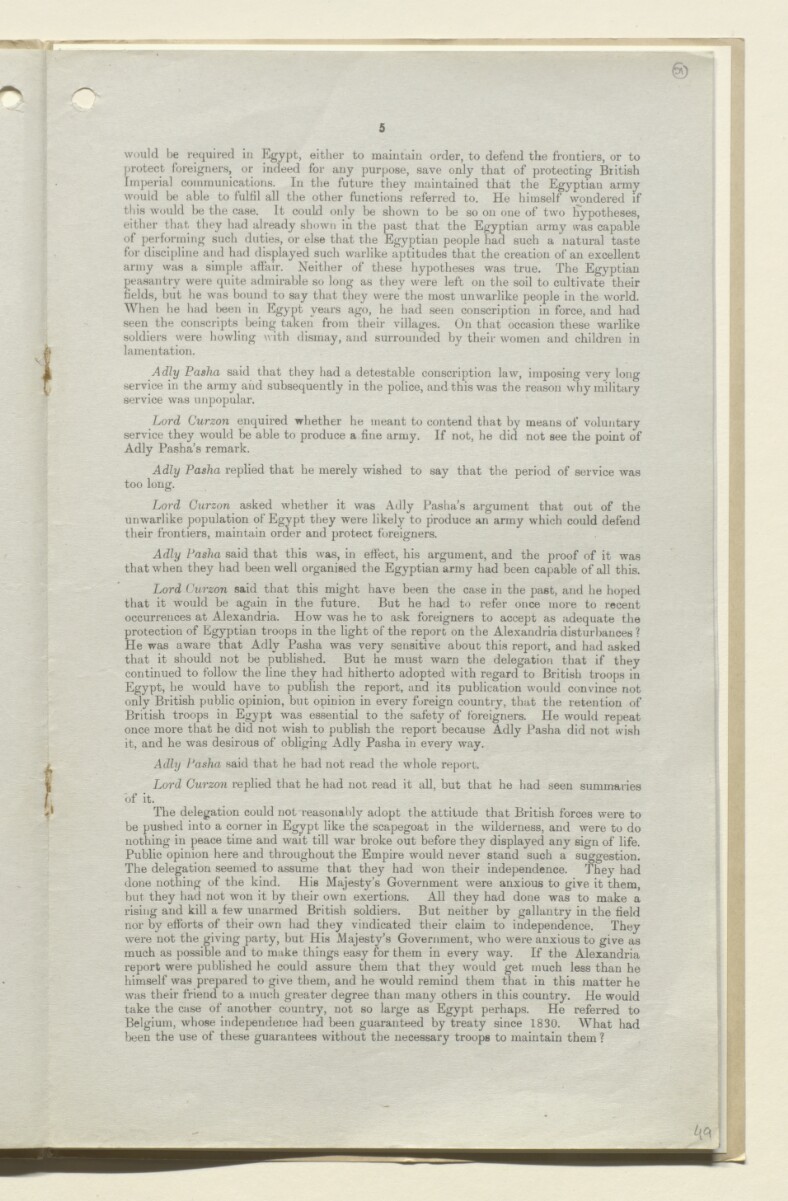
would be required in Egypt, either to maintain order, to defend the frontiers, or to
protect foreigners, or indeed for any purpose, save only that of protecting British
Imperial communications. In the future they maintained that the Egyptian army
would be able to fulfil all the other functions referred to. He himself wondered if
this would be the case. It could only be shown to be so on one of two hypotheses,
either that they had already shown in the past that the Egyptian army was capable
of performing such duties, or else that the Egyptian people had such a natural taste
for discipline and had displayed such warlike aptitudes that the creation of an excellent
army was a simple affair. Neither of these hypotheses was true. The Egyptian
peasantry were quite admirable so long as they were left on the soil to cultivate their
fields, but he was bound to say that they were the most unwarlike people in the world.
When he had been in Egypt years ago, he had seen conscription in force, and had
seen the conscripts being taken from their villages. On that occasion these warlike
soldiers were howling with dismay, and surrounded by their women and children in
lamentation.
Adly
Pasha
An Ottoman title used after the names of certain provincial governors, high-ranking officials and military commanders.
said that they had a detestable conscription law, imposing very long
service in the army and subsequently in the police, and this was the reason why military
service was unpopular.
Lord Curzon enquired whether he meant to contend that by means of voluntary
service they would be able to produce a fine army. If not, he did not see the point of
Adly Pasha’s remark.
Adly
Pasha
An Ottoman title used after the names of certain provincial governors, high-ranking officials and military commanders.
replied that he merely wished to say that the period of service was
too long.
Lord Curzon asked whether it was Adly Pasha’s argument that out of the
unwarlike population of Egypt they were likely to produce an army which could defend
their frontiers, maintain order and protect foreigners.
Adly
Pasha
An Ottoman title used after the names of certain provincial governors, high-ranking officials and military commanders.
said that this was, in effect, his argument, and the proof of it was
that when they had been well organised tbe Egyptian army had been capable of all this.
Lord Curzon said that this might have been the case in the past, and he hoped
that it would be again in the future. But he had to refer once more to recent
occurrences at Alexandria. How was he to ask foreigners to accept as adequate the
protection of Egyptian troops in the light of the report on the Alexandria disturbances ?
He was aware that Adly
Pasha
An Ottoman title used after the names of certain provincial governors, high-ranking officials and military commanders.
was very sensitive about this report, and had asked
that it should not be published. But he must warn the delegation that if they
continued to follow the line they had hitherto adopted with regard to British troops in
Egypt, he would have to publish the report, and its publication would convince not
only British public opinion, but opinion in every foreign country, that the retention of
British troops in Egypt was essential to the safety of foreigners. He would repeat
once more that he did not wish to publish the report because Adly
Pasha
An Ottoman title used after the names of certain provincial governors, high-ranking officials and military commanders.
did not wish
it, and he was desirous of obliging Adly
Pasha
An Ottoman title used after the names of certain provincial governors, high-ranking officials and military commanders.
in every way.
Adly I’asha said that he had not read the whole report.
Lord Curzon replied that he had not read it all, but that he had seen summaries
of it.
The delegation could not reasonably adopt the attitude that British forces were to
be pushed into a corner in Egypt like the scapegoat in the wilderness, and were to do
nothing in peace time and wait till war broke out before they displayed any sign of life.
Public opinion here and throughout the Empire would never stand such a suggestion.
The delegation seemed to assume that they had won their independence. They had
done nothing of the kind. His Majesty’s Government were anxious to give it them,
but they had not won it by their own exertions. All they had done was to make a
rising and kill a few unarmed British soldiers. But neither by gallantry in the field
nor by efforts of their own had they vindicated their claim to independence. They
were not the giving party, but His Majesty’s Government, who were anxious to give as
much as possible and to make things easy for them in every way. If the Alexandria
report were published he could assure them that they would get much less than he
himself was prepared to give them, and he would remind them that in this matter he
was their friend to a much greater degree than many others in this country. He would
take the case of another country, not so large as Egypt perhaps. He referred to
Belgium, whose independence had been guaranteed by treaty since 1830. What had
been the use of these guarantees without the necessary troops to maintain them ?
About this item
- Content
The file contains correspondence, minutes, and memoranda relating to negotiations between the British and Egyptian governments over Egyptian independence. Most of the file consists of minutes of conferences that took place at the Foreign Office during July and August 1921. These conferences involved an Egyptian delegation, led by Sir Adly Yeghen [Yakan] Pasha An Ottoman title used after the names of certain provincial governors, high-ranking officials and military commanders. , and the British, led by the Secretary of State for Foreign Affairs, Lord George Nathaniel Curzon. Matters covered in these meetings included: the termination of the British Protectorate, Britain's military presence, foreign relations, legislation, employment of foreign officials, financial and judicial control, Soudan [Sudan], the Suez Canal, communication rights, protection of minorities, retirement and compensation of British officials, and diplomatic relations between the two countries.
Also contained within the file are minutes by Ronald Charles Lindsay and John Murray, both Foreign Office officials, and correspondence between Curzon, Lindsay, Adly Pasha An Ottoman title used after the names of certain provincial governors, high-ranking officials and military commanders. , and Field Marshal Edmund Henry Hynman Allenby, High Commissioner for Egypt and Sudan. These papers all concern matters covered by the negotiations.
Documents of note include a copy of the Report of the Special Mission to Egypt, dated 9 December 1920 (folios 4-23), and a memorandum on the political situation in Egypt by John Murray, dated 4 January 1923 (folios 74-87).
- Extent and format
- 1 file (87 folios)
- Arrangement
The file is arranged in rough chronological order, from the front to the rear. On the inside front cover is a manuscript index with a numbered list of the file's contents.
- Physical characteristics
Foliation: the main foliation sequence (used for referencing) commences at the front cover with 1, and terminates at the inside back cover with 89; these numbers are written in pencil, are circled, and are located in the top right corner of the recto The front of a sheet of paper or leaf, often abbreviated to 'r'. side of each folio. An additional foliation sequence is present in parallel between ff 2-87; these numbers are also written in pencil, but are not circled.
Pagination: the file also contains an original printed pagination sequence.
- Written in
- English in Latin script View the complete information for this record
Use and share this item
- Share this item
File of printed papers marked 'Egyptian negotiation' between Curzon and Adly Pasha and the Egyptian delegation [51r] (101/178), British Library: India Office Records and Private Papers, Mss Eur F112/261, in Qatar Digital Library <https://www.qdl.qa/archive/81055/vdc_100077019155.0x000066> [accessed 26 July 2026]
https://www.qdl.qa/en/archive/81055/vdc_100077019155.0x000066
Copy and paste the code below into your web page where you would like to embed the image.
<meta charset="utf-8"><a href="https://www.qdl.qa/en/archive/81055/vdc_100077019155.0x000066">File of printed papers marked 'Egyptian negotiation' between Curzon and Adly Pasha and the Egyptian delegation [‎51r] (101/178)</a> <a href="https://www.qdl.qa/en/archive/81055/vdc_100077019155.0x000066"> <img src="https://iiif.qdl.qa/iiif/images/81055/vdc_100000001491.0x000296/Mss Eur F112_261_0101.jp2/full/!280,240/0/default.jpg" alt="" /> </a>
This record has a IIIF manifest available as follows. If you have a compatible viewer you can drag the icon to load it.https://www.qdl.qa/en/iiif/81055/vdc_100000001491.0x000296/manifestOpen in Universal viewerOpen in Mirador viewerMore options for embedding images
Copyright: How to use this content
- Reference
- Mss Eur F112/261
- Title
- File of printed papers marked 'Egyptian negotiation' between Curzon and Adly Pasha and the Egyptian delegation
- Pages
- front, front-i, 2r:24v, 27r:40v, 46r:53v, 55r:59v, 62r:62v, 64r, 65r, 66r:67v, 71r:85v, 88r:88v, back-i, back
- Author
- East India Company, the Board of Control, the India Office, or other British Government Department
- Usage terms
- Open Government Licence