
![Papers written by Curzon on the Near and Middle East [‎124r] (247/348)](https://iiif.qdl.qa/iiif/images/81055/vdc_100000001491.0x00028c/Mss Eur F112_278_0255.jp2/full/!1200,1200/0/default.jpg "Papers written by Curzon on the Near and Middle East [‎124r] (247/348)")
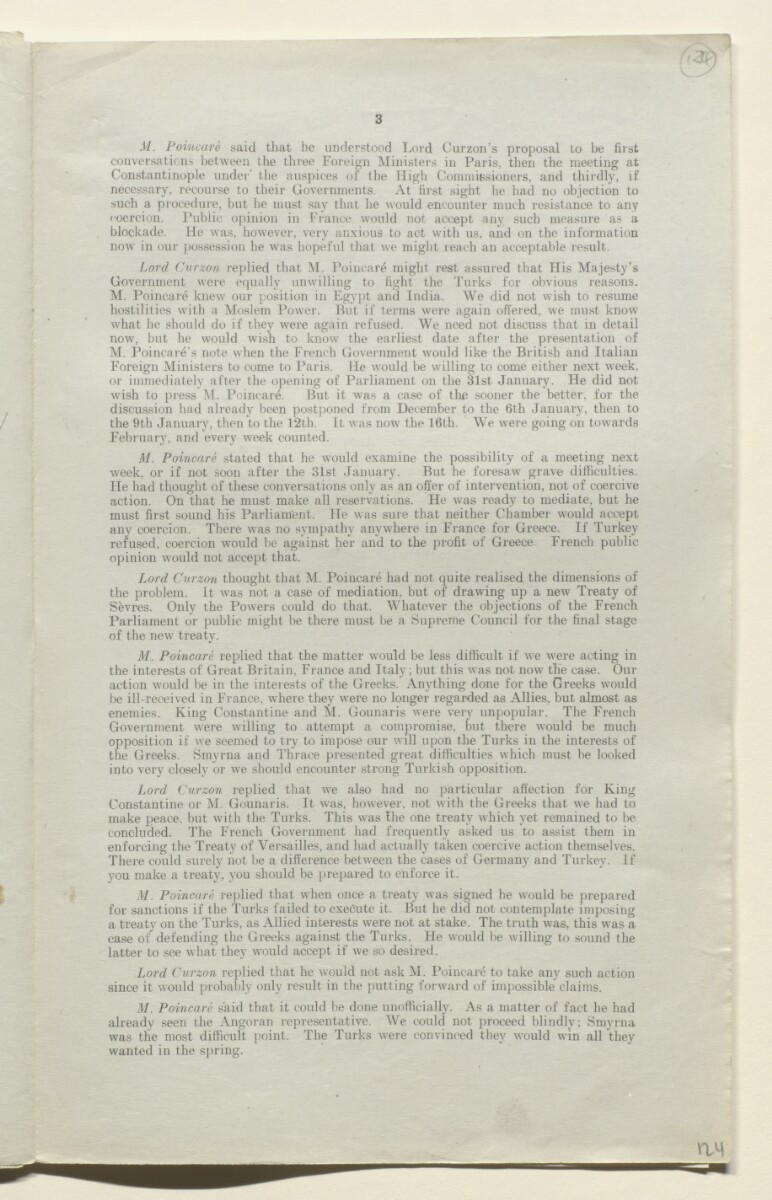
Papers written by Curzon on the Near and Middle East [124r] (247/348)
The record is made up of 1 file (174 folios). It was created in 16 Nov 1917-17 Jan 1924. It was written in English and French. The original is part of the British Library: India Office The department of the British Government to which the Government of India reported between 1858 and 1947. The successor to the Court of Directors. Records and Private Papers Documents collected in a private capacity. .
Transcription
This transcription is created automatically. It may contain errors.
'V-
3
M. Poincare said that he understood Lord Curzon’s proposal to be first
conversations between the three Foreign Ministers in Paris, then the meeting at
Constantinople under* the auspices of the High Commissioners, and thirdly, if
necessary, recourse to their Governments. At first sight he had no objection to
such a procedure, but he must say that he would encounter much resistance to any
roercion. Public opinion in France would not accept any such measure as a
blockade. He was, however, very anxious to act with us, and on the information
now in our possession he was hopeful that we might reach an acceptable result.
Lord Curzon replied that M. Poincare might rest assured that His Majesty’s
Government were equally unwilling to fight the Turks for obvious reasons.
M. Poincare knew our position in Egypt and India. We did not wish to resume
hostilities with a Moslem Power. But if terms were again offered, we must know
what he should do if they were again refused. We need not discuss that in detail
now, but he would wish to know the earliest date after the presentation of
M. Poincare's note when the French Government would like the British and Italian
Foreign Ministers to come to Paris. He would be willing to come either next week,
or immediately after the opening of Parliament on the 31st January. He did not
wish to press M. Poincare. But it was a case of the sooner the better, for the
discussion had already been postponed from December to the 6th January, then to
the 9th January, then to the 12th. It was now the 16th. We were going on towards
February, and every week counted.
M. Poincare stated that he would examine the possibility of a meeting next
week, or if not soon after the 31st January. But he foresaw grave difficulties.
He had thought of these conversations only as an offer of intervention, not of coercive
action. On that he must make all reservations. He was ready to mediate, but he
must first sound his Parliament. He was sure that neither Chamber would accept
any coercion. There was no sympathy anywhere in France for Greece. If Turkey
refused, coercion would be against her and to the profit of Greece. French public
opinion would not accept that.
Lord Curzon thought that M. Poincare had not quite realised the dimensions of
the problem. It was not a case of mediation, but of drawing up a new Treaty of
Sevres. Only the Powers could do that. Whatever the objections of the French
Parliament or public might be there must be a Supreme Council for the final stage
of the new treaty.
M,. Poincare replied that the matter would be less difficult if we were acting in
the interests of Great Britain, France and Italy; but this was not now the case. Our
action would be in the interests of the Greeks. Anything done for the Greeks would
be ill-received in France, where they were no longer regarded as Allies, but almost as
enemies. King Constantine and M. Gounaris were very unpopular. The French
Government were willing to attempt a compromise, but there would be much
opposition if we seemed to try to impose our will upon the Turks in the interests of
the Greeks. Smyrna and Thrace presented great difficulties which must be looked
into very closely or we should encounter strong Turkish opposition.
Lord Curzon replied that we also had no particular affection for King
Constantine or M. Gounaris. It was, however, not with the Greeks that we had to
make peace, but with the Turks. This was the one treaty which yet remained to be
concluded. The French Government had frequently asked us to assist them in
enforcing the Treaty of Versailles, and had actually taken coercive action themselves.
There could surely not be a difference between the cases of Germany and Turkey. If
you make a treaty, you should be prepared to enforce it.
M. Poincare replied that when once a treaty was signed he would be prepared
for sanctions if the Turks failed to execute it. But he did not contemplate imposing
a treaty on the Turks, as Allied interests were not at stake. The truth was, this was a
case of defending the Greeks against the Turks. He would be willing to sound the
latter to see what they would accept if we so desired.
Lord Curzon replied that he would not ask M. Poincare to take any such action
since it would probably only result in the putting forward of impossible claims.
M. Poincare said that it could be done unofficially. As a matter of fact he had
already seen the Angoran representative. We could not proceed blindly; Smyrna
was the most difficult point. The Turks were convinced they would win all "they
wanted in the spring.
riM
About this item
- Content
The file contains correspondence, memoranda, maps, and notes on various subjects connected to the Near and Middle East. The majority of the papers are written by George Curzon himself and concern the settlement of former territories of the Ottoman Empire following its break up after the First World War. Matters such as the Greek occupation of Smyrna, the division of Thrace, the Greco-Turkish War, Georgian independence, and the Treaties of Sèvres and Lausanne are all discussed.
Other matters covered by the file include those concerning the Arab territories of the former Ottoman Empire, American advisers in Persia, and the future of Palestine, including a report by the Committee on Palestine (Colonial Office) dated 27 July 1923 (folios 168-171).
Correspondence within the file is mostly between Curzon and representatives of the other Allied Powers, as well as officials from other governmental departments and diplomatic offices.
- Extent and format
- 1 file (174 folios)
- Arrangement
The file is arranged in chronological order from the front to the back.
- Physical characteristics
Foliation: the foliation sequence (used for referencing) commences at the first folio with 1, and terminates at the last folio with 174; these numbers are written in pencil, are circled, and are located in the top right corner of the recto The front of a sheet of paper or leaf, often abbreviated to 'r'. side of each folio.
- Written in
- English and French in Latin script View the complete information for this record
Use and share this item
- Share this item
Papers written by Curzon on the Near and Middle East [124r] (247/348), British Library: India Office Records and Private Papers, Mss Eur F112/278, in Qatar Digital Library <https://www.qdl.qa/archive/81055/vdc_100076917036.0x000030> [accessed 1 August 2026]
https://www.qdl.qa/en/archive/81055/vdc_100076917036.0x000030
Copy and paste the code below into your web page where you would like to embed the image.
<meta charset="utf-8"><a href="https://www.qdl.qa/en/archive/81055/vdc_100076917036.0x000030">Papers written by Curzon on the Near and Middle East [‎124r] (247/348)</a> <a href="https://www.qdl.qa/en/archive/81055/vdc_100076917036.0x000030"> <img src="https://iiif.qdl.qa/iiif/images/81055/vdc_100000001491.0x00028c/Mss Eur F112_278_0255.jp2/full/!280,240/0/default.jpg" alt="" /> </a>
This record has a IIIF manifest available as follows. If you have a compatible viewer you can drag the icon to load it.https://www.qdl.qa/en/iiif/81055/vdc_100000001491.0x00028c/manifestOpen in Universal viewerOpen in Mirador viewerMore options for embedding images
Copyright: How to use this content
- Reference
- Mss Eur F112/278
- Title
- Papers written by Curzon on the Near and Middle East
- Pages
- 2r:12v, 15r:48v, 54r:93v, 95r:105v, 118r:145r, 147v:153r, 154v, 156r:161v, 163r:173v, back, back-i
- Author
- East India Company, the Board of Control, the India Office, or other British Government Department
- Usage terms
- Open Government Licence