
![Papers written by Curzon on the Near and Middle East [‎38r] (75/348)](https://iiif.qdl.qa/iiif/images/81055/vdc_100000001491.0x00028c/Mss Eur F112_278_0075.jp2/full/!1200,1200/0/default.jpg "Papers written by Curzon on the Near and Middle East [‎38r] (75/348)")
Papers written by Curzon on the Near and Middle East [38r] (75/348)
The record is made up of 1 file (174 folios). It was created in 16 Nov 1917-17 Jan 1924. It was written in English and French. The original is part of the British Library: India Office The department of the British Government to which the Government of India reported between 1858 and 1947. The successor to the Court of Directors. Records and Private Papers Documents collected in a private capacity. .
Transcription
This transcription is created automatically. It may contain errors.
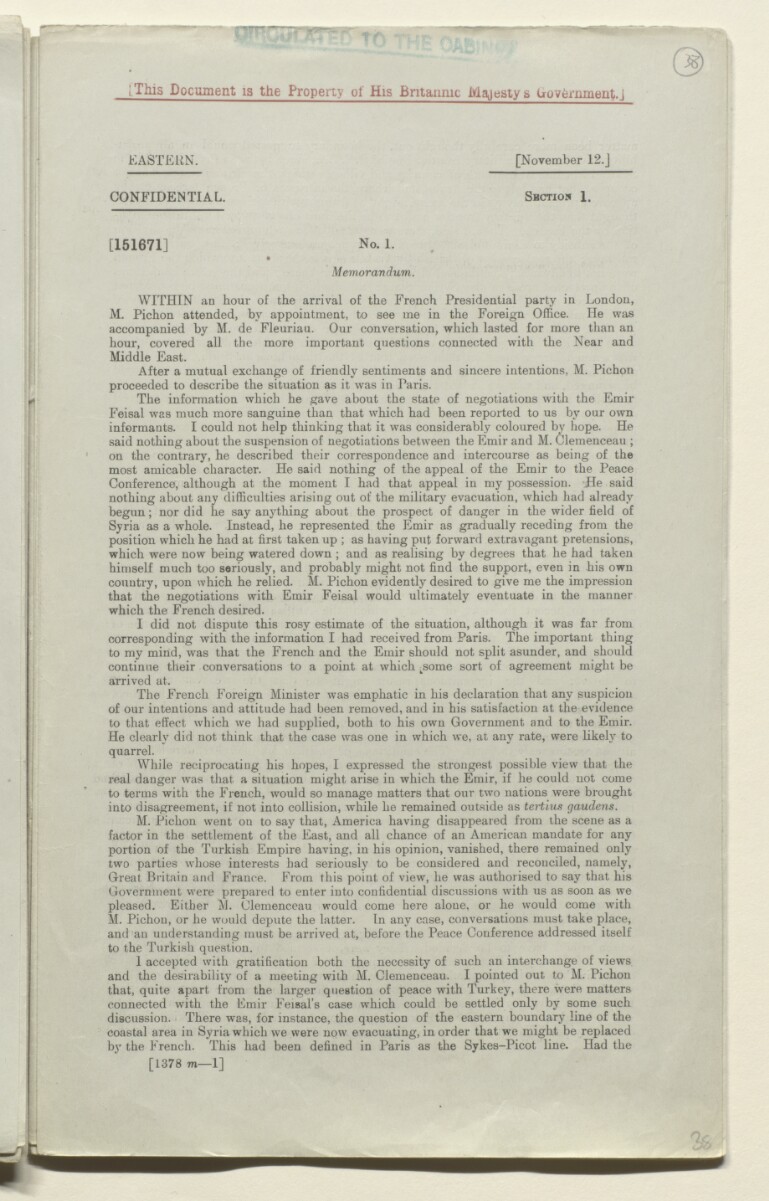
[Tliis Document is the Property oi His Britannic Majesty s (joyeminent.J
EASTERN. [November 12.J
CONFIDENTIAL. Sbctioh 1.
[151671] No. 1.
Memorandum.
WITHIN an hour of the arrival of the French Presidential party in London,
M. Pichon attended, by appointment, to see me in the Foreign Office. He was
accompanied by M. de Fleuriau. Our conversation, which lasted for more than an
hour, covered all the more important questions connected with the Near and
Middle East.
After a mutual exchange of friendly sentiments and sincere intentions, M. Pichon
proceeded to describe the situation as it was in Paris.
The information which he gave about the state of negotiations with the Emir
Feisal -was much more sanguine than that which had been reported to us by our own
informants. I could not help thinking that it was considerably coloured by hope. He
said nothing about the suspension of negotiations between the Emir and M. Clemenceau ;
on the contrary, he described their correspondence and intercourse as being of the
most amicable character. He said nothing of the appeal of the Emir to the Peace
Conference, although at the moment I had that appeal in my possession. He said
nothing about any difficulties arising out of the military evacuation, which had already
begun; nor did he say anything about the prospect of danger in the wider field of
Syria as a whole. Instead, he represented the Emir as gradually receding from the
position which he had at first taken up ; as having put forward extravagant pretensions,
which were now being watered down ; and as realising by degrees that he had taken
himself much too seriously, and probably might not find the support, even in his own
country, upon which he relied. M. Pichon evidently desired to give me the impression
that the negotiations with Emir Feisal would ultimately eventuate in the manner
which the French desired.
I did not dispute this rosy estimate of the situation, although it was far from
corresponding with the information I had received from Paris. The important thing
to my mind, was that the French and the Emir should not split asunder, and should
continue their conversations to a point at which k some sort of agreement might be
arrived at.
The French Foreign Minister was emphatic in his declaration that any suspicion
of our intentions and attitude had been removed, and in his satisfaction at the evidence
to that effect which we had supplied, both to his own Government and to the Emir.
He clearly did not think that the case was one in which we, at any rate, were likely to
quarrel.
While reciprocating his hopes, I expressed the strongest possible view that the
real danger was that a situation might arise in which the Emir, if he could not come
to terms with the French, would so manage matters that our two nations were brought
into disagreement, if not into collision, while he remained outside as tertius gaudens.
M. Pichon went on to say that, America having disappeared from the scene as a
factor in the settlement of the East, and all chance of an American mandate for any
portion of the Turkish Empire having, in his opinion, vanished, there remained only
two parties whose interests had seriously to be considered and reconciled, namely,
Great Britain and France. From this point of view, he was authorised to say that his
Government were prepared to enter into confidential discussions with us as soon as we
pleased. Either M. Olemenceau would come here alone, or he would come with
M. Pichon, or he would depute the latter. In any case, conversations must take place,
and an understanding must be arrived at, before the Peace Conference addressed itself
to the Turkish question.
1 accepted with gratification both the necessity of such an interchange of views
and the desirability of a meeting with M. Clemenceau. I pointed out to M. Pichon
that, quite apart from the larger question of peace with Turkey, there were matters
connected with the Emir Feisal’s case which could be settled only by some such
discussion. There was, for instance, the question of the eastern boundary line of the
coastal area in Syria which we were now evacuating, in order that we might be replaced
by the French. This had been defined in Paris as the Sykes-Picot line. Had the
[1378 m—1]
About this item
- Content
The file contains correspondence, memoranda, maps, and notes on various subjects connected to the Near and Middle East. The majority of the papers are written by George Curzon himself and concern the settlement of former territories of the Ottoman Empire following its break up after the First World War. Matters such as the Greek occupation of Smyrna, the division of Thrace, the Greco-Turkish War, Georgian independence, and the Treaties of Sèvres and Lausanne are all discussed.
Other matters covered by the file include those concerning the Arab territories of the former Ottoman Empire, American advisers in Persia, and the future of Palestine, including a report by the Committee on Palestine (Colonial Office) dated 27 July 1923 (folios 168-171).
Correspondence within the file is mostly between Curzon and representatives of the other Allied Powers, as well as officials from other governmental departments and diplomatic offices.
- Extent and format
- 1 file (174 folios)
- Arrangement
The file is arranged in chronological order from the front to the back.
- Physical characteristics
Foliation: the foliation sequence (used for referencing) commences at the first folio with 1, and terminates at the last folio with 174; these numbers are written in pencil, are circled, and are located in the top right corner of the recto The front of a sheet of paper or leaf, often abbreviated to 'r'. side of each folio.
- Written in
- English and French in Latin script View the complete information for this record
Use and share this item
- Share this item
Papers written by Curzon on the Near and Middle East [38r] (75/348), British Library: India Office Records and Private Papers, Mss Eur F112/278, in Qatar Digital Library <https://www.qdl.qa/archive/81055/vdc_100076917035.0x00004c> [accessed 31 July 2026]
https://www.qdl.qa/en/archive/81055/vdc_100076917035.0x00004c
Copy and paste the code below into your web page where you would like to embed the image.
<meta charset="utf-8"><a href="https://www.qdl.qa/en/archive/81055/vdc_100076917035.0x00004c">Papers written by Curzon on the Near and Middle East [‎38r] (75/348)</a> <a href="https://www.qdl.qa/en/archive/81055/vdc_100076917035.0x00004c"> <img src="https://iiif.qdl.qa/iiif/images/81055/vdc_100000001491.0x00028c/Mss Eur F112_278_0075.jp2/full/!280,240/0/default.jpg" alt="" /> </a>
This record has a IIIF manifest available as follows. If you have a compatible viewer you can drag the icon to load it.https://www.qdl.qa/en/iiif/81055/vdc_100000001491.0x00028c/manifestOpen in Universal viewerOpen in Mirador viewerMore options for embedding images
Copyright: How to use this content
- Reference
- Mss Eur F112/278
- Title
- Papers written by Curzon on the Near and Middle East
- Pages
- 2r:12v, 15r:48v, 54r:93v, 95r:105v, 118r:145r, 147v:153r, 154v, 156r:161v, 163r:173v, back, back-i
- Author
- East India Company, the Board of Control, the India Office, or other British Government Department
- Usage terms
- Open Government Licence