
![Papers written by Curzon on the Near and Middle East [‎8r] (15/348)](https://iiif.qdl.qa/iiif/images/81055/vdc_100000001491.0x00028c/Mss Eur F112_278_0015.jp2/full/!1200,1200/0/default.jpg "Papers written by Curzon on the Near and Middle East [‎8r] (15/348)")
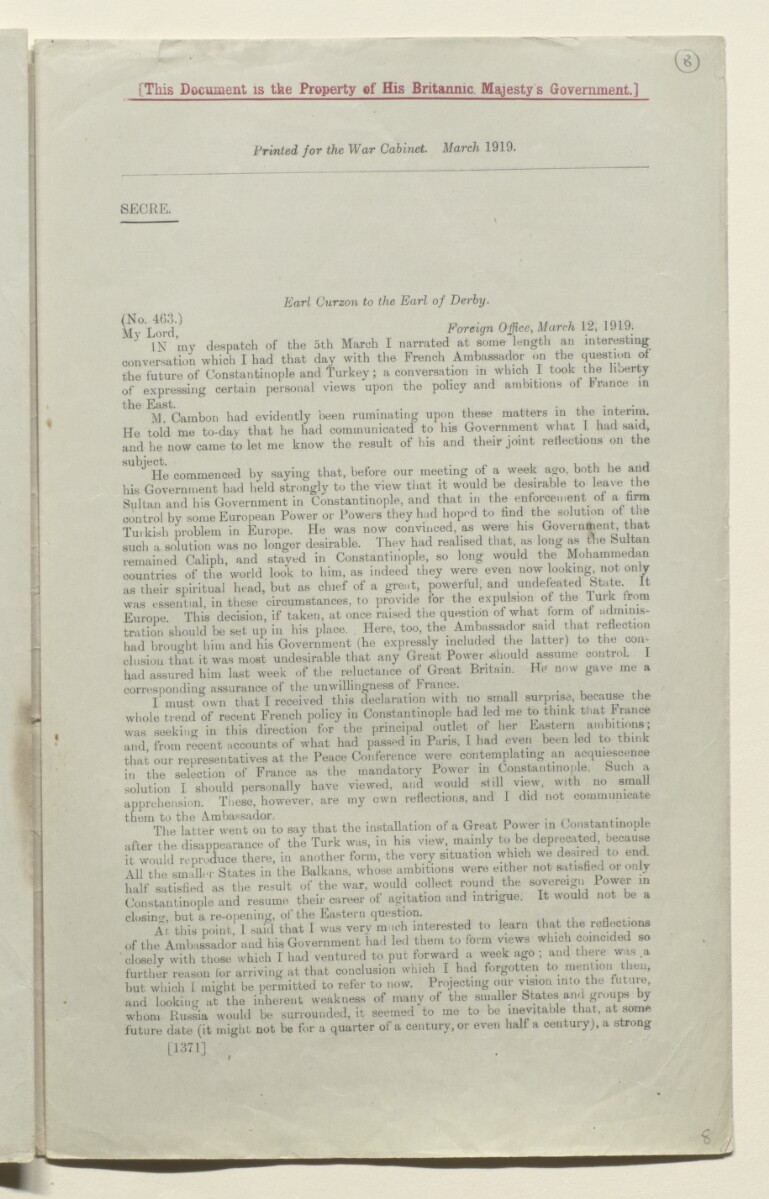
Papers written by Curzon on the Near and Middle East [8r] (15/348)
The record is made up of 1 file (174 folios). It was created in 16 Nov 1917-17 Jan 1924. It was written in English and French. The original is part of the British Library: India Office The department of the British Government to which the Government of India reported between 1858 and 1947. The successor to the Court of Directors. Records and Private Papers Documents collected in a private capacity. .
Transcription
This transcription is created automatically. It may contain errors.
[ 1371 ] .
[This Document is the Property of His Britannic. Majesty s Government.]
Printed for the War Cabinet. March 1919.
SECRE.
Earl Curzon to the Earl of Derby.
M\°Lord ' Foreign Office, March 12, 1919.
^ ' IN my despatch of the 5th March I narrated at some length an interesting
conversation which I had that day with the French Ambassador on the question of
the future of Constantinople and Turkey; a conversation in which 1 took the hoerty
of expressing certain personal views upon the policy and ambitions of b ranee in
^1. Gambon had evidently been ruminating upon these matters in the interim.
He told me to-day that he had communicated to his Government what 1 had said,
and he now came to let me know the result of his and their joint reflections on the
ubjecC commenced b y say i ng t h at> before our meeting of a week ago, both he and
his Government had held strongly to the view that it would be desirable to leave the
Sultan and his Government in Constantinople, and that in the enforcement, of a farm
control by some European Power or Powers they had hop'd to find the solution of the
Tmkish problem in Europe. He was now convinced as were his Government, that
such a solution was no longer desirable. They had realised that, as long as the Sultan
remained Caliph, and stayed in Constantinople, so long would the Mohammedan
countries of the world look to him, as indeed they were even now looking not only
as their spiritual head, but as chief of a great, powerful, and undefeated State. It
was essential, in these circumstances, to provide for the. expulsion of the lurk from
Europe. This decision, if taken, at once raised the question of what form of adminis
tration should be set up in his place. . Here, too, the. Ambassador said that reflection
had brought him and his Government (he expressly included the latter) to the con
clusion that it was most undesirable that any Great Power should assume control. 1
had assured him last week of the reluctance of Great Britain. He now gave me a
corresponding assurance of the unwillingness of France. . ,
I must own that I received this declaration with no small surprise, because the
whole trend of recent French policy in Constantinople had led me to think that France
was seeking in this direction for the principal outlet of her Eastern ambitions;
and from recent accounts of what had passed in Paris, I had even been led to think
that our representatives at the Peace Conference were contemplating an acquiescence
in the selection of France as the mandatory Power in Constantinople. Such a
solution I should personally have viewed, and would still view, with no small
apprehension. These, however, are my own reflections, and I did not communicate
them to the Annhassador. • r'l j. i
The latter went on to sav that the installation o! a Great 1 ower in <Constantinople
after the disappearance of the Turk was, in his view, mainly to be deprecated, because
it would reproduce there, in another form, the very situation which we desired to end.
All the smaller States in the Balkans, whose ambitions were either not satisfied or only
half satisfied as the result of the war, would collect round the sovereign 1 ower in
Constantinople and resume their career of agitation and intrigue. It would not be a
closing, but a re-opening, of the Eastern question. . , „ ,.
At this point, 1 said that I was very m ich interested to learn that the reflections
of the Ambassador and his Government had led them to form views winch coincided so
closely with those which I had ventured to put forward a week ago ; and there was a
further reason for arriving at that conclusion which I had forgotten to. mention then,
but which L might be permitted to refer to now. Projecting our vision mm the future,
and looking at the inherent weakness of many of the smaller States and gtoups h>
whom Russia would be surrounded, it seemed to me to be inevitable that, at some
future date (it might not be for a quarter of a century, or even half a century), a strong
About this item
- Content
The file contains correspondence, memoranda, maps, and notes on various subjects connected to the Near and Middle East. The majority of the papers are written by George Curzon himself and concern the settlement of former territories of the Ottoman Empire following its break up after the First World War. Matters such as the Greek occupation of Smyrna, the division of Thrace, the Greco-Turkish War, Georgian independence, and the Treaties of Sèvres and Lausanne are all discussed.
Other matters covered by the file include those concerning the Arab territories of the former Ottoman Empire, American advisers in Persia, and the future of Palestine, including a report by the Committee on Palestine (Colonial Office) dated 27 July 1923 (folios 168-171).
Correspondence within the file is mostly between Curzon and representatives of the other Allied Powers, as well as officials from other governmental departments and diplomatic offices.
- Extent and format
- 1 file (174 folios)
- Arrangement
The file is arranged in chronological order from the front to the back.
- Physical characteristics
Foliation: the foliation sequence (used for referencing) commences at the first folio with 1, and terminates at the last folio with 174; these numbers are written in pencil, are circled, and are located in the top right corner of the recto The front of a sheet of paper or leaf, often abbreviated to 'r'. side of each folio.
- Written in
- English and French in Latin script View the complete information for this record
Use and share this item
- Share this item
Papers written by Curzon on the Near and Middle East [8r] (15/348), British Library: India Office Records and Private Papers, Mss Eur F112/278, in Qatar Digital Library <https://www.qdl.qa/mirador/81055/vdc_100076917035.0x000010> [accessed 21 August 2026]
https://www.qdl.qa/en/archive/81055/vdc_100076917035.0x000010
Copy and paste the code below into your web page where you would like to embed the image.
<meta charset="utf-8"><a href="https://www.qdl.qa/en/archive/81055/vdc_100076917035.0x000010">Papers written by Curzon on the Near and Middle East [‎8r] (15/348)</a> <a href="https://www.qdl.qa/en/archive/81055/vdc_100076917035.0x000010"> <img src="https://iiif.qdl.qa/iiif/images/81055/vdc_100000001491.0x00028c/Mss Eur F112_278_0015.jp2/full/!280,240/0/default.jpg" alt="" /> </a>
This record has a IIIF manifest available as follows. If you have a compatible viewer you can drag the icon to load it.https://www.qdl.qa/en/iiif/81055/vdc_100000001491.0x00028c/manifestOpen in Universal viewerOpen in Mirador viewerMore options for embedding images
Copyright: How to use this content
- Reference
- Mss Eur F112/278
- Title
- Papers written by Curzon on the Near and Middle East
- Pages
- 2r:12v, 15r:48v, 54r:93v, 95r:105v, 118r:145r, 147v:153r, 154v, 156r:161v, 163r:173v, back, back-i
- Author
- East India Company, the Board of Control, the India Office, or other British Government Department
- Usage terms
- Open Government Licence