
!['Report on the Preliminary Survey of The Route for The Central Persia Telegraph Line from Quetta to Bam and Pahra' [‎55r] (114/162)](https://iiif.qdl.qa/iiif/images/81055/vdc_100000001491.0x00011e/Mss Eur F111_377_0116.jp2/full/!1200,1200/0/default.jpg "'Report on the Preliminary Survey of The Route for The Central Persia Telegraph Line from Quetta to Bam and Pahra' [‎55r] (114/162)")
'Report on the Preliminary Survey of The Route for The Central Persia Telegraph Line from Quetta to Bam and Pahra' [55r] (114/162)
The record is made up of 1 volume (77 folios). It was created in 1901. It was written in English. The original is part of the British Library: India Office The department of the British Government to which the Government of India reported between 1858 and 1947. The successor to the Court of Directors. Records and Private Papers Documents collected in a private capacity. .
Transcription
This transcription is created automatically. It may contain errors.
*5
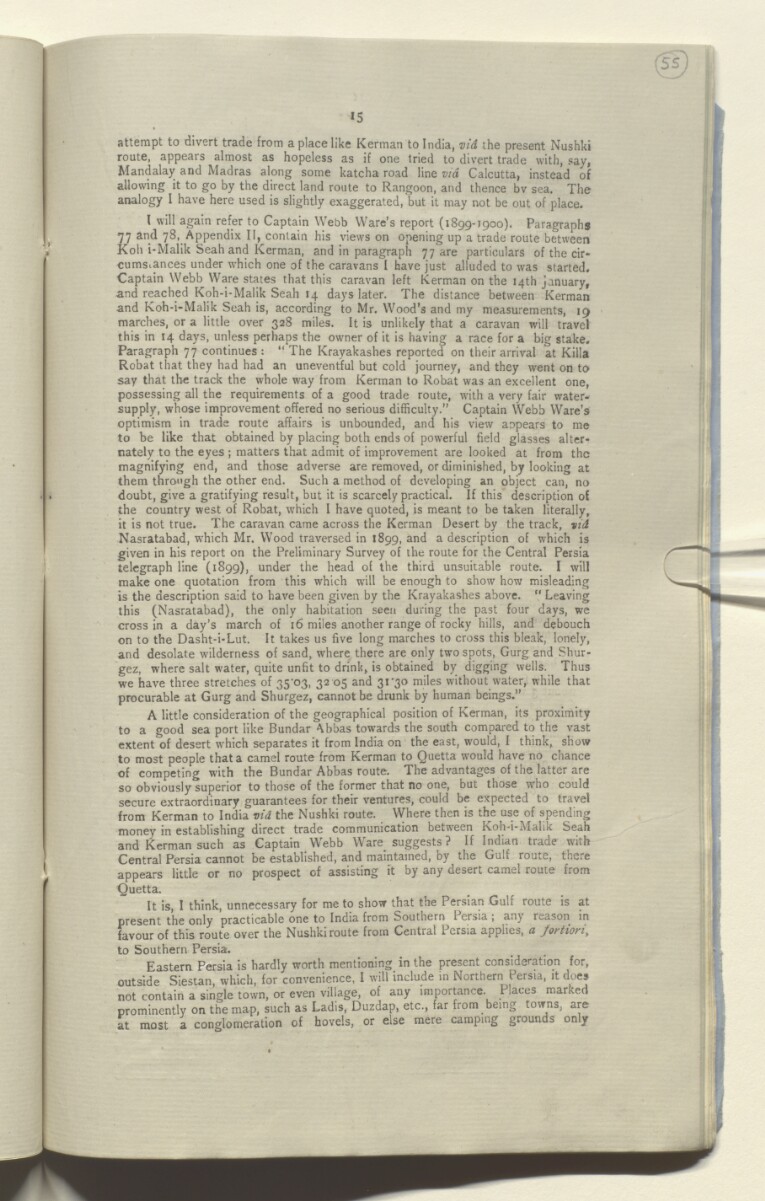
attempt to divert trade from a place like Kerman to India, vid the present Nushki
route, appears almost as hopeless as if one tried to divert trade with, say,
Mandalay and Madras along some katcha road line via Calcutta, instead of
allowing it to go by the direct land route to Rangoon, and thence bv sea. The
analogy I have here used is slightly exaggerated, but it may not be out of place.
I will again refer to Captain Webb Ware’s report (1899-1900). Paragraphs
77 and 78, Appendix II, contain his views on opening up a trade route between
Koh i-Malik Seah and Kerman, and in paragraph 77 are particulars of the cir
cumstances under which one of the caravans I have just alluded to was started.
Captain Webb Ware states that this caravan left Kerman on the 14th January,
and reached Koh-i-Malik Seah 14 days later. The distance between Kerman
and Koh-i-Malik Seah is, according to Mr. Wood’s and my measurements, 19
marches, or a little over 328 miles. It is unlikely that a caravan will travel
this in 14 days, unless perhaps the owner of it is having a race for a big stake.
Paragraph 77 continues : “ The Krayakashes reported on their arrival at Killa
Robat that they had had an uneventful but cold journey, and they went on to
say that the track the whole way from Kerman to Robat was an excellent one,
possessing all the requirements of a good trade route, with a very fair water-
supply, whose improvement offered no serious difficulty.” Captain Webb Ware’s
optimism in trade route affairs is unbounded, and his view appears to me
to be like that obtained by placing both ends of powerful field glasses alter
nately to the eyes ; matters that admit of improvement are looked at from the
magnifying end, and those adverse are removed, or diminished, by looking at
them through the other end. Such a method of developing an object can, no
doubt, give a gratifying result, but it is scarcely practical. If this description of
the country west of Robat, which I have quoted, is meant to be taken literally,
it is not true. The caravan came across the Kerman Desert by the track, vid
Nasratabad, which Mr. Wood traversed in 1899, and a description of which is
given in his report on the Preliminary Survey of the route for the Central Persia
telegraph line (1899), under the head of the third unsuitable route. I will
make one quotation from this which wall be enough to show how misleading
is the description said to have been given by the Krayakashes above. “ Leaving
this (Nasratabad), the only habitation seen during the past four days, we
cross in a day’s march of 16 miles another range of rocky hills, and debouch
on to the Dasht-i-Lut. It takes us five long marches to cross this bleak, lonely,
and desolate wilderness of sand, where there are only two spots, Gurg and Shur-
gez, where salt water, quite unfit to drink, is obtained by digging wells. Thus
we have three stretches of 35*03, 32 05 and 31*30 miles without water, while that
procurable at Gurg and Shurgez, cannot be drunk by human beings.”
A little consideration of the geographical position of Kerman, its proximity
to a good sea port like Bundar Abbas towards the south compared to the vast
extent of desert which separates it from India on the east, w r ould, I think, show
to most people that a camel route from Kerman to Quetta w r ould have no chance
of competing with the Bundar Abbas route. The advantages of the latter are
so obviously superior to those of the former that no one, but those who could
secure extraordinary guarantees for their ventures, could be expected to travel
from Kerman to India vid the Nushki route. Where then is the use of spending
money in establishing direct trade communication between Koh-i-Mahk Seah
and Kerman such as Captain VVebb Ware suggests ? If Indian trade with
Central Persia cannot be established, and maintained, by the Gulf route, there
appears little or no prospect of assisting it by any desert camel route from
Quetta.
It is, I think, unnecessary for me to show that the
Persian Gulf
The historical term used to describe the body of water between the Arabian Peninsula and Iran.
roiuc is at
present the only practicable one to India from Southern Persia ; any reason in
favour of this route over the Nushki route from Central I crsia applies, a fortiori,.
to Southern Persia.
Eastern Persia is hardly w'orth mentioning in the present consideration for,
outside Siestan, which, for convenience, I will include in Northern Persia, it does
not contain a single town, or even village, of any importance. Peaces marked
prominently on the map, such as Ladis, Duzdap, etc., far from being towns, are
at most a conglomeration of hovels, or else mere camping grounds on y
About this item
- Content
A report by Mr H A Armstrong, Assistant Superintendent, Indian Telegraph Department. Printed at the Government Central Printing Office, Simla, 1901. The report is a survey of a potential route for extending a telegraph line from India to Persia, running from Quetta to Bam, with an alternative route going to Pahra. The volume contains a description of the routes taken, estimates of cost, and notes on alignment, marking out, location of offices, shelter huts for linestaff, maintenance, water, sand, supplies, climate, and the Quetta-Siestan [Sistan] trade route.
Throughout the report are black and white photographs of the route that accompany the descriptions (folios 26,28, 30, 32, 34, 37, 39, 41, 46, 49, 51, 52, 63, 67, 70, and 71). Folio 23 is a map showing the route taken. Enclosed at the front of the volume is a copy of the 'Convention between The United Kingdom and Persia extending the System of Telegraphic Communication between Europe and India Through Persia', 1902 (folios 2-6), and twelve loose sheets of manuscript notes on the report written by George Curzon (folios 7-18).
- Extent and format
- 1 volume (77 folios)
- Physical characteristics
Foliation: the foliation sequence (used for referencing) commences at the front cover with 1, and terminates at the inside back cover with 79; these numbers are written in pencil, are circled, and are located in the top right corner of the recto The front of a sheet of paper or leaf, often abbreviated to 'r'. side of each folio.
- Written in
- English in Latin script View the complete information for this record
Use and share this item
- Share this item
'Report on the Preliminary Survey of The Route for The Central Persia Telegraph Line from Quetta to Bam and Pahra' [55r] (114/162), British Library: India Office Records and Private Papers, Mss Eur F111/377, in Qatar Digital Library <https://www.qdl.qa/archive/81055/vdc_100075142289.0x000073> [accessed 25 July 2026]
https://www.qdl.qa/en/archive/81055/vdc_100075142289.0x000073
Copy and paste the code below into your web page where you would like to embed the image.
<meta charset="utf-8"><a href="https://www.qdl.qa/en/archive/81055/vdc_100075142289.0x000073">'Report on the Preliminary Survey of The Route for The Central Persia Telegraph Line from Quetta to Bam and Pahra' [‎55r] (114/162)</a> <a href="https://www.qdl.qa/en/archive/81055/vdc_100075142289.0x000073"> <img src="https://iiif.qdl.qa/iiif/images/81055/vdc_100000001491.0x00011e/Mss Eur F111_377_0116.jp2/full/!280,240/0/default.jpg" alt="" /> </a>
This record has a IIIF manifest available as follows. If you have a compatible viewer you can drag the icon to load it.https://www.qdl.qa/en/iiif/81055/vdc_100000001491.0x00011e/manifestOpen in Universal viewerOpen in Mirador viewerMore options for embedding images
Copyright: How to use this content
- Reference
- Mss Eur F111/377
- Title
- 'Report on the Preliminary Survey of The Route for The Central Persia Telegraph Line from Quetta to Bam and Pahra'
- Pages
- front, back, spine, edge, head, tail, front-i, 7r:22v, 24r:25v, 26v:27v, 28v:30r, 31r:32r, 33r:34r, 35r:37r, 38r:39r, 40r:41r, 42r:45v, 46v:48v, 49v:50v, 51v:52r, 53r:63r, 64r:66v, 67v:69v, 70v:71r, 72r:78v, back-i
- Author
- East India Company, the Board of Control, the India Office, or other British Government Department
- Usage terms
- Open Government Licence