
![Correspondence with A J Balfour, Sir R Wingate, Lord Allenby, Lord Milner and others on Egypt [‎3r] (5/300)](https://iiif.qdl.qa/iiif/images/81055/vdc_100000001491.0x000294/Mss Eur F112_259_0005.jp2/full/!1200,1200/0/default.jpg "Correspondence with A J Balfour, Sir R Wingate, Lord Allenby, Lord Milner and others on Egypt [‎3r] (5/300)")
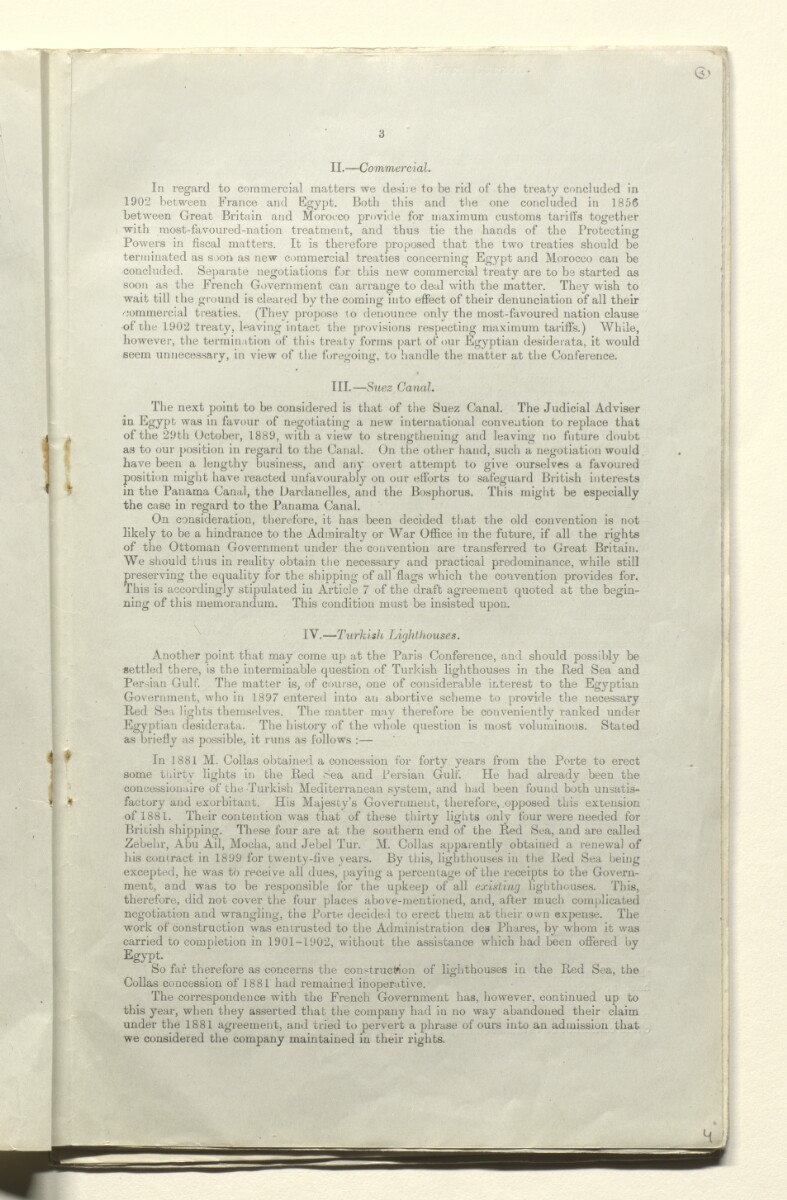
Correspondence with A J Balfour, Sir R Wingate, Lord Allenby, Lord Milner and others on Egypt [3r] (5/300)
The record is made up of 1 file (150 folios). It was created in 12 Dec 1918-13 Mar 1920. It was written in English. The original is part of the British Library: India Office The department of the British Government to which the Government of India reported between 1858 and 1947. The successor to the Court of Directors. Records and Private Papers Documents collected in a private capacity. .
Transcription
This transcription is created automatically. It may contain errors.
3
II. — Commercial.
In regard to commercial matters we desire to be rid of the treaty concluded in
1902 between France and Egypt. Both this and the one concluded in 1856
between Great Britain and Morocco provide for maximum customs tariffs together
with most-favoured-nation treatment, and thus tie the hands of the Protecting
Powers in fiscal matters. It is therefore proposed that the two treaties should be
terminated as soon as new commercial treaties concerning Egypt and Morocco can be
concluded. Separate negotiations for this new commercial treaty are to be started as
soon as the French Government can arrange to deal with the matter. They wish to
wait till the ground is cleared by the coming into effect of their denunciation of all their
commercial treaties. (They propose to denounce only the most-favoured nation clause
of the 1902 treaty, leaving intact the provisions respecting maximum tariffs.) While,
however, the termination of this treaty forms part of our Egyptian desiderata, it would
seem unnecessary, in view of the foregoing, to handle the matter at the Conference.
III. —Suez Canal.
The next point to be considered is that of the Suez Canal. The Judicial Adviser
in Egypt was in favour of negotiating a new international convention to replace that
of the 29th October, 1889, with a view to strengthening and leaving no future doubt
as to our position in regard to the Canal. On the other hand, such a negotiation would
have been a lengthy business, and any overt attempt to give ourselves a favoured
position might have reacted unfavourably on our efforts to safeguard British interests
in the Panama Canal, the Dardanelles, and the Bosphorus. This might be especially
the case in regard to the Panama Canal.
On consideration, therefore, it has been decided that the old convention is not
likely to be a hindrance to the Admiralty or War Office in the future, if all the rights
of the Ottoman Government under the convention are transferred to Great Britain.
We should thus in reality obtain the necessary and practical predominance, while still
preserving the equality for the shipping of all flags which the convention provides for.
This is accordingly stipulated in Article 7 of the draft agreement quoted at the begin-
ning of this memorandum. This condition must be insisted upon.
IV .—Turkish Lighthouses.
Another point that may come up at the Paris Conference, and should possibly be
settled there, is the interminable question of Turkish lighthouses in the Red Sea and
Persian Gulf
The historical term used to describe the body of water between the Arabian Peninsula and Iran.
. The matter is, of course, one of considerable interest to the Egyptian
Government, who in 1897 entered into an abortive scheme to provide the necessary
Red Sea lights themselves. The matter may therefore be conveniently ranked under
Egyptian desiderata. The history of the whole question is most voluminous. Stated
as briefly as possible, it runs as follows :—
In 1881 M. Collas obtained a concession for forty years from the Porte to erect
some thirty lights in the Red Sea and
Persian Gulf
The historical term used to describe the body of water between the Arabian Peninsula and Iran.
. He had already been the
concessionaire of the Turkish Mediterranean system, and had been found both unsatis
factory
An East India Company trading post.
and exorbitant. His Majesty’s Government, therefore, opposed this extension
of 1881. Their contention was that of these thirty lights only four were needed for
British shipping. These four are at the southern end of the Red Sea, and are called
Zebehr, Abu Ail, Mocha, and Jebel Tur. M. Collas apparently obtained a renewal of
his contract in 1899 for twenty-five years. By this, lighthouses in the Red Sea being
excepted, he was to receive all dues, paying a percentage of the receipts to the Govern
ment, and was to be responsible for the upkeep of all existing lighthouses. This,
therefore, did not cover the four places above-mentioned, and, after much complicated
negotiation and wrangling, the Porte decided to erect them at their own expense. The
work of construction was entrusted to the Administration des Phares, by whom it was
carried to completion in 1901-1902, without the assistance which had been offered by
E S>'Pt-
So far therefore as concerns the construction of lighthouses in the Red Sea, the
Collas concession of 1881 had remained inoperative.
The correspondence with the French Government has, however, continued up to
this year, when they asserted that the company had in no way abandoned their claim
under the 1881 agreement, and tried to pervert a phrase of ours into an admission that
we considered the company maintained in their rights.
About this item
- Content
The file contains official and private correspondence, memoranda, and reports relating to political affairs in Egypt. The correspondents and authors are officials at the Foreign Office (Lord Curzon was Secretary of State for Foreign Affairs at the time), War Office, Air Ministry, Admiralty, Colonial Office, Board of Trade, Board of Education, as well as those within the Egyptian civil service.
The papers discuss the situation in Egypt following unrest by nationalists in 1919, including how to respond to the crisis, accounts of events on the ground, and plans to form a special mission to investigate the causes and propose solutions. Several pages of Curzon's manuscript notes are contained in the file.
- Extent and format
- 1 file (150 folios)
- Arrangement
The file is arranged in chronological order, from the front to the rear.
- Physical characteristics
Foliation: the foliation sequence (used for referencing) commences at the first folio with 1, and terminates at the last folio with 150, these numbers are written in pencil, are circled, and are located in the top right corner of the recto The front of a sheet of paper or leaf, often abbreviated to 'r'. side of each folio.
- Written in
- English in Latin script View the complete information for this record
Use and share this item
- Share this item
Correspondence with A J Balfour, Sir R Wingate, Lord Allenby, Lord Milner and others on Egypt [3r] (5/300), British Library: India Office Records and Private Papers, Mss Eur F112/259, in Qatar Digital Library <https://www.qdl.qa/archive/81055/vdc_100075118298.0x000006> [accessed 21 August 2026]
https://www.qdl.qa/en/archive/81055/vdc_100075118298.0x000006
Copy and paste the code below into your web page where you would like to embed the image.
<meta charset="utf-8"><a href="https://www.qdl.qa/en/archive/81055/vdc_100075118298.0x000006">Correspondence with A J Balfour, Sir R Wingate, Lord Allenby, Lord Milner and others on Egypt [‎3r] (5/300)</a> <a href="https://www.qdl.qa/en/archive/81055/vdc_100075118298.0x000006"> <img src="https://iiif.qdl.qa/iiif/images/81055/vdc_100000001491.0x000294/Mss Eur F112_259_0005.jp2/full/!280,240/0/default.jpg" alt="" /> </a>
This record has a IIIF manifest available as follows. If you have a compatible viewer you can drag the icon to load it.https://www.qdl.qa/en/iiif/81055/vdc_100000001491.0x000294/manifestOpen in Universal viewerOpen in Mirador viewerMore options for embedding images
Copyright: How to use this content
- Reference
- Mss Eur F112/259
- Title
- Correspondence with A J Balfour, Sir R Wingate, Lord Allenby, Lord Milner and others on Egypt
- Pages
- 1r:14v, 28r:33v, 54r:54v, 67r:69v, 79v, 84r:85v, 119r:120v, 126r:150v
- Author
- East India Company, the Board of Control, the India Office, or other British Government Department
- Usage terms
- Open Government Licence