
![Letters and Papers Concerning the Trans-Persian Railway and Other Railways in Persia [‎157v] (314/442)](https://iiif.qdl.qa/iiif/images/81055/vdc_100000001491.0x0001bd/Mss Eur F112_252_0318.jp2/full/!1200,1200/0/default.jpg "Letters and Papers Concerning the Trans-Persian Railway and Other Railways in Persia [‎157v] (314/442)")
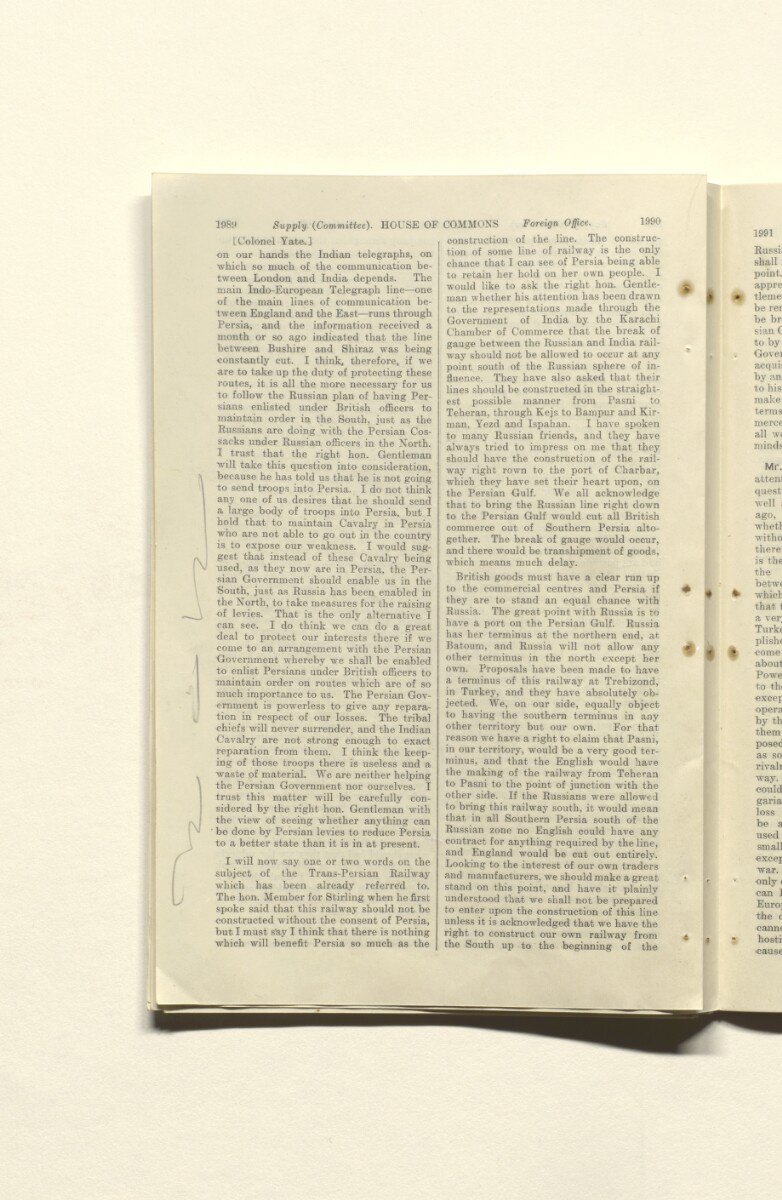
Letters and Papers Concerning the Trans-Persian Railway and Other Railways in Persia [157v] (314/442)
The record is made up of 1 file (221 folios). It was created in Nov 1911-Mar 1917. It was written in English. The original is part of the British Library: India Office The department of the British Government to which the Government of India reported between 1858 and 1947. The successor to the Court of Directors. Records and Private Papers Documents collected in a private capacity. .
Transcription
This transcription is created automatically. It may contain errors.
1989
1990
Supply (Committee). HOUSE OF
[Colonel Yate.]
on our hands the Indian telegraphs, on
which so much of the communication be
tween London and India depends. The
main Indo-European Telegraph line—one
of the main lines of communication be
tween England and the East—runs through
Persia, and the information received a
month or so ago indicated that the line
between Bushire and Shiraz was being
constantly cut. I think, therefore, if we
are to take up the duty of protecting these
routes, it is all the more necessary for us
to follow the Russian plan of having Per
sians enlisted under British officers to
maintain order in the South, just as the
Russians are doing with the Persian Cos
sacks under Russian officers in the North.
I trust that the right hon. Gentleman
will take this question into consideration,
because he has told us that he is not going
1 to send troops into Persia. I do not think
any one of us desires that he should send
a large body of troops into Persia, but I
hold that to maintain Cavalry in Persia
who are not able to go out in the country
is to expose our weakness. I would sug
gest that instead of these Cavalry being
used, as they now are in Persia, the Per
sian Government should enable us in the
South, just as Russia has been enabled in
the North, to take measures for the raising
of levies. That is the only alternative I
can see. I do think we can do a great
deal to protect our interests there if we
come to an arrangement with the Persian
Government whereby we shall be enabled
to enlist Persians under British officers to
maintain order on routes which are of so
much importance to us. The Persian Gov
ernment is powerless to give any repara
tion in respect of our losses. The tribal
chiefs will never surrender, and the Indian
Cavalry are not strong enough to exact
reparation from them. I think the keep
ing of those troops there is useless and a
waste of material. We are neither helping
the Persian Government nor ourselves. I
trust this matter will be carefully con
sidered by the right hon. Gentleman with
the view of seeing whether anything can
be done by Persian levies to reduce Persia
to a better state than it is in at present.
I will now say one or two words on the
subject of the Trans-Persian Railway
which has been already referred to.
The hon. Member for Stirling when he first
spoke said that this railway should not be
constructed without the consent of Persia,
but I must s'ay I think that there is nothing
which will benefit Persia so much as the
COMMONS Foreign Office.
construction of the line. The construc
tion of some line of railway is the only
chance that I can see of Persia being able
to retain her hold on her own people. I
would like to ask the right hon. Gentle
man whether his attention has been drawn
to the representations made through the
Government of India by the Karachi
Chamber of Commerce that the break of
gauge between the Russian and India rail
way should not be allowed to occur at any
point south of the Russian sphere of in
fluence. They have also asked that their
lines should be constructed in the straight-
est possible manner from Pasni to
Teheran, through Kejs to Bam pur and Kir-
man, Yezd and Ispahan. I have spoken
to many Russian friends, and they have
always tried to impress on me that they
should have the construction of the rail
way right rown to the port of Charbar,
which they have set their heart upon, on
the
Persian Gulf
The historical term used to describe the body of water between the Arabian Peninsula and Iran.
. We all acknowledge
that to bring the Russian line right down
to the
Persian Gulf
The historical term used to describe the body of water between the Arabian Peninsula and Iran.
would cut all British
commerce out of Southern Persia alto
gether. The break of gauge would occur,
and there would be transhipment of goods,
which means much delay.
British goods must have a clear run up
to the commercial centres and Persia if
they are to stand an equal chance with
Russia. The great point with Russia is to
have a port on the
Persian Gulf
The historical term used to describe the body of water between the Arabian Peninsula and Iran.
. Russia
has her terminus at the northern end, at
Batoum, and Russia will not allow any
other terminus in the north except her
own. Proposals have been made to have
a terminus of this railway at Trebizond,
in Turkey, and they have absolutely ob
jected. We, on our side, equally object
to having the southern terminus in any
other territory but our own. For that
reason we have a right to claim that Pasni,
in our territory, would be a very good ter
minus, and that the English would have
the making of the railway from Teheran
to Pasni to the point of junction with the
other side. If the Russians were allowed
to bring this railway south, it would mean
that in all Southern Persia south of the
Russian zone no English could have any
contract for anything required by the line,
and England would be cut out entirely.
Looking to the interest of our own traders
and manufacturers, we should make a great
stand on this point, and have it plainly
understood that we shall not be prepared
to enter upon the construction of this line
unless it is acknowledged that we have the
right to construct our own railway from
the South up to the beginning of the
About this item
- Content
The file contains correspondence, memoranda, and other papers relating to railway projects in Persia [Iran] and the surrounding region. The papers deal with the proposals for, planning, and progress of, several railway lines, including one from the Mediterranean to India, the Trans-Persian Railway, the Baghdad Railway, and the Nushki and Dalbandin extension from Quetta. The documents discuss the merits and flaws of the proposals, technical issues such as gauge sizes, and the impact of such projects on Britain's relations with Russia, Germany, France, and Turkey.
At the back of the file are a number of official reports on Parliamentary debates within the House of Commons, dating from 10 July 1912 to 25 May 1914, all of which feature railways (folios 128-218). Also at the rear of the file are three maps:
- General Map of Asia with proposed British, German, and Russian rail lines added by hand
- War Office map of the Middle East, showing railways and railway projects
- As above with further rail lines added and details of gauges given.
Correspondents include: Arthur Campbell Yate, army Officer; Henry McNiel; Francis Richard Maunsell, army officer; George Lloyd, politician; Lieutenant-Colonel Charles à Court Repington, army officer and war correspondent; Lord Robert Offley Ashburton Crewe-Milnes, Leader of the House of Lords; Henry Charles Keith Petty-Fitzmaurice (Lord Lansdowne), statesman; Lucien Wolf, journalist and historian; Charles Staniforth, businessman and railway investor; Charles Prestwich Scott, Editor of the Manchester Guardian; Hugh Shakespear Barnes, Director, Imperial Bank of Persia; and Colonel Frank Cooke Webb Ware, former Political Agent A mid-ranking political representative (equivalent to a Consul) from the diplomatic corps of the Government of India or one of its subordinate provincial governments, in charge of a Political Agency. , Chagai.
- Extent and format
- 1 file (221 folios)
- Arrangement
The file is arranged in chronological order from the front to the rear.
- Physical characteristics
Foliation: the foliation sequence (used for referencing) commences at the first folio with 1, and terminates at the last folio with 221; these numbers are written in pencil, are circled, and are located in the top right corner of the recto The front of a sheet of paper or leaf, often abbreviated to 'r'. side of each folio.
- Written in
- English in Latin script View the complete information for this record
Use and share this item
- Share this item
Letters and Papers Concerning the Trans-Persian Railway and Other Railways in Persia [157v] (314/442), British Library: India Office Records and Private Papers, Mss Eur F112/252, in Qatar Digital Library <https://www.qdl.qa/archive/81055/vdc_100075113116.0x000073> [accessed 25 June 2026]
https://www.qdl.qa/en/archive/81055/vdc_100075113116.0x000073
Copy and paste the code below into your web page where you would like to embed the image.
<meta charset="utf-8"><a href="https://www.qdl.qa/en/archive/81055/vdc_100075113116.0x000073">Letters and Papers Concerning the Trans-Persian Railway and Other Railways in Persia [‎157v] (314/442)</a> <a href="https://www.qdl.qa/en/archive/81055/vdc_100075113116.0x000073"> <img src="https://iiif.qdl.qa/iiif/images/81055/vdc_100000001491.0x0001bd/Mss Eur F112_252_0318.jp2/full/!280,240/0/default.jpg" alt="" /> </a>
This record has a IIIF manifest available as follows. If you have a compatible viewer you can drag the icon to load it.https://www.qdl.qa/en/iiif/81055/vdc_100000001491.0x0001bd/manifestOpen in Universal viewerOpen in Mirador viewerMore options for embedding images
Copyright: How to use this content
- Reference
- Mss Eur F112/252
- Title
- Letters and Papers Concerning the Trans-Persian Railway and Other Railways in Persia
- Pages
- 87r:90v, 95r:221v
- Author
- East India Company, the Board of Control, the India Office, or other British Government Department
- Usage terms
- Open Government Licence