
![Papers of the Interdepartmental Conference on Middle Eastern Affairs [‎125r] (249/290)](https://iiif.qdl.qa/iiif/images/81055/vdc_100000001491.0x0002a9/Mss Eur F112_275_0249.jp2/full/!1200,1200/0/default.jpg "Papers of the Interdepartmental Conference on Middle Eastern Affairs [‎125r] (249/290)")
Papers of the Interdepartmental Conference on Middle Eastern Affairs [125r] (249/290)
The record is made up of 1 file (145 folios). It was created in 7 Jan 1919-7 Dec 1920. It was written in English. The original is part of the British Library: India Office The department of the British Government to which the Government of India reported between 1858 and 1947. The successor to the Court of Directors. Records and Private Papers Documents collected in a private capacity. .
Transcription
This transcription is created automatically. It may contain errors.
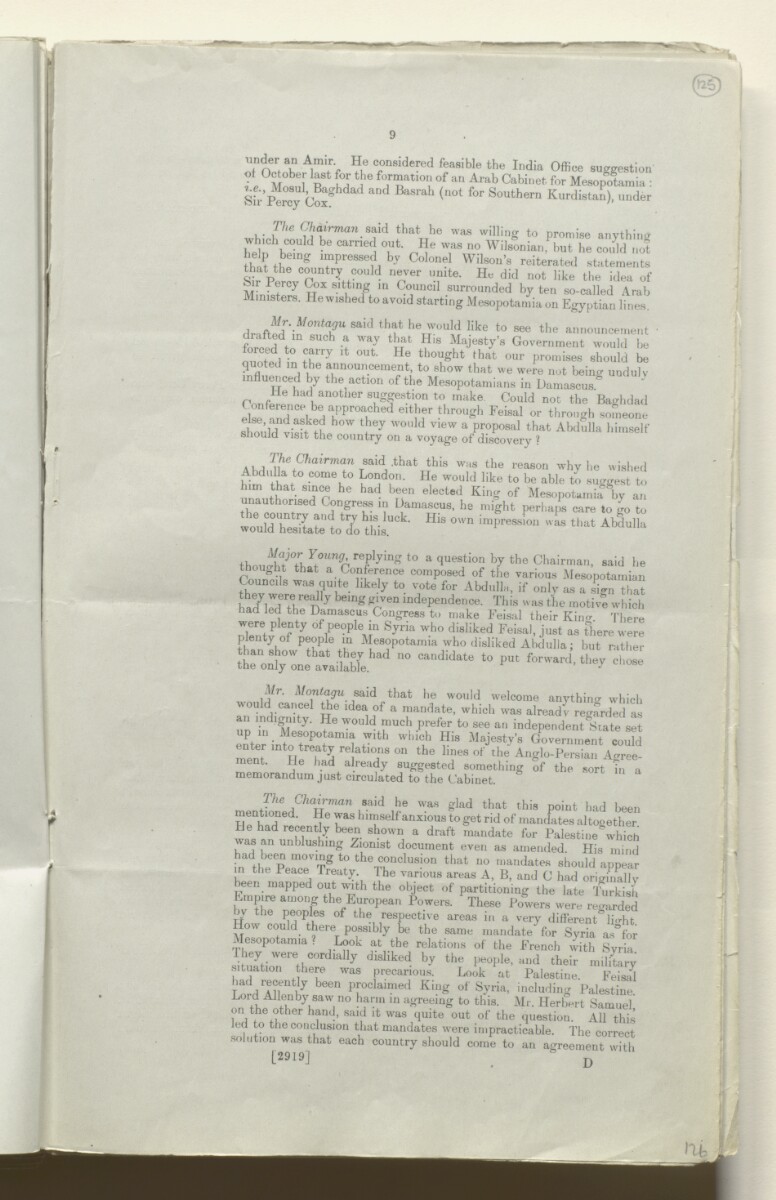
9
under an Amir. He considered feasible the
India Office
The department of the British Government to which the Government of India reported between 1858 and 1947. The successor to the Court of Directors.
suggestion
fe Mosul R M l 16 f T p atl0, ‘°/ aI ‘ f rab Cabinet ' for Mesopotamia :
sfr Percy Cox" ^ (n0t f ° r Southern Kurdistan), under
wh.VWo M a v! Vman -T d tbat T , he was willin g t0 Promise anything
which could be carried out. He was no Wilsonian, but he could not
help being impressed by Colonel Wilson’s reiterated statements
Sir Pelr ^ 00 '’ n n er “i 11 * 6 - He diJ n0t like the i(1 oa of
Ministlr{ TT Slt i*' n i g i ln 9° llnci1 surrounded by ten so-called Arab
Ministers. Hewished to avoid starting Mesopotamia on Egyptian lines.
Mr. Montagu said that he would like to see the announcement
forced d t m S -f "7 1 ! bs Majesty’s Government would be
ouoteMn tk 1 ' 7 ° U H ! thou g ht that °u r promises should be
quoted in the announcement, to show that we were not being unduly
influenced by the action of the Mesopotamians in Damascus
PnnflT 6 had anotlier suggestion to make. Could not the Baghdad
Conference be approached either through Feisal or through someone
shmiffi'vith h ° W ^ W °" ld V ‘ eW a Proposal that Abdulla himself
should visit the country on a voyage of discovery ?
* r i 7 e f C7lairm “” T Said - that this w ’«s the reason why he wished
Abdulla to come to London. He would like to be able to suggest to
him that since he had been elected King of Mesopotamia by an
unautlionsed Congress in Damascus, he might perhaps care to go to
H “ ■“
thoulTtJr^r re P lym g t0 a question by the Chairman, said he
( ,3 k, 1 a ., Co “ feren f composed of the various Mesopotamian
Councils was quite likely to vote for Abdulla, if only as a .sign that
had Dd^thTn 7 mg *7 eD mde P eudence - This was the motive which
had led the Damascus Congress to make Feisal their King. There
were plenty of people in Syria who disliked Feisal, just as there were
plenty of people in Mesopotamia who disliked Abdulla; but rather
an show that they had no candidate to put forward, they chose
the only one available. ^
-J/r. Montagu said that he would welcome anything which
would cancel the idea of a mandate, which was already- regarded as
an indignity. He would much prefer to see an independentlState set
^terinfoTrLlrir 411 " 7 Government coidd
ment He h»d T ° n 6 f" ° r the An g l0 -Persian Agree-
nent. He had already suggested something of the sort in a
memorandum just circulated to the Cabinet.
The Chairman said he was glad that this point had been
mentioned. He was himself anxious to get rid of mandates altogether
He had lecently been shown a draft mandate for Palestine' which
was an unblushing Zionist document even as amended. His mind
ffiHmPeace'rfe^ the “ ,lclusion that no mandates should appear
in the Peace Treaty 1 he various areas A, B, and 0 had oriffinallv
been mapped out with the object of partitioning the late Turkish
Empire among the European Powers. These Powers were regarded
bv the peoples of the respective areas in a very different"li.ffit
How could there possibly be the same mandate for Syria as for
Mesopotamia ' ,. L ? 1 ok at the relations of the French with Syria
sEuLoTh 7 <JlSliked by the P e °P le ’ '"’J their military
situation there was precarious. Look at Palestine. Feisal
had recently been proclaimed King of Syria, including Palestine
Loid Allenby saw no harm in agreeing to this. Mr. Herbert Samuel
oil the other hand, said it was quite out of the question. AH this
led to the conclusion that mandates were impracticable. The correct
solution was that each country should come to an agreement with
[2919] D
About this item
- Content
This file is composed of papers produced by the Foreign Office's Interdepartmental Conference on Middle Eastern Affairs. It consists entirely of printed minutes of meetings of the conference, most of which are chaired by George Curzon.
Those attending include senior representatives of the Foreign Office, the India Office The department of the British Government to which the Government of India reported between 1858 and 1947. The successor to the Court of Directors. (most notably the Secretary of State for India), the War Office, the Admiralty, the Air Ministry, and the Treasury (including the Chancellor of the Exchequer). Other notable figures attending include Harry St John Bridger Philby and Gertrude Margaret Lowthian Bell.
The meetings concern British policy in the Middle East, and mainly cover the following geographical areas: Mesopotamia, Kurdistan, Trans-Caspia, Trans-Caucasia, the Caspian Sea, Palestine, Persia, Hejaz, and Afghanistan. Some of the meetings also touch on matters beyond the Middle East (e.g. wireless telegraphy in Tibet, ff 79-80).
Recurring topics of discussion include railways (chiefly in relation to Mesopotamia), Bolshevik influence in the Middle East (particularly in Persia and Trans-Caspia), and relations between King Hussein [Ḥusayn bin ‘Alī al-Hāshimī] and Ibn Saud [‘Abd al-‘Azīz bin ‘Abd al-Raḥmān bin Fayṣal Āl Sa‘ūd].
Several sets of minutes also contain related memoranda as appendices.
- Extent and format
- 1 file (145 folios)
- Arrangement
The papers are arranged in approximate chronological order from the front to the rear of the file.
- Physical characteristics
Foliation: the foliation sequence (used for referencing) commences at the first folio with 1, and terminates at the last folio with 145, these numbers are written in pencil, are circled, and are located in the top right corner of the recto The front of a sheet of paper or leaf, often abbreviated to 'r'. side of each folio.
- Written in
- English in Latin script View the complete information for this record
Use and share this item
- Share this item
Papers of the Interdepartmental Conference on Middle Eastern Affairs [125r] (249/290), British Library: India Office Records and Private Papers, Mss Eur F112/275, in Qatar Digital Library <https://www.qdl.qa/archive/81055/vdc_100070539236.0x000032> [accessed 9 June 2026]
https://www.qdl.qa/en/archive/81055/vdc_100070539236.0x000032
Copy and paste the code below into your web page where you would like to embed the image.
<meta charset="utf-8"><a href="https://www.qdl.qa/en/archive/81055/vdc_100070539236.0x000032">Papers of the Interdepartmental Conference on Middle Eastern Affairs [‎125r] (249/290)</a> <a href="https://www.qdl.qa/en/archive/81055/vdc_100070539236.0x000032"> <img src="https://iiif.qdl.qa/iiif/images/81055/vdc_100000001491.0x0002a9/Mss Eur F112_275_0249.jp2/full/!280,240/0/default.jpg" alt="" /> </a>
This record has a IIIF manifest available as follows. If you have a compatible viewer you can drag the icon to load it.https://www.qdl.qa/en/iiif/81055/vdc_100000001491.0x0002a9/manifestOpen in Universal viewerOpen in Mirador viewerMore options for embedding images
Copyright: How to use this content
- Reference
- Mss Eur F112/275
- Title
- Papers of the Interdepartmental Conference on Middle Eastern Affairs
- Pages
- front, front-i, 2r:144v, back-i, back
- Author
- East India Company, the Board of Control, the India Office, or other British Government Department
- Usage terms
- Open Government Licence