
![Papers of the Interdepartmental Conference on Middle Eastern Affairs [‎115r] (229/290)](https://iiif.qdl.qa/iiif/images/81055/vdc_100000001491.0x0002a9/Mss Eur F112_275_0229.jp2/full/!1200,1200/0/default.jpg "Papers of the Interdepartmental Conference on Middle Eastern Affairs [‎115r] (229/290)")
Papers of the Interdepartmental Conference on Middle Eastern Affairs [115r] (229/290)
The record is made up of 1 file (145 folios). It was created in 7 Jan 1919-7 Dec 1920. It was written in English. The original is part of the British Library: India Office The department of the British Government to which the Government of India reported between 1858 and 1947. The successor to the Court of Directors. Records and Private Papers Documents collected in a private capacity. .
Transcription
This transcription is created automatically. It may contain errors.
HW
3
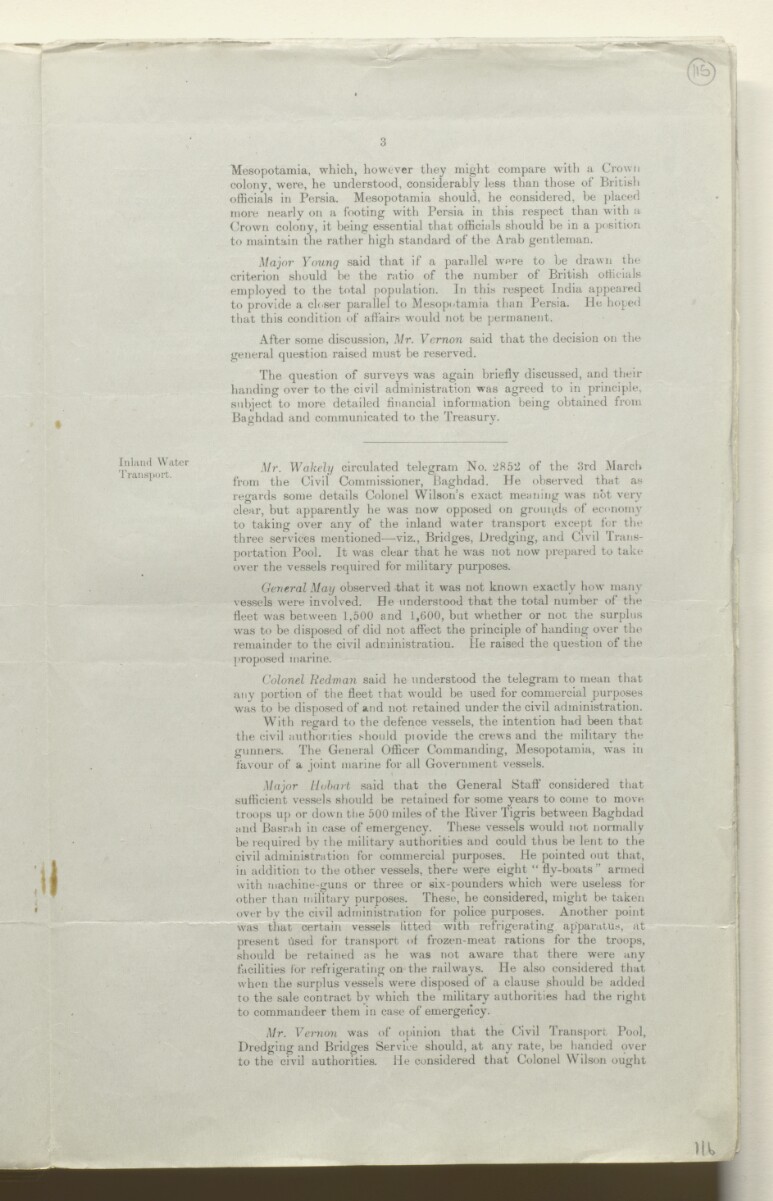
Mesopotamia, which, however they might compare with a Crown
colony, were, he understood, considerably less than those of British
officials in Persia. Mesopotamia should, he considered, he placed
more nearly on a footing with Persia in this respect than with a
Crown colony, it being essential that officials should he in a position
to maintain the rather high standard of the Arab gentleman.
Major Young said that if a parallel were to be drawn the
criterion should be the ratio of the number of British officials
employed to the total population. In this respect India appeared
to provide a closer parallel to Mesopotamia than Persia. He hoped
that this condition of affairs would not be permanent.
After some discussion, Mr. Vcrno7i said that the decision on the
general question raised must be reserved.
The question of surveys was again briefly discussed, and their
handing over to the civil administration was agreed to in principle,
subject to more detailed financial information being obtained from
Baghdad and communicated to the Treasury.
Inland Water
Transport.
Mr. Wakely circulated telegram No. 2852 of the 3rd March
from the Civil Commissioner, Baghdad. He observed that as
regards some details Colonel Wilsons exact meaning was not very
clear, but apparently he was now opposed on grounds of economy
to taking over any of the inland water transport except for the
three services mentioned—viz., Bridges, Dredging, and Civil Trans
portation Pool. It was clear that he w'as not now prepared to take
over the vessels required for military purposes.
General May observed that it was not known exactly how many
vessels were involved. He understood that the total number of the
fleet was between 1,500 and 1,600, but whether or not the surplus
was to be disposed of did not affect the principle of handing over the
remainder to the civil administration. He raised the question of the
proposed marine.
Colonel Redman said he understood the telegram to mean that
any portion of the fleet that would be used for commercial purposes
was to be disposed of and not retained under the civil administration.
With regard to the defence vessels, the intention had been that
the civil authorities should piovide the crews and the military the
gunners. The General Officer Commanding, Mesopotamia, was in
favour of a joint marine for all Government vessels.
Major Hobart said that the General Staff considered that
sufficient vessels should be retained for some years to come to move
troops up or down the 500 miles of the Itiver Tigris between Baghdad
and Basrah in case of emergency. These vessels would not normally
be required by the military authorities and could thus be lent to the
civil administration for commercial purposes. He pointed out that,
in addition to the other vessels, there were eight “ fly-boats " armed
with machine-guns or three or six-pounders which were useless for
other than military purposes. These, he considered, might be taken
over by the civil administration for police purposes. Another point
was that certain vessels fitted with refrigerating apparatus, at
present used for transport of frozen-meat rations for the troops,
should be retained as he was not aware that there were any
facilities for refrigerating on the railways. He also considered that
when the surplus vessels were disposed of a clause should be added
to the sale contract by which the military authorities had the right
to commandeer them in case of emergency.
Mr. Vernon was of opinion that the Civil Transport Pool,
Dredging and Bridges Service should, at any rate, be handed over
to the civil authorities. He considered that Colonel Wilson ought
About this item
- Content
This file is composed of papers produced by the Foreign Office's Interdepartmental Conference on Middle Eastern Affairs. It consists entirely of printed minutes of meetings of the conference, most of which are chaired by George Curzon.
Those attending include senior representatives of the Foreign Office, the India Office The department of the British Government to which the Government of India reported between 1858 and 1947. The successor to the Court of Directors. (most notably the Secretary of State for India), the War Office, the Admiralty, the Air Ministry, and the Treasury (including the Chancellor of the Exchequer). Other notable figures attending include Harry St John Bridger Philby and Gertrude Margaret Lowthian Bell.
The meetings concern British policy in the Middle East, and mainly cover the following geographical areas: Mesopotamia, Kurdistan, Trans-Caspia, Trans-Caucasia, the Caspian Sea, Palestine, Persia, Hejaz, and Afghanistan. Some of the meetings also touch on matters beyond the Middle East (e.g. wireless telegraphy in Tibet, ff 79-80).
Recurring topics of discussion include railways (chiefly in relation to Mesopotamia), Bolshevik influence in the Middle East (particularly in Persia and Trans-Caspia), and relations between King Hussein [Ḥusayn bin ‘Alī al-Hāshimī] and Ibn Saud [‘Abd al-‘Azīz bin ‘Abd al-Raḥmān bin Fayṣal Āl Sa‘ūd].
Several sets of minutes also contain related memoranda as appendices.
- Extent and format
- 1 file (145 folios)
- Arrangement
The papers are arranged in approximate chronological order from the front to the rear of the file.
- Physical characteristics
Foliation: the foliation sequence (used for referencing) commences at the first folio with 1, and terminates at the last folio with 145, these numbers are written in pencil, are circled, and are located in the top right corner of the recto The front of a sheet of paper or leaf, often abbreviated to 'r'. side of each folio.
- Written in
- English in Latin script View the complete information for this record
Use and share this item
- Share this item
Papers of the Interdepartmental Conference on Middle Eastern Affairs [115r] (229/290), British Library: India Office Records and Private Papers, Mss Eur F112/275, in Qatar Digital Library <https://www.qdl.qa/archive/81055/vdc_100070539236.0x00001e> [accessed 12 August 2026]
https://www.qdl.qa/en/archive/81055/vdc_100070539236.0x00001e
Copy and paste the code below into your web page where you would like to embed the image.
<meta charset="utf-8"><a href="https://www.qdl.qa/en/archive/81055/vdc_100070539236.0x00001e">Papers of the Interdepartmental Conference on Middle Eastern Affairs [‎115r] (229/290)</a> <a href="https://www.qdl.qa/en/archive/81055/vdc_100070539236.0x00001e"> <img src="https://iiif.qdl.qa/iiif/images/81055/vdc_100000001491.0x0002a9/Mss Eur F112_275_0229.jp2/full/!280,240/0/default.jpg" alt="" /> </a>
This record has a IIIF manifest available as follows. If you have a compatible viewer you can drag the icon to load it.https://www.qdl.qa/en/iiif/81055/vdc_100000001491.0x0002a9/manifestOpen in Universal viewerOpen in Mirador viewerMore options for embedding images
Copyright: How to use this content
- Reference
- Mss Eur F112/275
- Title
- Papers of the Interdepartmental Conference on Middle Eastern Affairs
- Pages
- front, front-i, 2r:144v, back-i, back
- Author
- East India Company, the Board of Control, the India Office, or other British Government Department
- Usage terms
- Open Government Licence