
![Papers of the Interdepartmental Conference on Middle Eastern Affairs [‎77v] (154/290)](https://iiif.qdl.qa/iiif/images/81055/vdc_100000001491.0x0002a9/Mss Eur F112_275_0154.jp2/full/!1200,1200/0/default.jpg "Papers of the Interdepartmental Conference on Middle Eastern Affairs [‎77v] (154/290)")
Papers of the Interdepartmental Conference on Middle Eastern Affairs [77v] (154/290)
The record is made up of 1 file (145 folios). It was created in 7 Jan 1919-7 Dec 1920. It was written in English. The original is part of the British Library: India Office The department of the British Government to which the Government of India reported between 1858 and 1947. The successor to the Court of Directors. Records and Private Papers Documents collected in a private capacity. .
Transcription
This transcription is created automatically. It may contain errors.
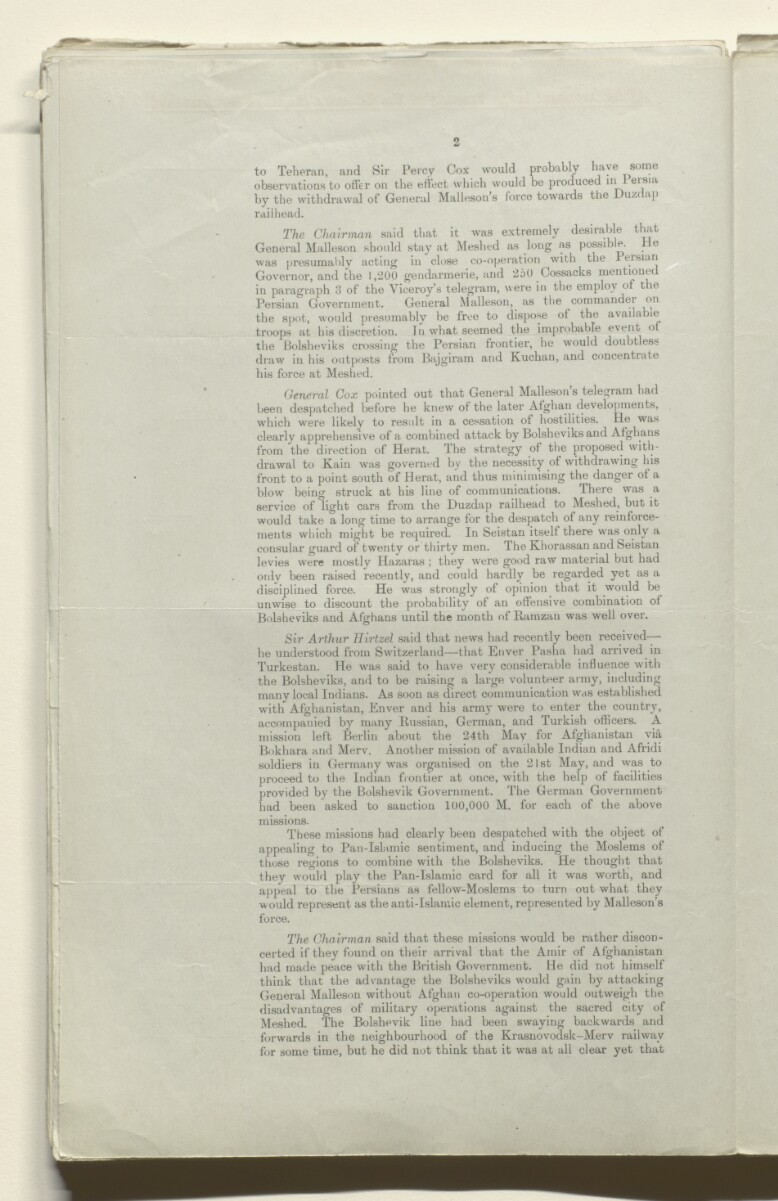
2
to Teheran, and Sir Percy Cox would probably have some
observations to offer on tbe effect which would be produced m eisia
by the withdrawal of General Mallesons force towards the 1 u/( ap
railhead.
The Chairman said that it was extremely desirable that
General Malleson should stay at Meshed as long as possible. He
was presumably acting in close co-operation with the Persian
Governor, and the 1,200 gendarmerie, and 250 Cossacks mentioned
in paragraph 3 of the Viceroy’s telegram, were in the employ of the
Persian Government. General Malleson, as the commander on
the spot, would presumably be free to dispose of the available
troops at his discretion. In what seemed the improbable event of
the Bolsheviks crossing the Persian frontier, he would doubtless
draw in his outposts from Bajgiram and Kuchan, and concentrate
his force at Meshed.
General Cox pointed out that General Malleson’s telegram had
been despatched before he knew of the later Afghan developments,
which were likely to result in a cessation of hostilities. He was
clearly apprehensive of a combined attack by Bolsheviks and Afghans
from the direction of Herat. The strategy of the proposed with
drawal to Kain was governed by the necessity of withdrawing his
front to a point south of Herat, and thus minimising the danger of a
blow being struck at his line of communications. There was a
service of light cars from the Uuzdap railhead to Meshed, but it
would take a long time to arrange for the despatch of any reinforce
ments which might be required. In Seistan itself there was only a
consular guard of twenty or thirty men. The Khorassan and Seistan
levies were mostly Hazaras ; they were good raw material but had
only been raised recently, and could hardly be regarded yet as a
disciplined force. He was strongly of opinion that it would be
unwise to discount the probability of an offensive combination of
Bolsheviks and Afghans until the month of Bamzan was well over.
Sir Arthur Eirtzel said that news had recently been received—
be understood from Switzerland—that Enver
Pasha
An Ottoman title used after the names of certain provincial governors, high-ranking officials and military commanders.
had arrived in
Turkestan. He was said to have very considerable influence with
the Bolsheviks, and to be raising a large volunteer army, including
many local Indians. As soon as direct communication was established
with Afghanistan, Enver and his arm)' were to enter the country,
accompanied by many Russian, German, and Turkish officers. A
mission left Berlin about the 24th May for Afghanistan via
Bokhara and Merv. Another mission of available Indian and Afridi
soldiers in Germany was organised on the 21 st May, and was to
proceed to the Indian frontier at once, with the help of facilities
provided by the Bolshevik Government. The German Government
had been asked to sanction 100,000 M. for each of the above
missions.
These missions had clearly been despatched with the object of
appealing to Pan-Islamic sentiment, and inducing the Moslems of
those regions to combine with the Bolsheviks. He thought that
they would play the Pan-Islamic card for all it was worth, and
appeal to the Persians as fellow-Moslems to turn out what they
would represent as the anti-Islamic element, represented by Malleson’s
force.
The Chairman said that these missions would be rather discon
certed if they found on their arrival that the Amir of Afghanistan
had made peace with the British Government. He did not himself
think that the advantage the Bolsheviks would gain by attacking
General Malleson without Afghan co-operation would outweigh the
disadvantages of military operations against the sacred city of
Meshed. The Bolshevik line had been swaying backwards and
forwards in the neighbourhood of the Krasnovodsk-Merv railway
for some time, but he did not think that it was at all clear yet that
About this item
- Content
This file is composed of papers produced by the Foreign Office's Interdepartmental Conference on Middle Eastern Affairs. It consists entirely of printed minutes of meetings of the conference, most of which are chaired by George Curzon.
Those attending include senior representatives of the Foreign Office, the India Office The department of the British Government to which the Government of India reported between 1858 and 1947. The successor to the Court of Directors. (most notably the Secretary of State for India), the War Office, the Admiralty, the Air Ministry, and the Treasury (including the Chancellor of the Exchequer). Other notable figures attending include Harry St John Bridger Philby and Gertrude Margaret Lowthian Bell.
The meetings concern British policy in the Middle East, and mainly cover the following geographical areas: Mesopotamia, Kurdistan, Trans-Caspia, Trans-Caucasia, the Caspian Sea, Palestine, Persia, Hejaz, and Afghanistan. Some of the meetings also touch on matters beyond the Middle East (e.g. wireless telegraphy in Tibet, ff 79-80).
Recurring topics of discussion include railways (chiefly in relation to Mesopotamia), Bolshevik influence in the Middle East (particularly in Persia and Trans-Caspia), and relations between King Hussein [Ḥusayn bin ‘Alī al-Hāshimī] and Ibn Saud [‘Abd al-‘Azīz bin ‘Abd al-Raḥmān bin Fayṣal Āl Sa‘ūd].
Several sets of minutes also contain related memoranda as appendices.
- Extent and format
- 1 file (145 folios)
- Arrangement
The papers are arranged in approximate chronological order from the front to the rear of the file.
- Physical characteristics
Foliation: the foliation sequence (used for referencing) commences at the first folio with 1, and terminates at the last folio with 145, these numbers are written in pencil, are circled, and are located in the top right corner of the recto The front of a sheet of paper or leaf, often abbreviated to 'r'. side of each folio.
- Written in
- English in Latin script View the complete information for this record
Use and share this item
- Share this item
Papers of the Interdepartmental Conference on Middle Eastern Affairs [77v] (154/290), British Library: India Office Records and Private Papers, Mss Eur F112/275, in Qatar Digital Library <https://www.qdl.qa/archive/81055/vdc_100070539234.0x00009b> [accessed 12 August 2026]
https://www.qdl.qa/en/archive/81055/vdc_100070539234.0x00009b
Copy and paste the code below into your web page where you would like to embed the image.
<meta charset="utf-8"><a href="https://www.qdl.qa/en/archive/81055/vdc_100070539234.0x00009b">Papers of the Interdepartmental Conference on Middle Eastern Affairs [‎77v] (154/290)</a> <a href="https://www.qdl.qa/en/archive/81055/vdc_100070539234.0x00009b"> <img src="https://iiif.qdl.qa/iiif/images/81055/vdc_100000001491.0x0002a9/Mss Eur F112_275_0154.jp2/full/!280,240/0/default.jpg" alt="" /> </a>
This record has a IIIF manifest available as follows. If you have a compatible viewer you can drag the icon to load it.https://www.qdl.qa/en/iiif/81055/vdc_100000001491.0x0002a9/manifestOpen in Universal viewerOpen in Mirador viewerMore options for embedding images
Copyright: How to use this content
- Reference
- Mss Eur F112/275
- Title
- Papers of the Interdepartmental Conference on Middle Eastern Affairs
- Pages
- front, front-i, 2r:144v, back-i, back
- Author
- East India Company, the Board of Control, the India Office, or other British Government Department
- Usage terms
- Open Government Licence