
![Papers of the Interdepartmental Conference on Middle Eastern Affairs [‎30v] (60/290)](https://iiif.qdl.qa/iiif/images/81055/vdc_100000001491.0x0002a9/Mss Eur F112_275_0060.jp2/full/!1200,1200/0/default.jpg "Papers of the Interdepartmental Conference on Middle Eastern Affairs [‎30v] (60/290)")
Papers of the Interdepartmental Conference on Middle Eastern Affairs [30v] (60/290)
The record is made up of 1 file (145 folios). It was created in 7 Jan 1919-7 Dec 1920. It was written in English. The original is part of the British Library: India Office The department of the British Government to which the Government of India reported between 1858 and 1947. The successor to the Court of Directors. Records and Private Papers Documents collected in a private capacity. .
Transcription
This transcription is created automatically. It may contain errors.
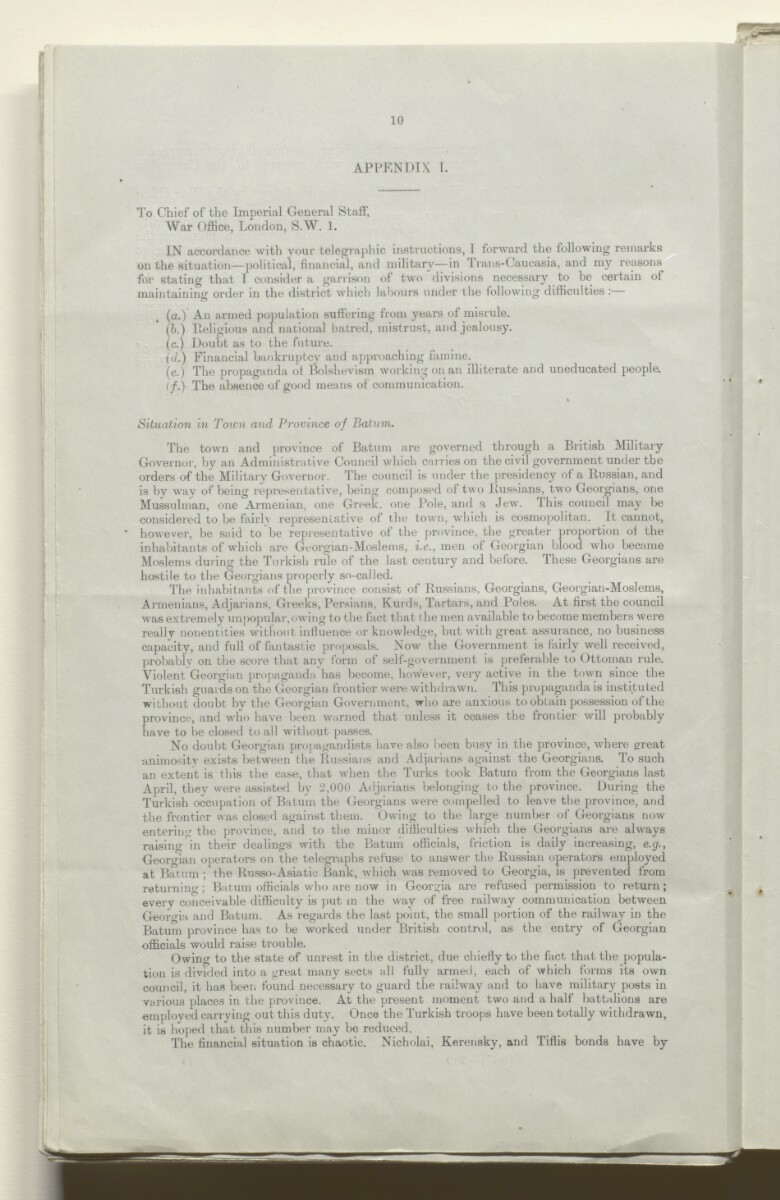
10
APPENDIX t.
To Chief of the Imperial General Staff,
War Office, London, S.W. 1.
IN accordance with vour telegraphic instructions, I forward the following remarks
on the situation—political, financial, and military—in Iraus-Caucasia, and my reasons
for stating that 1 consider a garrison of two divisions necessary to be certain of
maintaining order in the district which labours under the following difficulties :
(a.) An armed population suffering from years of misrule.
(6.) Religious and national hatred, mistrust, and jealousy.
(c.) Doubt as to the future.
(d) Financial bankruptcy and approaching famine.
(e.) The propaganda of Bolshevism working on an illiterate and uneducated people.
(/.) The absence of good means of communication.
Situation in Town and Province of Batum.
The town and province of Batum are governed through a British Military
Governor, by an Administrative Council which carries on the civil government under the
orders of the Military Governor. The council is under the
presidency
The name given to each of the three divisions of the territory of the East India Company, and later the British Raj, on the Indian subcontinent.
of a Russian, and
is by way of being representative, being composed of two Russians, two Georgians, one
Mussulman, one Armenian, one Greek, one Pole, and a Jew\ this council may be
considered to be fairly representative of the town, which is cosmopolitan. It cannot,
however, be siud to be representative of the province, the greater proportion of the
inhabitants of which are Georgian-Moslems, i.e., men of Georgian blood who became
Moslems during the Turkish rule of the last century and before. These Georgians are
hostile to the Georgians properly so-called.
The inhabitants of the province consist of Russians, Georgians, Georgian-Moslems,
Armenians, Adjarians, Greeks, Persians, Kurds, Tartars, and Poles. At first the council
was extremely unpopular, owing to the fact that the men available to become members were
really nonentities without influence or knowledge, but with great assurance, no business
capacity, and full of fantastic proposals. Now the Government is fairly well received,
probably on the score that any form of self-government is preferable to Ottoman rule.
Violent Georgian propaganda has become, however, very active in the town since the
Turkish guards on the Georgian frontier were withdrawn. This propaganda is instituted
without doubt by the Georgian Government, who are anxious to obtain possession of the
province, and who have been warned that unless it ceases the frontier will probably
have to be closed to all without passes.
No doubt Georgian propagandists have also been busy in the province, where jjreat
animosity exists between the Russians and Adjarians against the Georgians. To such
an extent is this the case, that when the Turks took Batum from the Georgians last
April, they were assisted by 2,000 Adjarians belonging to the province. During the
Turkish occupation of Batum the Georgians were compelled to leave the province, and
the frontier was closed against them. Owing to the large number of Georgians now
enterimr the province, and to the minor difficulties which the Georgians are always
raising in their dealings with the Batum officials, friction is daily increasing, e.p.,
Georgian operators on the telegraphs refuse to answer the Russian operators employed
at Batum ; the Russo-Asiatic Bank, which was removed to Georgia, is prevented from
returning; Batum officials who are now in Georgia are refused permission to return;
every conceivable difficulty is put in the way of free railway communication between
Georgia and Batum. As regards the last point, the small portion of the railway in the
Batum province has to be worked under British control, as the entry of Georgian
officials would raise trouble.
Owing to the state of unrest in the district, due chiefly to the fact that the popula
tion is divided into a great many sects all fully armed, each of which forms its own
council, it has been found necessary to guard the railway and to have military posts in
various places in the province. At the present moment two and a half battalions are
employed carrying out this duty. Once the Turkish troops have been totally withdrawn,
it is hoped that this number may be reduced.
The financial situation is chaotic. Nicholai, Kerensky, and Tifiis bonds have by
About this item
- Content
This file is composed of papers produced by the Foreign Office's Interdepartmental Conference on Middle Eastern Affairs. It consists entirely of printed minutes of meetings of the conference, most of which are chaired by George Curzon.
Those attending include senior representatives of the Foreign Office, the India Office The department of the British Government to which the Government of India reported between 1858 and 1947. The successor to the Court of Directors. (most notably the Secretary of State for India), the War Office, the Admiralty, the Air Ministry, and the Treasury (including the Chancellor of the Exchequer). Other notable figures attending include Harry St John Bridger Philby and Gertrude Margaret Lowthian Bell.
The meetings concern British policy in the Middle East, and mainly cover the following geographical areas: Mesopotamia, Kurdistan, Trans-Caspia, Trans-Caucasia, the Caspian Sea, Palestine, Persia, Hejaz, and Afghanistan. Some of the meetings also touch on matters beyond the Middle East (e.g. wireless telegraphy in Tibet, ff 79-80).
Recurring topics of discussion include railways (chiefly in relation to Mesopotamia), Bolshevik influence in the Middle East (particularly in Persia and Trans-Caspia), and relations between King Hussein [Ḥusayn bin ‘Alī al-Hāshimī] and Ibn Saud [‘Abd al-‘Azīz bin ‘Abd al-Raḥmān bin Fayṣal Āl Sa‘ūd].
Several sets of minutes also contain related memoranda as appendices.
- Extent and format
- 1 file (145 folios)
- Arrangement
The papers are arranged in approximate chronological order from the front to the rear of the file.
- Physical characteristics
Foliation: the foliation sequence (used for referencing) commences at the first folio with 1, and terminates at the last folio with 145, these numbers are written in pencil, are circled, and are located in the top right corner of the recto The front of a sheet of paper or leaf, often abbreviated to 'r'. side of each folio.
- Written in
- English in Latin script View the complete information for this record
Use and share this item
- Share this item
Papers of the Interdepartmental Conference on Middle Eastern Affairs [30v] (60/290), British Library: India Office Records and Private Papers, Mss Eur F112/275, in Qatar Digital Library <https://www.qdl.qa/archive/81055/vdc_100070539234.0x00003d> [accessed 10 June 2026]
https://www.qdl.qa/en/archive/81055/vdc_100070539234.0x00003d
Copy and paste the code below into your web page where you would like to embed the image.
<meta charset="utf-8"><a href="https://www.qdl.qa/en/archive/81055/vdc_100070539234.0x00003d">Papers of the Interdepartmental Conference on Middle Eastern Affairs [‎30v] (60/290)</a> <a href="https://www.qdl.qa/en/archive/81055/vdc_100070539234.0x00003d"> <img src="https://iiif.qdl.qa/iiif/images/81055/vdc_100000001491.0x0002a9/Mss Eur F112_275_0060.jp2/full/!280,240/0/default.jpg" alt="" /> </a>
This record has a IIIF manifest available as follows. If you have a compatible viewer you can drag the icon to load it.https://www.qdl.qa/en/iiif/81055/vdc_100000001491.0x0002a9/manifestOpen in Universal viewerOpen in Mirador viewerMore options for embedding images
Copyright: How to use this content
- Reference
- Mss Eur F112/275
- Title
- Papers of the Interdepartmental Conference on Middle Eastern Affairs
- Pages
- front, front-i, 2r:144v, back-i, back
- Author
- East India Company, the Board of Control, the India Office, or other British Government Department
- Usage terms
- Open Government Licence