
![Papers of the Interdepartmental Conference on Middle Eastern Affairs [‎18v] (36/290)](https://iiif.qdl.qa/iiif/images/81055/vdc_100000001491.0x0002a9/Mss Eur F112_275_0036.jp2/full/!1200,1200/0/default.jpg "Papers of the Interdepartmental Conference on Middle Eastern Affairs [‎18v] (36/290)")
Papers of the Interdepartmental Conference on Middle Eastern Affairs [18v] (36/290)
The record is made up of 1 file (145 folios). It was created in 7 Jan 1919-7 Dec 1920. It was written in English. The original is part of the British Library: India Office The department of the British Government to which the Government of India reported between 1858 and 1947. The successor to the Court of Directors. Records and Private Papers Documents collected in a private capacity. .
Transcription
This transcription is created automatically. It may contain errors.
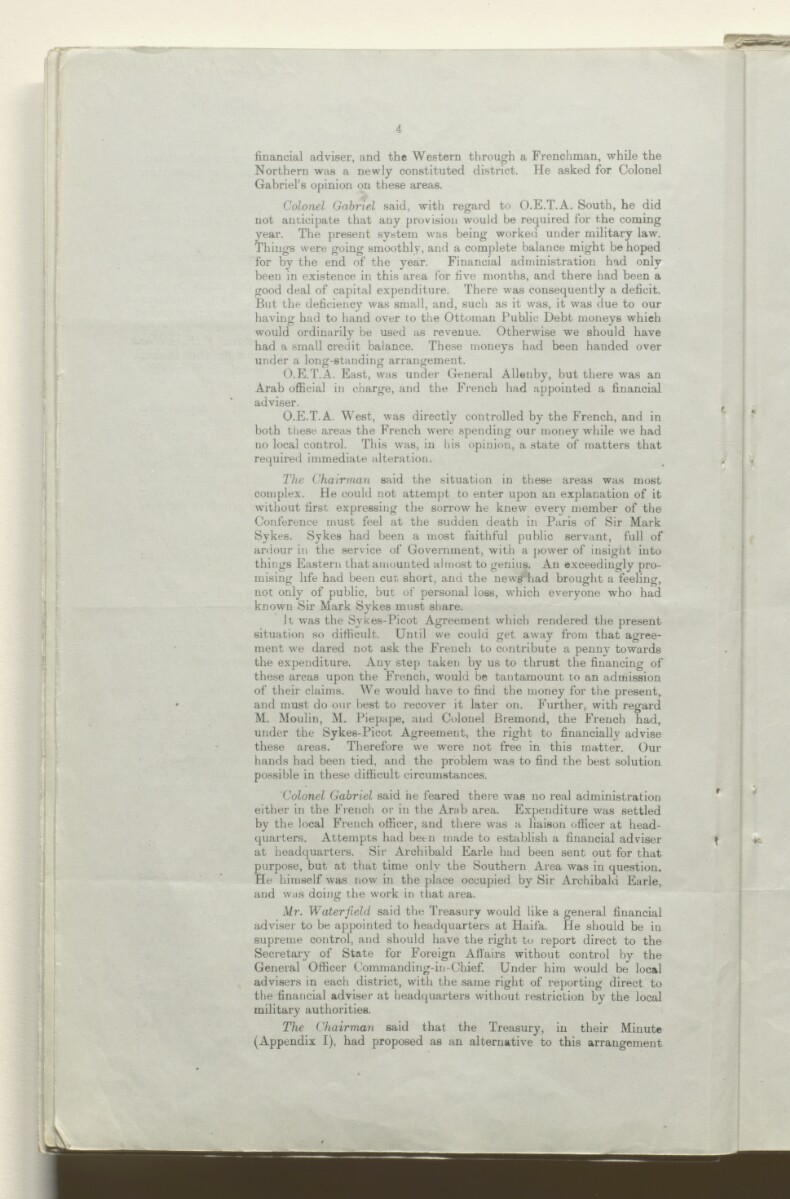
4
financial adviser, and the Western through a Frenchman, while the
Northern was a newly constituted district. He asked for Colonel
Gabriel’s opinion on these areas.
Colonel Gabriel said, with regard to O.E.T.A. South, he did
not anticipate that any provision would be required for the coming
year. The present system was being worked under military law.
Things were going smoothly, and a complete balance might be hoped
for by the end of the year. Financial administration had only
been in existence in this area for five months, and there had been a
good deal of capital expenditure. There was consequently a deficit.
But the deficiency was small, and, such as it was, it was due to our
having had to hand over to the Ottoman Public Debt moneys which
would ordinarily be used as revenue. Otherwise we should have
had a small credit balance. These moneys had been handed over
under a long-standing arrangement.
O.E.T.A. East, was under General Allenby, but there was an
Arab official in charge, and the French had appointed a financial
adviser.
O.E.T.A. West, was directly controlled by the French, and in
both these areas the French were spending our money while we had
no local control. This was, in his opinion, a state of matters that
required immediate jiI teration.
The Chairman said the situation in these areas was most
complex. He could not attempt to enter upon an explanation of it
without first expressing the sorrow he knew every member of the
Conference must feel at the sudden death in Paris of Sir Mark
Sykes. Sykes had been a most faithful public servant, full of
ardour in the service of Government, with a power of insight into
things Eastern that amounted almost to genius. An exceedingly pro
mising life had been cut short, and the news had brought a feeling,
not only of public, but of personal loss, which everyone who had
known Sir Mark Sykes must share.
It was the Sykes-Picot Agreement which rendered the present
situation so difficult. Until we could get away from that agree
ment we dared not ask the French to contribute a penny towards
the expenditure. Any step taken by us to thrust the financing of
these areas upon the French, would be tantamount to an admission
of their claims. We would have to find the money for the present,
and must do our best to recover it later on. Further, with regard
M. Moulin, M. Piepape, and Colonel Bremond, the French had,
under the Sykes-Picot Agreement, the right to financially advise
these areas. Therefore we were not free in this matter. Our
hands had been tied, and the problem was to find the best solution
possible in these difficult circumstances.
Colonel Gabriel said he feared there was no real administration
either in the French or in the Arab area. Expenditure was settled
by the local French officer, and there was a liaison officer at head
quarters. Attempts had been made to establish a financial adviser
at headquarters. Sir Archibald Earle had been sent out for that
purpose, but at that time only the Southern Area was in question.
He himself was now in the place occupied by Sir Archibald Earle,
and was doing the work in that area.
Mr. Water field said the Treasury would like a general financial
adviser to be appointed to headquarters at Haifa. He should be in
supreme control, and should have the right to report direct to the
Secretary of State for Foreign Affairs without control by the
General Officer Commanding-in-Chief. Under him would be local
advisers in each district, with the same right of reporting direct to
the financial adviser at headquarters without restriction by the local
military authorities.
The Chairman said that the Treasury, in their Minute
(Appendix I), had proposed as an alternative to this arrangement
About this item
- Content
This file is composed of papers produced by the Foreign Office's Interdepartmental Conference on Middle Eastern Affairs. It consists entirely of printed minutes of meetings of the conference, most of which are chaired by George Curzon.
Those attending include senior representatives of the Foreign Office, the India Office The department of the British Government to which the Government of India reported between 1858 and 1947. The successor to the Court of Directors. (most notably the Secretary of State for India), the War Office, the Admiralty, the Air Ministry, and the Treasury (including the Chancellor of the Exchequer). Other notable figures attending include Harry St John Bridger Philby and Gertrude Margaret Lowthian Bell.
The meetings concern British policy in the Middle East, and mainly cover the following geographical areas: Mesopotamia, Kurdistan, Trans-Caspia, Trans-Caucasia, the Caspian Sea, Palestine, Persia, Hejaz, and Afghanistan. Some of the meetings also touch on matters beyond the Middle East (e.g. wireless telegraphy in Tibet, ff 79-80).
Recurring topics of discussion include railways (chiefly in relation to Mesopotamia), Bolshevik influence in the Middle East (particularly in Persia and Trans-Caspia), and relations between King Hussein [Ḥusayn bin ‘Alī al-Hāshimī] and Ibn Saud [‘Abd al-‘Azīz bin ‘Abd al-Raḥmān bin Fayṣal Āl Sa‘ūd].
Several sets of minutes also contain related memoranda as appendices.
- Extent and format
- 1 file (145 folios)
- Arrangement
The papers are arranged in approximate chronological order from the front to the rear of the file.
- Physical characteristics
Foliation: the foliation sequence (used for referencing) commences at the first folio with 1, and terminates at the last folio with 145, these numbers are written in pencil, are circled, and are located in the top right corner of the recto The front of a sheet of paper or leaf, often abbreviated to 'r'. side of each folio.
- Written in
- English in Latin script View the complete information for this record
Use and share this item
- Share this item
Papers of the Interdepartmental Conference on Middle Eastern Affairs [18v] (36/290), British Library: India Office Records and Private Papers, Mss Eur F112/275, in Qatar Digital Library <https://www.qdl.qa/archive/81055/vdc_100070539234.0x000025> [accessed 4 July 2026]
https://www.qdl.qa/en/archive/81055/vdc_100070539234.0x000025
Copy and paste the code below into your web page where you would like to embed the image.
<meta charset="utf-8"><a href="https://www.qdl.qa/en/archive/81055/vdc_100070539234.0x000025">Papers of the Interdepartmental Conference on Middle Eastern Affairs [‎18v] (36/290)</a> <a href="https://www.qdl.qa/en/archive/81055/vdc_100070539234.0x000025"> <img src="https://iiif.qdl.qa/iiif/images/81055/vdc_100000001491.0x0002a9/Mss Eur F112_275_0036.jp2/full/!280,240/0/default.jpg" alt="" /> </a>
This record has a IIIF manifest available as follows. If you have a compatible viewer you can drag the icon to load it.https://www.qdl.qa/en/iiif/81055/vdc_100000001491.0x0002a9/manifestOpen in Universal viewerOpen in Mirador viewerMore options for embedding images
Copyright: How to use this content
- Reference
- Mss Eur F112/275
- Title
- Papers of the Interdepartmental Conference on Middle Eastern Affairs
- Pages
- front, front-i, 2r:144v, back-i, back
- Author
- East India Company, the Board of Control, the India Office, or other British Government Department
- Usage terms
- Open Government Licence