
![Papers of the War Cabinet's Eastern Committee [‎235r] (469/544)](https://iiif.qdl.qa/iiif/images/81055/vdc_100000001491.0x0002a8/Mss Eur F112_274_0469.jp2/full/!1200,1200/0/default.jpg "Papers of the War Cabinet's Eastern Committee [‎235r] (469/544)")
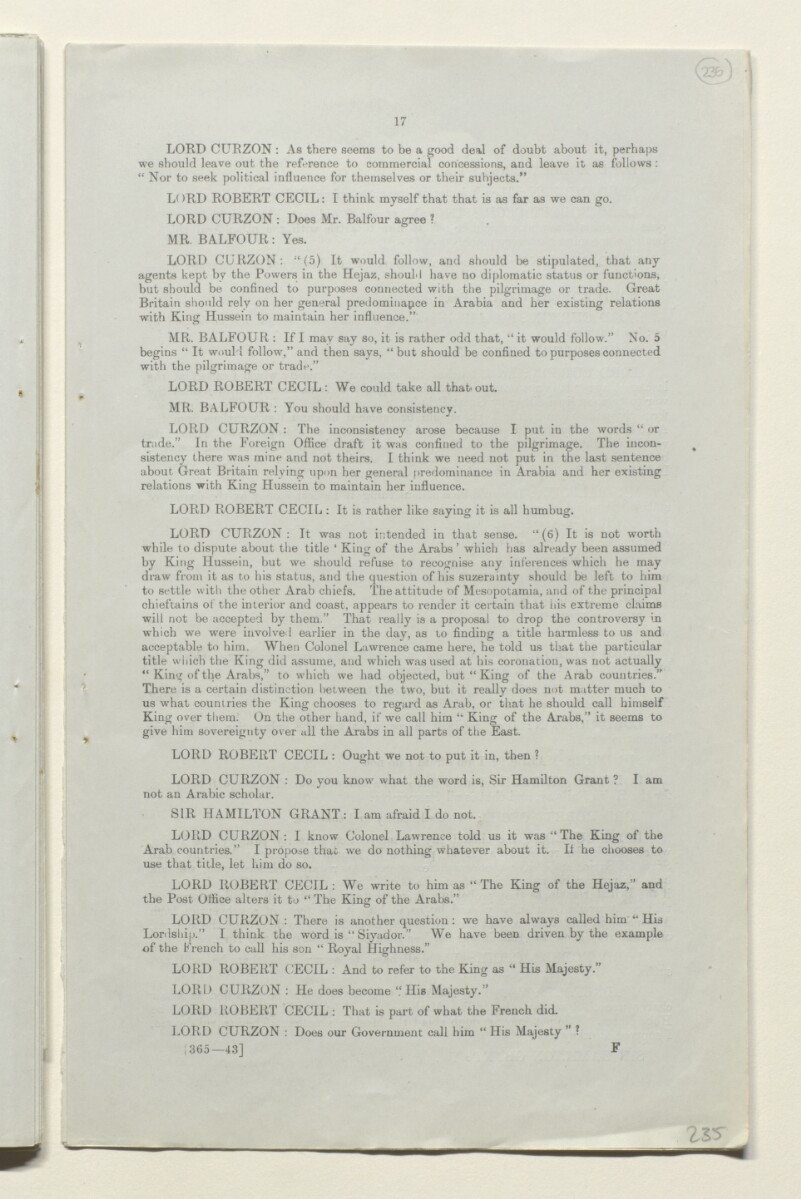
Papers of the War Cabinet's Eastern Committee [235r] (469/544)
The record is made up of 1 file (272 folios). It was created in 13 Mar 1918-7 Jan 1919. It was written in English. The original is part of the British Library: India Office The department of the British Government to which the Government of India reported between 1858 and 1947. The successor to the Court of Directors. Records and Private Papers Documents collected in a private capacity. .
Transcription
This transcription is created automatically. It may contain errors.
LOUD CURZON : As there seems to be a good deal of doubt about it, perhaps
we should leave out the reference to commercial concessions, and leave it as follows :
“ Nor to seek political influence for themselves or their subjects.*’
L( )RD ROBERT CECIL: I think myself that that is as far as we can go.
LORD CURZON : Does Mr. Balfour agree ?
MR. BALFOUR: Yes.
LORD CURZON: (5) It would follow, and should be stipulated, that any
agents kept by the Powers in the Hejaz, shouM have no diplomatic status or functions,
but should be confined to purposes connected with the pilgrimage or trade. Great
Britain should rely on her general predominapce in Arabia and her existing relations
with King Hussein to maintain her influence.”
MR. BALFOUR : If I may say so, it is rather odd that, “ it would follow.” No. 5
begins “ It would follow,” and then says, “ but should be confined to purposes connected
with the pilgrimage or trade.”
LORD ROBERT CECIL: We could take all that-out.
MR. BALFOUR : You should have consistency.
LORD CURZON: The inconsistency arose because I put in the words “ or
trade.” In the Foreign Office draft it was confined to the pilgrimage. The incon
sistency there was mine and not theirs. I think we need not put in the last sentence
about Great Britain relying upon her general predominance in Arabia and her existing
relations with King Hussein to maintain her influence.
LORD ROBERT CECIL : It is rather like saying it is all humbug.
LORD CURZON : It was not intended in that sense. “(6) It is not worth
while to dispute about the title ‘ King of the Arabs ’ which has already been assumed
by King Hussein, but we should refuse to recognise any inferences which he may
draw from it as to his status, and the question of his suzerainty should be left to him
to settle with the other Arab chiefs. The attitude of Mesopotamia, and of the principal
chieftains of the interior and coast, appears to render it certain that his extreme claims
will not be accepted by them.” That really is a proposal to drop the controversy in
w’hich we were involve ! earlier in the day, as to finding a title harmless to us and
acceptable to him. When Colonel Lawrence came here, he told us that the particular
title which the King did assume, and which was used at his coronation, was not actually
“ King of the Arabs,” to which we had objected, but “ King of the Arab countries.”
There is a certain distinction between the two, but it really does not matter much to
us what countries the King chooses to regard as Arab, or that he should call himself
King over them. On the other hand, if we call him “ King of the Arabs,” it seems to
give him sovereignty over all the Arabs in all parts of the East.
LORD ROBERT CECIL : Ought we not to put it in, then ?
LORD CURZON : Do you know what the word is, Sir Hamilton Grant ? I am
not an Arabic scholar.
SIR HAMILTON GRANT: I am afraid I do not.
LORD CURZON : I know Colonel Lawrence told us it was “The King of the
Arab countries.” I propose that we do nothing whatever about it. II he chooses to
use that title, let him do so.
LORD ROBERT CECIL : We write to him as “ The King of the Hejaz,” and
the Post Office alters it to “ The King of the Arabs.”
LORD CURZON : There is another question : we have always called him * l His
Lordship.” I think the word is “ Siyador.” We have been driven by the example
of the French to call his son “ Royal Highness.”
LORD ROBERT CECIL : And to refer to the King as “ His Majesty.”
LORD CURZON : He does become “His Majesty.”
LORD ROBERT CECIL : That is part of what the French did.
LORD CURZON : Does our Government call him “ His Majesty ” ?
1365—43]
F
About this item
- Content
This file is composed of papers produced by the War Cabinet's Eastern Committee, which was chaired by George Curzon for most of its existence. The file contains a complete set of printed minutes, beginning with the committee's first meeting on 28 March 1918, and concluding with its final meeting on 7 January 1919 (ff 6-214 and ff 227-272).
The file begins with two copies of a memorandum by Curzon, dated 13 March 1918, proposing the formation of the Eastern Committee. This is followed by a memorandum by Arthur James Balfour, Secretary of State for Foreign Affairs, approving Curzon's proposal, and a copy of a procedure for the newly created committee, outlining arrangements for committee meetings and the dissemination of information to committee members.
Also included is a set of resolutions, passed by the committee in December 1918, in order to guide British representatives at the Paris Peace conference (ff 216-225). The resolutions cover the following: the Caucasus and Armenia; Syria; Palestine; Hejaz and Arabia; Mesopotamia, Mosul, Baghdad and Basra. They are preceded by a handwritten note written by Curzon 'some years later', which remarks on how they are a 'rather remarkable forecast of the bulk of the results since obtained.'
- Extent and format
- 1 file (272 folios)
- Arrangement
The papers are arranged in approximate chronological order from the front to the rear of the file.
- Physical characteristics
Foliation: the foliation sequence (used for referencing) commences at the first folio with 1, and terminates at the last folio with 272; these numbers are written in pencil, are circled, and are located in the top right corner of the recto The front of a sheet of paper or leaf, often abbreviated to 'r'. side of each folio.
- Written in
- English in Latin script View the complete information for this record
Use and share this item
- Share this item
Papers of the War Cabinet's Eastern Committee [235r] (469/544), British Library: India Office Records and Private Papers, Mss Eur F112/274, in Qatar Digital Library <https://www.qdl.qa/archive/81055/vdc_100069672679.0x000046> [accessed 20 June 2026]
https://www.qdl.qa/en/archive/81055/vdc_100069672679.0x000046
Copy and paste the code below into your web page where you would like to embed the image.
<meta charset="utf-8"><a href="https://www.qdl.qa/en/archive/81055/vdc_100069672679.0x000046">Papers of the War Cabinet's Eastern Committee [‎235r] (469/544)</a> <a href="https://www.qdl.qa/en/archive/81055/vdc_100069672679.0x000046"> <img src="https://iiif.qdl.qa/iiif/images/81055/vdc_100000001491.0x0002a8/Mss Eur F112_274_0469.jp2/full/!280,240/0/default.jpg" alt="" /> </a>
This record has a IIIF manifest available as follows. If you have a compatible viewer you can drag the icon to load it.https://www.qdl.qa/en/iiif/81055/vdc_100000001491.0x0002a8/manifestOpen in Universal viewerOpen in Mirador viewerMore options for embedding images
Copyright: How to use this content
- Reference
- Mss Eur F112/274
- Title
- Papers of the War Cabinet's Eastern Committee
- Pages
- 1r:214v, 216r:272v
- Author
- East India Company, the Board of Control, the India Office, or other British Government Department
- Usage terms
- Open Government Licence