
![File 53/1915 Part IV 'German War: Turkey; Caliphate etc' [‎235r] (466/481)](https://iiif.qdl.qa/iiif/images/81055/vdc_100000000419.0x0001a4/IOR_L_PS_10_525_0475.jp2/full/!1200,1200/0/default.jpg "File 53/1915 Part IV 'German War: Turkey; Caliphate etc' [‎235r] (466/481)")
File 53/1915 Part IV 'German War: Turkey; Caliphate etc' [235r] (466/481)
The record is made up of 1 item (242 folios). It was created in 1915-1916. It was written in English. The original is part of the British Library: India Office The department of the British Government to which the Government of India reported between 1858 and 1947. The successor to the Court of Directors. Records and Private Papers Documents collected in a private capacity. .
Transcription
This transcription is created automatically. It may contain errors.
An
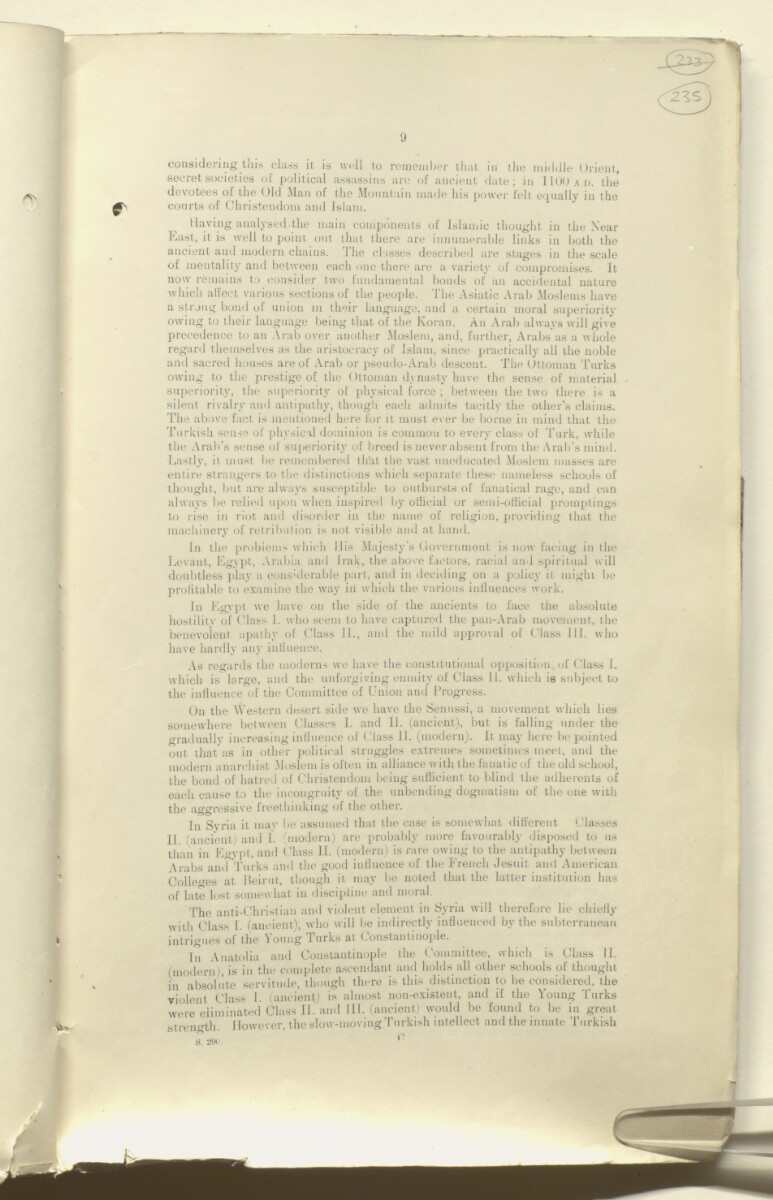
considering this class it is well to remember that in the middle Orient,
secret societies o! political assassins are of ancient date; in 1100 ad. the
devotees of the Old Man of the Mountain made his power felt equally in the
courts of Christendom and Islam.
Having analysed-the main components of Islamic thought in the Near
Last, it is well to point out that there are innumerable links in both the
ancient and modern chains. The classes described are stages in the scale
of mentality and between each one there are a variety of compromises. It
now remains to consider two fundamental bonds of an accidental nature
which affect various sections of the people. The Asiatic Arab Moslems have
a strong bond of union m their language, and a certain moral superiority
owing to their language being that of the Koran. An Arab always will give
precedence to an Arab over another Moslem, and, further, Arabs as a whole
regard themselves as the aristocracy of Islam, since practically all the noble
and sacred houses are of Arab or pseudo-Arab descent. The Ottoman Turks
owing to the prestige of the Ottoman dynasty have the sense of material
superiority, the superiority of physical force ; between the two there is a
silent rivalry and antipathy, though each admits tacitly the other’s claims.
The above fact is mentioned here for it must ever be borne in mind that the
Turkish sense of physical dominion is common to every class of Turk, while
the Arab’s sense of superiority of breed is never absent from the Arab’s mind.
Lastly, it must be remembered that the vast uneducated Moslem masses are
entire strangers to the distinctions which separate these nameless schools of
thought, but are always susceptible to outbursts of fanatical rage, and can
always be relied upon when inspired by official or semi-official promptings
to rise in riot and disorder in the name of religion, providing that the
machinery of retribution is not visible and at hand.
In the problems which His Majesty’s Government is now facing in the
Levant
A geographical area corresponding to the region around the eastern Mediterranean Sea.
, Egypt, Arabia and Irak, the above factors, racial and spiritual will
doubtless play a cons'durable part, and in deciding on a policy it might be
profitable to examine the way in which the various influences work.
In Egypt we have on the side of the ancients to face the absolute
hostility of Class 1. who seem to have captured the pan-Arab movement, the
benevolent apathy of Class II., and the mild approval of Class III. who
have hardly any influence.
As regards the moderns we have the constitutional opposition of Class I.
which is large, and the unforgiving enmity of Class 11. which is subject to
the influence of tiie Committee of Union and Progress.
On the Western desert side we have the Senussi, a movement which lies
somewhere between Classes 1. and 11. (ancient), but is falling under the
gradually increasing influence of Class 11. (modern). It may here be pointed
out that"as in other political struggles extremes sometimes meet, and the
modern anarchist Moslem is often in alliance with the fanatic of the old school,
the bond of hatred of Christendom being sufficient to blind the adherents of
each cause to the incongruity of the unbending dogmatism of the one with
the aggressive freethiliking of the other.
In Svria it may be assumed that the case is somewhat different Classes
II. I'ancient) and I. (modern) are probably more favourably disposed to us
than in Egypt, and Class II. (modern) is rare owing to the antipathy between
Arabs and Turks and the good influence of the French Jesuit and American
Colleges at Beirut, though it may be noted that the latter institution has
of late lost somewhat in discipline and moral.
The anti-Christian and violent element in Syria will therefore lie chiefly'
with Class I. (ancient), who will be indirectly influenced by the subterranean
intrigues of the \oung lurks at Constantinople.
In
Anatolia
Peninsula that forms most of modern-day Turkey.
and Constantinople the Committee, which is Class II.
(modern), is in the complete ascendant and holds all other schools of thought
m absolute servitude, though there is this distinction to be considered, the
violent Class I. (ancient) is almost non-existent, and if the Young Turks
u-e eliminated Class II. and 111. (ancient) would be found to be in great
•ength. I lowever, the slow-moving Turkish intellect and the innate Turkish
c,
zzs
we
sti
S. 290.
About this item
- Content
Part 4 consists of correspondence relating to the possible declaration of a caliphate in Arabia and is a continuation of part 3 (IOR/L/PS/10/525/1). The papers tell of the British assessment of the situation and the French attitude, as well as correspondence and negotiations with Ḥusayn bin ‘Alī al-Hāshimī, the Grand Sharif of Mecca. The file also discusses the British view of the proposed blockade of the Arabian ports in the Red Sea.
The file also includes a printed document (ff 25-242) marked 'secret' entitled 'Policy in the Middle East', which consists mainly of communications on the military situation in Mespotamia from Lieutenant-Colonel Sir Mark Sykes to the Director of Military Information.
The discussion over such matters is mostly between Sir Arthur Henry McMahon, the General Officer Commanding, Egypt, and the Commander-in-Chief, India.
- Extent and format
- 1 item (242 folios)
- Arrangement
The papers are arranged in approximate chronological order from the rear to the front.
- Written in
- English in Latin script View the complete information for this record
Use and share this item
- Share this item
File 53/1915 Part IV 'German War: Turkey; Caliphate etc' [235r] (466/481), British Library: India Office Records and Private Papers, IOR/L/PS/10/525/2, in Qatar Digital Library <https://www.qdl.qa/archive/81055/vdc_100054091590.0x00004c> [accessed 19 July 2026]
https://www.qdl.qa/en/archive/81055/vdc_100054091590.0x00004c
Copy and paste the code below into your web page where you would like to embed the image.
<meta charset="utf-8"><a href="https://www.qdl.qa/en/archive/81055/vdc_100054091590.0x00004c">File 53/1915 Part IV 'German War: Turkey; Caliphate etc' [‎235r] (466/481)</a> <a href="https://www.qdl.qa/en/archive/81055/vdc_100054091590.0x00004c"> <img src="https://iiif.qdl.qa/iiif/images/81055/vdc_100000000419.0x0001a4/IOR_L_PS_10_525_0475.jp2/full/!280,240/0/default.jpg" alt="" /> </a>
This record has a IIIF manifest available as follows. If you have a compatible viewer you can drag the icon to load it.https://www.qdl.qa/en/iiif/81055/vdc_100000000419.0x0001a4/manifestOpen in Universal viewerOpen in Mirador viewerMore options for embedding images
Copyright: How to use this content
- Reference
- IOR/L/PS/10/525/2
- Title
- File 53/1915 Part IV 'German War: Turkey; Caliphate etc'
- Pages
- 3r:14v, 15ar, 15r:65v, 72r:78v, 80v:125v, 129r:129v, 131r:172v, 179r:184v, 188r:188v, 190r:196r, 198r:203r, 204v:242v
- Author
- East India Company, the Board of Control, the India Office, or other British Government Department
- Usage terms
- Open Government Licence