
![File 53/1915 Part IV 'German War: Turkey; Caliphate etc' [‎234r] (464/481)](https://iiif.qdl.qa/iiif/images/81055/vdc_100000000419.0x0001a4/IOR_L_PS_10_525_0473.jp2/full/!1200,1200/0/default.jpg "File 53/1915 Part IV 'German War: Turkey; Caliphate etc' [‎234r] (464/481)")
File 53/1915 Part IV 'German War: Turkey; Caliphate etc' [234r] (464/481)
The record is made up of 1 item (242 folios). It was created in 1915-1916. It was written in English. The original is part of the British Library: India Office The department of the British Government to which the Government of India reported between 1858 and 1947. The successor to the Court of Directors. Records and Private Papers Documents collected in a private capacity. .
Transcription
This transcription is created automatically. It may contain errors.
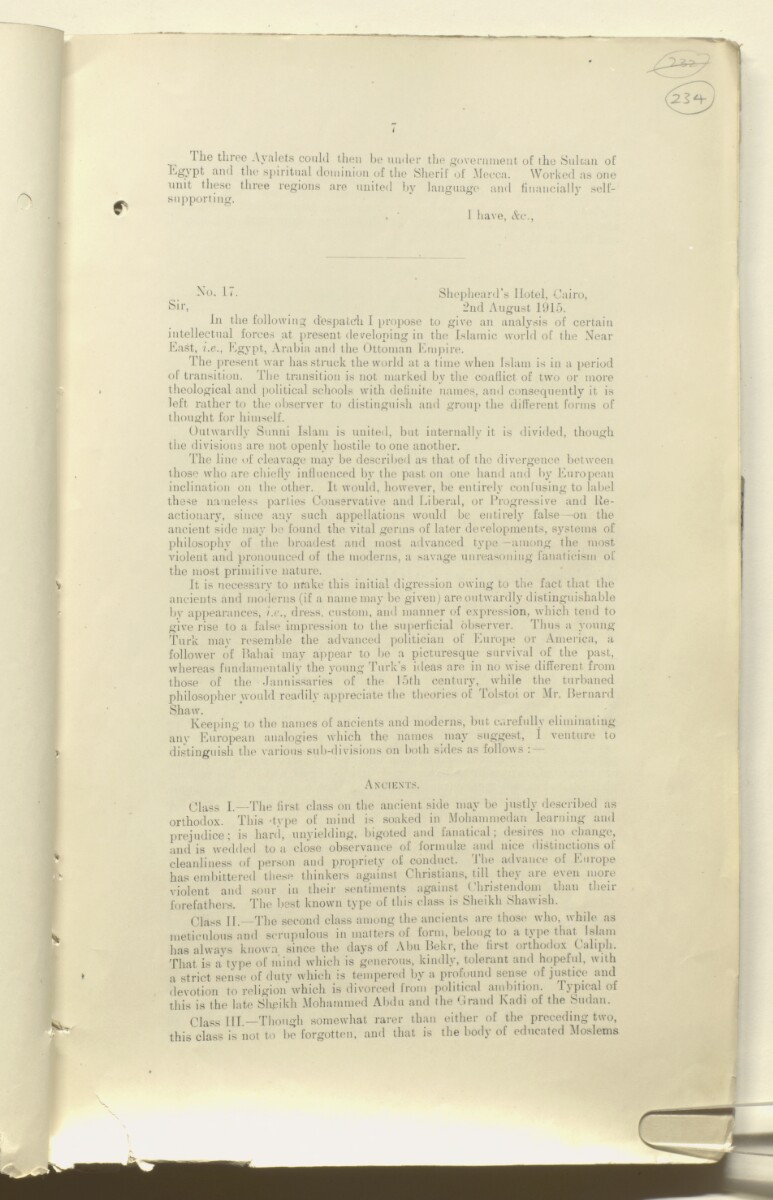
1 he tlnee A valets could then be under the government of the Sultan of
Egypt and the spiritual dominion of the Sheri 1 of Mecca. Worked as one
unit these three regions are united by language and financially self-
supporting.
, ' 1 have, &e.,
* 0 - 1^* Shepheard’s Hotel, Cairo,
Sir, 2nd August 1915.
In the following despatch l propose to give an analysis of certain
intellectual forces at present developing in the Islamic world of the Near
East, ?.e., Egypt, Arabia and the Ottoman Empire.
The present war has struck the world at a time when Islam is in a period
of transition. The transition is not marked by the conflict of two or more
theological and political schools with definite names, and consequently it is
left rather to the observer to distinguish and group the different forms of
thought for himself.
Outwardly Sunni Islam is united, but internally it is divided, though
the divisions are not openly hostile to one another.
The line of cleavage may be described as that of the divergence between
those who are chiefly influenced by the past on one hand and by European
inclination on the other. It would, however, be entirely confusing to label
these nameless parties Conservative and Liberal, or Progressive and Re
actionary, since any such appellations would be entirely false—on the
ancient side may be found the vital germs of later developments, systems of
philosophy of the broadest and most advanced type —among the most
violent and pronounced of the moderns, a savage unreasoning fanaticism of
the most primitive nature.
It is necessary to make this initial digression owing to the fact that the
ancients and moderns (if a name may be given) are outwardly distinguishable
by appearances, i.e., dress, custom, and manner of expression, which tend to
give rise to a false impression to the superficial observer. Thus a young
Turk may resemble the advanced politician of Europe or America, a
follower of Bahai may appear to be a picturesque survival of the past,
whereas fundamentally the young Turks ideas are in no wise different from
those of the Jannissaries of the 15th century, while the turbaned
philosopher would readily appreciate the theories of lolstoi or Mr. Bernard
Shaw.
Keeping to the names of ancients and moderns, but carefully eliminating
any European analogies which the names may suggest, 1 venture to
distinguish the various sub-divisions on both sales as follows : —
Ancients.
Class I.—The first class on the ancient side may be justly described as
orthodox. This -type of mind is soaked in Mohammedan learning and
prejudice j is hard, unyielding, bigoted and fanatical, desnes no ( hcinge,
ami is wedded to a close observance of formulae and nice distinctions of
cleanliness of person and propriety of conduct. The advance of Europe
has embittered these thinkers against Christians, till the\ uie (Ain moic
violent and sour in their sentiments against Christendom than their
forefathers. The best known type of this class is Sheikh Shawish.
Class II.—The second class among the ancients are those who, while as
meticulous and scrupulous in matters of form, belong to a type that Islam
has always known since the days of Abu Beki, the fiist oithodox Caliph.
That is a type of mind which is generous, kindly, tolerant and hopeful, with
a strict sense of duty which is tempered by a profound sense of justice and
devotion to religion which is divorced irom political ambition. l\pical of
this is the late Sheikh Mohammed Abdu and the Crand Kadi of the Sudan.
Class III —Though somewhat rarer than either of the preceding two,
this class is not to be forgotten, and that is the body of educated Moslems
About this item
- Content
Part 4 consists of correspondence relating to the possible declaration of a caliphate in Arabia and is a continuation of part 3 (IOR/L/PS/10/525/1). The papers tell of the British assessment of the situation and the French attitude, as well as correspondence and negotiations with Ḥusayn bin ‘Alī al-Hāshimī, the Grand Sharif of Mecca. The file also discusses the British view of the proposed blockade of the Arabian ports in the Red Sea.
The file also includes a printed document (ff 25-242) marked 'secret' entitled 'Policy in the Middle East', which consists mainly of communications on the military situation in Mespotamia from Lieutenant-Colonel Sir Mark Sykes to the Director of Military Information.
The discussion over such matters is mostly between Sir Arthur Henry McMahon, the General Officer Commanding, Egypt, and the Commander-in-Chief, India.
- Extent and format
- 1 item (242 folios)
- Arrangement
The papers are arranged in approximate chronological order from the rear to the front.
- Written in
- English in Latin script View the complete information for this record
Use and share this item
- Share this item
File 53/1915 Part IV 'German War: Turkey; Caliphate etc' [234r] (464/481), British Library: India Office Records and Private Papers, IOR/L/PS/10/525/2, in Qatar Digital Library <https://www.qdl.qa/archive/81055/vdc_100054091590.0x00004a> [accessed 23 August 2026]
https://www.qdl.qa/en/archive/81055/vdc_100054091590.0x00004a
Copy and paste the code below into your web page where you would like to embed the image.
<meta charset="utf-8"><a href="https://www.qdl.qa/en/archive/81055/vdc_100054091590.0x00004a">File 53/1915 Part IV 'German War: Turkey; Caliphate etc' [‎234r] (464/481)</a> <a href="https://www.qdl.qa/en/archive/81055/vdc_100054091590.0x00004a"> <img src="https://iiif.qdl.qa/iiif/images/81055/vdc_100000000419.0x0001a4/IOR_L_PS_10_525_0473.jp2/full/!280,240/0/default.jpg" alt="" /> </a>
This record has a IIIF manifest available as follows. If you have a compatible viewer you can drag the icon to load it.https://www.qdl.qa/en/iiif/81055/vdc_100000000419.0x0001a4/manifestOpen in Universal viewerOpen in Mirador viewerMore options for embedding images
Copyright: How to use this content
- Reference
- IOR/L/PS/10/525/2
- Title
- File 53/1915 Part IV 'German War: Turkey; Caliphate etc'
- Pages
- 3r:14v, 15ar, 15r:65v, 72r:78v, 80v:125v, 129r:129v, 131r:172v, 179r:184v, 188r:188v, 190r:196r, 198r:203r, 204v:242v
- Author
- East India Company, the Board of Control, the India Office, or other British Government Department
- Usage terms
- Open Government Licence