
![File 756/1917 Pt 2-3 ‘ARAB BULLETIN Nos 66-114’ [‎247v] (503/834)](https://iiif.qdl.qa/iiif/images/81055/vdc_100000000419.0x000229/IOR_L_PS_10_658_0503.jp2/full/!1200,1200/0/default.jpg "File 756/1917 Pt 2-3 ‘ARAB BULLETIN Nos 66-114’ [‎247v] (503/834)")
File 756/1917 Pt 2-3 ‘ARAB BULLETIN Nos 66-114’ [247v] (503/834)
The record is made up of 1 volume (411 folios). It was created in 1917-1920. It was written in English. The original is part of the British Library: India Office The department of the British Government to which the Government of India reported between 1858 and 1947. The successor to the Court of Directors. Records and Private Papers Documents collected in a private capacity. .
Transcription
This transcription is created automatically. It may contain errors.
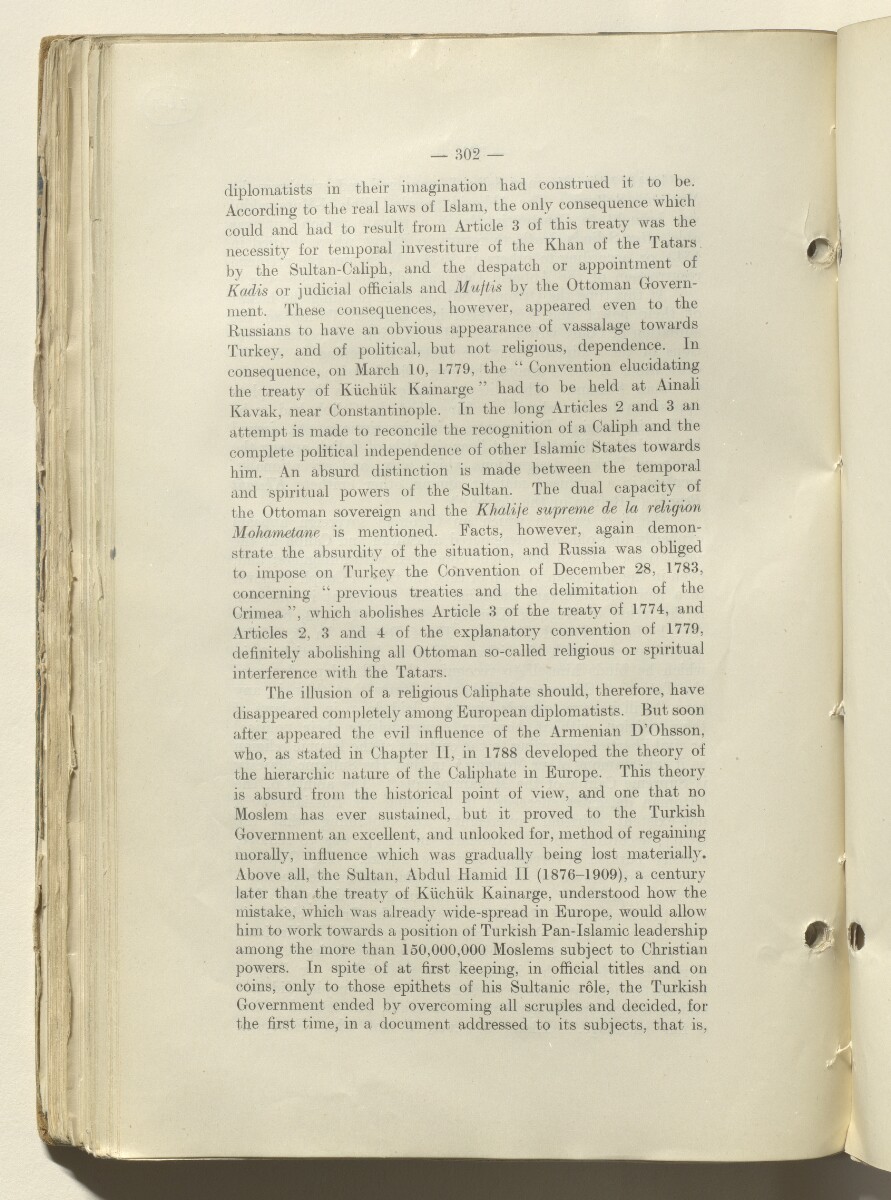
— 302 —
diplomatists in their imagination had construed it to be.
According to the real laws of Islam, the only consequence which
could and had to result from Article 3 of this treaty was the
necessity for temporal investiture of the Khan of the Tatars,
by the Sultan-Caliph, and the despatch or appointment of
Kadis or judicial officials and Muftis by the Ottoman Govern
ment. These consequences, however, appeared even to the
Russians to have an obvious appearance of vassalage towards
Turkey, and of political, but not religious, dependence. In
consequence, on March 10, 1779, the Convention elucidating
the treaty of Kiichuk Kainarge had to be held at Amali
Kavak, near Constantinople. In the long Articles 2 and 3 an
attempt is made to reconcile the recognition of a Caliph and the
complete political independence of other Islamic States towards
him. An absurd distinction is made between the temporal
and spiritual powers of the Sultan. The dual capacity of
the Ottoman sovereign and the Khalife supreme de la religion
Mohametane is mentioned. Facts, however, again demon
strate the absurdity of the situation, and Russia was obliged
to impose on Turkey the Convention of December 28, 1783,
concerning “ previous treaties and the delimitation of the
Crimea ”, which abolishes Article 3 of the treaty of 1774, and
Articles 2, 3 and 4 of the explanatory convention of 1779,
definitely abolishing all Ottoman so-called religious or spiritual
interference with the Tatars.
The illusion of a religious Caliphate should, therefore, have
disappeared completely among European diplomatists. But soon
after appeared the evil influence of the Armenian D Ohsson,
who, as stated in Chapter II, in 1788 developed the theory of
the hierarchic nature of the Caliphate in Europe. This theory
is absurd from the historical point of view, and one that no
Moslem has ever sustained, but it proved to the Turkish
Government an excellent, and unlooked for, method of regaining
morally, influence which was gradually being lost materially.
Above all, the Sultan, Abdul Hamid II (1876-1909), a century
later than the treaty of Kiichiik Kainarge, understood how the
mistake, which was already wide-spread in Europe, would allow
him to work towards a position of Turkish Pan-Islamic leadership
among the more than 150,000,000 Moslems subject to Christian
powers. In spite of at first keeping, in official titles and on
coins, only to those epithets of his Sultanic role, the Turkish
Government ended by overcoming all scruples and decided, for
the first time, in a document addressed to its subjects, that is,
About this item
- Content
The volume consists of individual copies of the Arab Bulletin produced by the Arab Bureau at the Savoy Hotel, Cairo numbers 66-114. These publications contain wartime, and post-war intelligence obtained by British sources. They deal with economic, military, and political matters in Turkey, the Middle East, Arabia, and elsewhere, which – in the opinion of British officials – affect the ‘Arab movement’; the bulletins cover a wide range of topics and key personalities.
The volume contains the following maps:
- A map of Central Arabia showing St John Philby's route from Uqair to Jidda 17 November to 31 December 1917: folio 103.
- Sketch map prepared from RNAS photographs and reconnaissance by HMS City of Oxford of Wadi A seasonal or intermittent watercourse, or the valley in which it flows. Mur February to March 1918 : folio 170.
- Sketch map of Hejaz (1919): folio 317.
- Tribal sketch map of the Hadhramaut ‘showing only tribes of fighting value’: folios 333v.
Towards the back of the volume is a small amount of correspondence respecting the distribution of Notes on the Middle East ; the Arab Bulletin was superseded by this publication. Copies of numbers 3-4 of this publication can also be found at the back of the volume.
Tables of content can be found at the front of each issue. A small amount of content is in French.
- Extent and format
- 1 volume (411 folios)
- Arrangement
The Arab Bulletins are arranged in numerical order from the front to the back of the file. The Notes on the Middle East follow on from the bulletins at the back of the file in reverse numerical order.
The subject 759 (Arab Bulletins) consists of two volumes. IOR/L/PS/10/657-658.
- Physical characteristics
Condition: the edges of some of the folios towards the back of the volume have suffered damage to their edges due to general wear and tear. The affected folios are 389-390, 407-409, and 412.
Foliation: the foliation sequence for this description commences at the first folio with 1, and terminates at the inside back cover with 413; these numbers are written in pencil, are circled, and are located in the top right corner of the recto The front of a sheet of paper or leaf, often abbreviated to 'r'. side of each folio. The front cover and the leading flyleaf have not been foliated. A previous foliation sequence, which is present between ff 357-363 and ff 374-412 and is also circled, has been superseded and therefore crossed out.
- Written in
- English in Latin script View the complete information for this record
Use and share this item
- Share this item
File 756/1917 Pt 2-3 ‘ARAB BULLETIN Nos 66-114’ [247v] (503/834), British Library: India Office Records and Private Papers, IOR/L/PS/10/658, in Qatar Digital Library <https://www.qdl.qa/archive/81055/vdc_100048056856.0x000068> [accessed 19 June 2026]
https://www.qdl.qa/en/archive/81055/vdc_100048056856.0x000068
Copy and paste the code below into your web page where you would like to embed the image.
<meta charset="utf-8"><a href="https://www.qdl.qa/en/archive/81055/vdc_100048056856.0x000068">File 756/1917 Pt 2-3 ‘ARAB BULLETIN Nos 66-114’ [‎247v] (503/834)</a> <a href="https://www.qdl.qa/en/archive/81055/vdc_100048056856.0x000068"> <img src="https://iiif.qdl.qa/iiif/images/81055/vdc_100000000419.0x000229/IOR_L_PS_10_658_0503.jp2/full/!280,240/0/default.jpg" alt="" /> </a>
This record has a IIIF manifest available as follows. If you have a compatible viewer you can drag the icon to load it.https://www.qdl.qa/en/iiif/81055/vdc_100000000419.0x000229/manifestOpen in Universal viewerOpen in Mirador viewerMore options for embedding images
Copyright: How to use this content
- Reference
- IOR/L/PS/10/658
- Title
- File 756/1917 Pt 2-3 ‘ARAB BULLETIN Nos 66-114’
- Pages
- 238r:240v, 246r:248r, 253r:255r, 259r:259v
- Author
- Nallino, Carlo Alfonso
- Usage terms
- Public Domain