
![File 756/1917 Pt 2-3 ‘ARAB BULLETIN Nos 66-114’ [‎182r] (372/834)](https://iiif.qdl.qa/iiif/images/81055/vdc_100000000419.0x000229/IOR_L_PS_10_658_0372.jp2/full/!1200,1200/0/default.jpg "File 756/1917 Pt 2-3 ‘ARAB BULLETIN Nos 66-114’ [‎182r] (372/834)")
File 756/1917 Pt 2-3 ‘ARAB BULLETIN Nos 66-114’ [182r] (372/834)
The record is made up of 1 volume (411 folios). It was created in 1917-1920. It was written in English. The original is part of the British Library: India Office The department of the British Government to which the Government of India reported between 1858 and 1947. The successor to the Court of Directors. Records and Private Papers Documents collected in a private capacity. .
Transcription
This transcription is created automatically. It may contain errors.
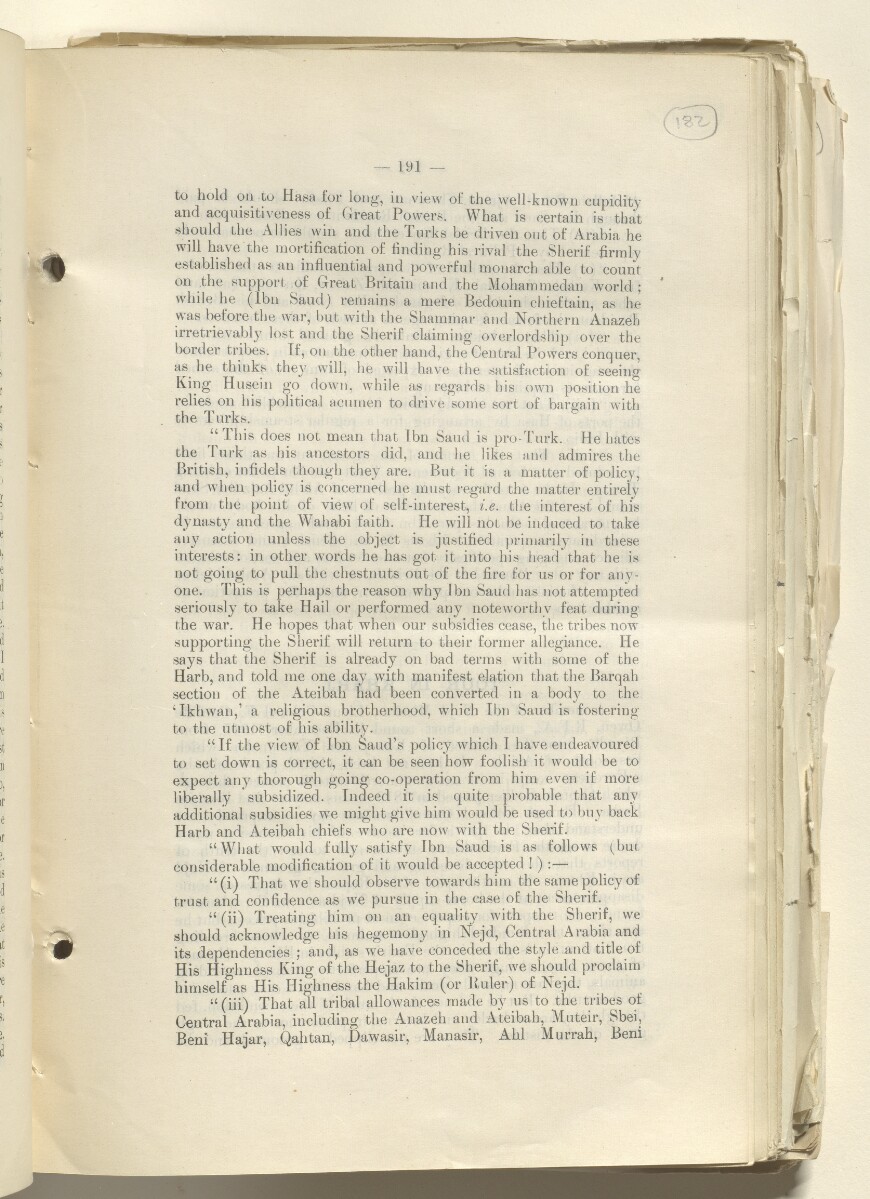
to hold on to Hasa for long, in view of the well-known cupidity
and acquisitiveness of Great Powers. What is certain is that
should the Allies win and the Turks be driven out of Arabia he
will have the mortification of finding his rival the Sherif firmly
established as an influential and powerful monarch able to count
on the support of Great Britain and the Mohammedan world ;
while he (Ibn Sand) remains a mere Bedouin chieftain, as he
was before the war, but with the Shammar and Northern Anazeh
irretrievably lost and the Sherif claiming overlordship over the
border tribes. If, on the other hand, the Central Powers conquer,
as he thinks they will, he will have the satisfaction of seeing
King Husein go down, while as regards his own position he
relies on his political acumen to drive some sort of bargain with
the Turks.
“ This does not mean that Ibn Sand is pro-Turk. He hates
the lurk as his ancestors did, and he likes and admires the
British, infidels though they are. But it is a matter of policy,
and when policy is concerned he must regard the matter entirely
from the point of view of self-interest, i.e. the interest of his
dynasty and the Wahabi faith. He will not be induced to take
any action unless the object is justified primarily in these
interests: in other words he has got it into his head that he is
not going to pull the chestnuts out of the fire for us or for any
one. This is perhaps the reason why fbn Saud has not attempted
seriously to take Hail or performed any noteworthy feat during
the war. He hopes that when our subsidies cease, the tribes now
supporting the Sherif will return to their former allegiance. He
says that the Sherif is already on bad terms with some of the
Harb, and told me one day with manifest elation that the Barqah
section of the Ateibah had been converted in a body to the
‘ Ikhwan,’ a religious brotherhood, which Ibn Saud is fostering
to the utmost of his ability.
“If the view of Ibn Sand’s policy which I have endeavoured
to set down is correct, it can be seen how foolish it would be to
expect any thorough going co-operation from him even if more
liberally subsidized. Indeed it is quite probable that any
additional subsidies we might give him would be used to buy back
Harb and Ateibah chiefs who are now with the Sherif.
“What would fully satisfy Ibn Saud is as follows (but
considerable modification of it would be accepted !) :—
“(i) That we should observe towards him the same policy of
trust and confidence as we pursue in the case of the Sherif.
“ (ii) Treating him on an equality with the Sherif, we
should acknowledge his hegemony in Nejd, Central Arabia and
its dependencies ; and, as we have conceded the style and title of
His Highness King of the Hejaz to the Sherif, we should proclaim
himself as His Highness the Hakim (or Ruler) of Nejd.
“ (iii) That all tribal allowances made by us to the tribes of
Central Arabia, including the Anazeh and Ateibah, Muteir, Sbefi
Beni Hajar, Qahtan, Dawasir, Manasir, Ahl Murrah, Beni
About this item
- Content
The volume consists of individual copies of the Arab Bulletin produced by the Arab Bureau at the Savoy Hotel, Cairo numbers 66-114. These publications contain wartime, and post-war intelligence obtained by British sources. They deal with economic, military, and political matters in Turkey, the Middle East, Arabia, and elsewhere, which – in the opinion of British officials – affect the ‘Arab movement’; the bulletins cover a wide range of topics and key personalities.
The volume contains the following maps:
- A map of Central Arabia showing St John Philby's route from Uqair to Jidda 17 November to 31 December 1917: folio 103.
- Sketch map prepared from RNAS photographs and reconnaissance by HMS City of Oxford of Wadi A seasonal or intermittent watercourse, or the valley in which it flows. Mur February to March 1918 : folio 170.
- Sketch map of Hejaz (1919): folio 317.
- Tribal sketch map of the Hadhramaut ‘showing only tribes of fighting value’: folios 333v.
Towards the back of the volume is a small amount of correspondence respecting the distribution of Notes on the Middle East ; the Arab Bulletin was superseded by this publication. Copies of numbers 3-4 of this publication can also be found at the back of the volume.
Tables of content can be found at the front of each issue. A small amount of content is in French.
- Extent and format
- 1 volume (411 folios)
- Arrangement
The Arab Bulletins are arranged in numerical order from the front to the back of the file. The Notes on the Middle East follow on from the bulletins at the back of the file in reverse numerical order.
The subject 759 (Arab Bulletins) consists of two volumes. IOR/L/PS/10/657-658.
- Physical characteristics
Condition: the edges of some of the folios towards the back of the volume have suffered damage to their edges due to general wear and tear. The affected folios are 389-390, 407-409, and 412.
Foliation: the foliation sequence for this description commences at the first folio with 1, and terminates at the inside back cover with 413; these numbers are written in pencil, are circled, and are located in the top right corner of the recto The front of a sheet of paper or leaf, often abbreviated to 'r'. side of each folio. The front cover and the leading flyleaf have not been foliated. A previous foliation sequence, which is present between ff 357-363 and ff 374-412 and is also circled, has been superseded and therefore crossed out.
- Written in
- English in Latin script View the complete information for this record
Use and share this item
- Share this item
File 756/1917 Pt 2-3 ‘ARAB BULLETIN Nos 66-114’ [182r] (372/834), British Library: India Office Records and Private Papers, IOR/L/PS/10/658, in Qatar Digital Library <https://www.qdl.qa/archive/81055/vdc_100048056855.0x0000ad> [accessed 20 July 2026]
https://www.qdl.qa/en/archive/81055/vdc_100048056855.0x0000ad
Copy and paste the code below into your web page where you would like to embed the image.
<meta charset="utf-8"><a href="https://www.qdl.qa/en/archive/81055/vdc_100048056855.0x0000ad">File 756/1917 Pt 2-3 ‘ARAB BULLETIN Nos 66-114’ [‎182r] (372/834)</a> <a href="https://www.qdl.qa/en/archive/81055/vdc_100048056855.0x0000ad"> <img src="https://iiif.qdl.qa/iiif/images/81055/vdc_100000000419.0x000229/IOR_L_PS_10_658_0372.jp2/full/!280,240/0/default.jpg" alt="" /> </a>
This record has a IIIF manifest available as follows. If you have a compatible viewer you can drag the icon to load it.https://www.qdl.qa/en/iiif/81055/vdc_100000000419.0x000229/manifestOpen in Universal viewerOpen in Mirador viewerMore options for embedding images
Copyright: How to use this content
- Reference
- IOR/L/PS/10/658
- Title
- File 756/1917 Pt 2-3 ‘ARAB BULLETIN Nos 66-114’
- Pages
- front, back, spine, edge, head, tail, front-i, i-r:i-v, 1r:34v, 36v:47v, 49v:53v, 56r:95v, 98r:132r, 133v:139v, 141r:149r, 150v:174v, 175v:184v, 186r:194v, 195v:196r, 197v, 199v:216v, 219r:233v, 234v:237v, 241r:245v, 248v:252v, 255v:258v, 260r:264v, 266r:275v, 279r:286v, 287v:313r, 316r:349v, 351r:352r, 354r, 355r:358r, 361r, 363r:365r, 366v:367v, 368v:369v, 370v:397v, 400r:412v, back-i
- Author
- East India Company, the Board of Control, the India Office, or other British Government Department
- Usage terms
- Open Government Licence