
!['Mesopotamia Commission. Report of the Commission Appointed by Act of Parliament to Enquire into the Operations of War in Mesopotamia, together with a Special Report by Commander J Wedgwood, DSO, MP, and Appendices. London: HMSO, 1917.' [‎98r] (195/248)](https://iiif.qdl.qa/iiif/images/81055/vdc_100000000912.0x0000b2/IOR_L_PS_20_257_0197.jp2/full/!1200,1200/0/default.jpg "'Mesopotamia Commission. Report of the Commission Appointed by Act of Parliament to Enquire into the Operations of War in Mesopotamia, together with a Special Report by Commander J Wedgwood, DSO, MP, and Appendices. London: HMSO, 1917.' [‎98r] (195/248)")
'Mesopotamia Commission. Report of the Commission Appointed by Act of Parliament to Enquire into the Operations of War in Mesopotamia, together with a Special Report by Commander J Wedgwood, DSO, MP, and Appendices. London: HMSO, 1917.' [98r] (195/248)
The record is made up of 1 volume (122 folios). It was created in 1906-1918. It was written in English. The original is part of the British Library: India Office The department of the British Government to which the Government of India reported between 1858 and 1947. The successor to the Court of Directors. Records and Private Papers Documents collected in a private capacity. .
Transcription
This transcription is created automatically. It may contain errors.
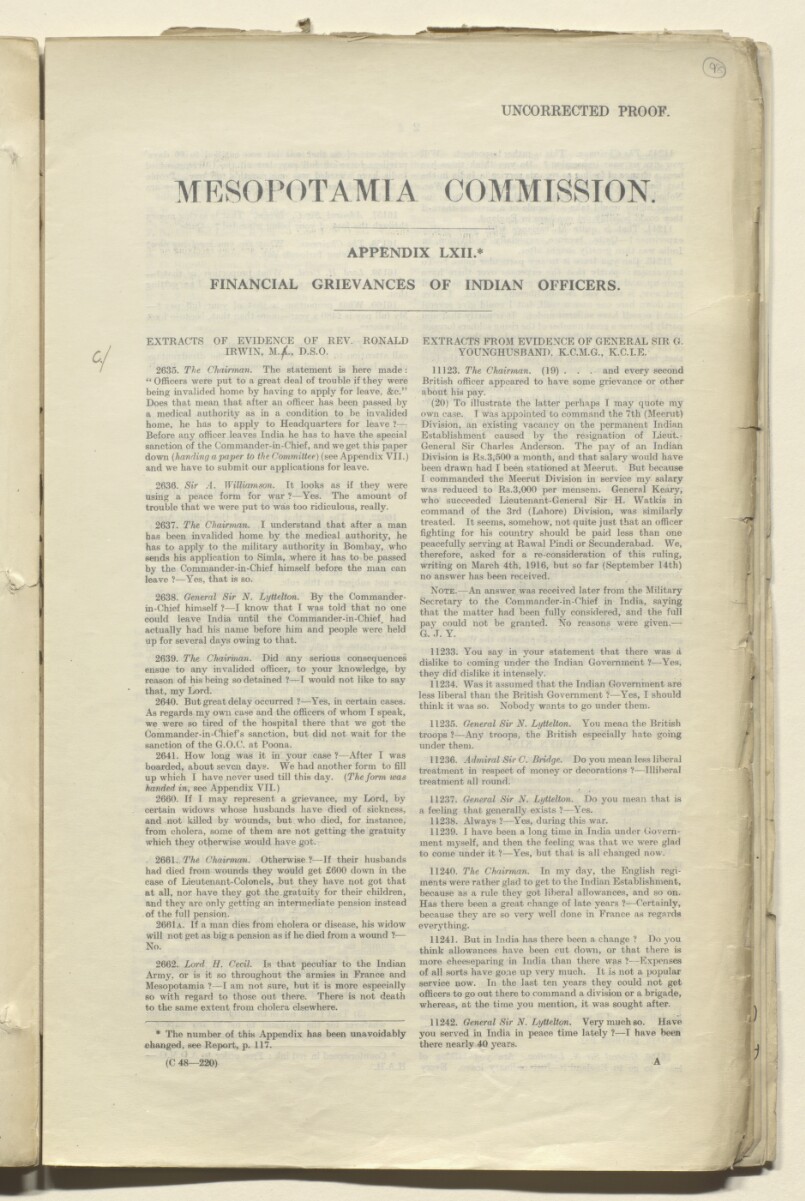
UNCORRECTED PROOF.
MESOPOTAMIA COMMISSION
APPENDIX LXII.*
FINANCIAL GRIEVANCES OF INDIAN OFFICERS.
EXTRACTS OF EVIDENCE OF REV. RONALD
IRWIN, D.S.O.
2635. The Chairman. The statement is here made:
“ Officers were put to a great deal of trouble if they were
being invalided home by having to apply for leave, &c.”
Does that mean that after an officer has been passed by
a medical authority as in a condition to be invalided
home, he has to apply to Headquarters for leave ?—
Before any officer leaves India he has to have the special
sanction of the Commander-in-Chief, and we get this paper
down (handing a paper to the Committee) (see Appendix VII.)
and w r e have to submit our applications for leave.
2636. Sir .1. Williamson. It looks as if they were
using a peace form for war ?—Yes. The amount of
trouble that we were put to was too ridiculous, really.
2637. The Chairman. I understand that after a man
has been invalided home by the medical authority, he
has to apply to the military authority in Bombay, who
sends his application to Simla, where it has to be passed
by the Commander-in-Chief himself before the man can
leave ?—Yes, that is so.
2638. General Sir N. Lyttelton. By the Commander-
in-Chief himself ?—I know that I was told that no one
could leave India until the Commander-in-Chief, had
actually had his name before him and people were held
up for several days owing to that.
2639. The Chairman. Did any serious consequences
ensue to any invalided officer, to your knowledge, by
reason of his being so detained ?—I would not like to say
that, my Lord.
2640. But great delay occurred ?—Yes, in certain cases.
As regards my own case and the officers of whom I speak,
we were so tired of the hospital there that we got the
Commander-in-Chief’s sanction, but did not wait for the
sanction of the G.O.C. at Poona.
2641. How long was it in your case ?—After I was
boarded, about seven days. We had another form to fill
up which I have never used till this day. (The form was
handed in, see Appendix VII.)
2660. If I may represent a grievance, my Lord, by
certain widows whose husbands have died of sickness,
and not killed by wounds, but who died, for instance,
from cholera, some of them are not getting the gratuity
which they otherwise would have got.
2661. The Chairman. Otherwise?—If their husbands
had died from wounds they would get £600 down in the
case of Lieutenant-Colonels, but they have not got that
at all, nor have they got the gratuity for their children,
and they are only getting an intermediate pension instead
of the full pension.
2661a. If a man dies from cholera or disease, his widow
will not get as big a pension as if he died from a wound ?—
No.
2662. Lord H. Cecil. Is that peculiar to the Indian
Army, or is it so throughout the armies in France and
Mesopotamia ?—I am not sure, but it is more especially
so with regard to those out there. There is not death
to the same extent from cholera elsewhere.
* The number of this Appendix has been unavoidably
changed, see Report, p. 117.
(C 48—220)
EXTRACTS FROM EVIDENCE OF GENERAL SIR G.
YOUNGHUSBAND. K.C.M.G., K.C.I.E.
11123. The Chairman. (19) . . . and every second
British officer appeared to have some grievance or other
about his pay.
(20) To illustrate the latter perhaps I may quote my
own case. I was appointed to command the 7th (Meerut)
Division, an existing vacancy on the permanent Indian
Establishment caused by the resignation of Lieut.-
General Sir Charles Anderson. The pay of an Indian
Division is Rs.3,500 a month, and that salary would have
been drawn had I been stationed at Meerut. But because
I commanded the Meerut Division in service my salary
was reduced to Rs.3,000 per mensem. General Keary,
who succeeded Lieutenant-General Sir H. Watkis in
command of the 3rd (Lahore) Division, was similarly
treated. It seems, somehow, not quite just that an officer
fighting for his country should be paid less than one
peacefully serving at Rawal Pindi or Secunderabad. We,
therefore, asked for a re-consideration of this ruling,
writing on March 4th, 1916, but so far (September 14th)
no answer has been received.
Note. —An answer was received later from the Military
Secretary to the Commander-in-Chief in India, saying
that the matter had been fully considered, and the full
pay could not be granted. No reasons were given.—
G, J. Y.
11233. You say in your statement that there was a
dislike to coming under the Indian Government ?—Yes,
they did dislike it intensely.
11234. Was it assumed that the Indian Government are
less liberal than the British Government ?—Yes, I should
think it was so. Nobody wants to go under them.
11235. General Sir N. Lyttelton. You mean the British
troops ?—Any troops, the British especially hate going
under them.
11236. Admiral Sir C. Bridge. Do you mean less liberal
treatment in respect of money or decorations ?—Illiberal
treatment all round.
11237. General Sir N. Lyttelton. Do you mean that is
a feeling that generally exists ?—Yes.
11238. Always ?—Yes, during this war.
11239. I have been a long time in India under Govern
ment myself, and then the feeling was that we were glad
to come under it ?—Yes, but that is all changed now.
11240. The Chairman. In my day, the English regi
ments were rather glad to get to the Indian Establishment,
because as a rule they got liberal allowances, and so on.
Has there been a great change of late years ?—Certainly,
because they are so very well done in France as regards
everything.
11241. But in India has there been a change ? Do you
think allowances have been cut down, or that there is
more cheeseparing in India than there was ?—Expenses
of all sorts have gone up very much. It is not a popular
service now. In the last ten years they could not get
officers to go out there to command a division or a brigade,
whereas, at the time you mention, it was sought after.
11242. General Sir N. Lyttelton. Very much so. Have
you served in India in peace time lately ?—I have been
there nearly 40 years.
A
About this item
- Content
A signed proof, folios 1-100, plus additional material, folios 101-124. The cover bears the signature of Sir Arthur Hirtzel, Assistant Under-Secretary of State. The report has been annotated in blue pencil at various points.
Contents:
- 'Part I. Preface.
- 'Part II. Origin of Mesopotamia [Iraq] Expedition.'
- 'Part III. Advance from Basra to Kurna.'
- 'Part IV. The Advance to Amara [Al-'Amārah] and Kut [Al-Kūt].'
- 'Part V. Correspondence and Telegrams as to Advance on Baghdad.'
- 'Part VI. The Advance from Kut to Ctesiphon.'
- 'Part VII. Operations for Relief of Kut.'
- 'Part VIII. Armament, Equipment, Reinforcements, &c.'
- 'Part IX. Transport.'
- 'Part X. Medical Breakdown.'
- 'Part XI. Causes Contributing to the Errors of Judgement and Shortcomings of Responsible Authorities.'
- 'Part XII. Findings and Conclusions. Recommendations.'
- 'Separate Report by Commander J Wedgwood, DSO, MP.'
- 'Appendix I. Vincent-Bingley Report.'
- 'Appendix II. Memorandum by Sir Beauchamp Duff.'
- 'Appendix III. Colonel Hehir's Account of the Siege of Kut-el-Amara.'
Additional material:
- Folio 101. Manuscript note [by Arthur Hirtzel] on net military expenditure.
- Folios 102-109. Copy of the East India (Army Administration), Further Papers regarding the Administration of the Army in India , 1906.
- Folios 110-115. Manuscript notes, titled 'Suggested redraft & amplification of second half of parag 1' [unknown hand].
- Folio 116. A clipping from the Daily Telegraph , Wednesday 4 July 1917, featuring an article titled 'Mesopotamia. Ex-Viceroy's Statement. The Medical Breakdown.'
- Folios 117-124. An expanded typescript version of Hirtzel's manuscript notes (folio 101).
- Extent and format
- 1 volume (122 folios)
- Arrangement
A table of contents can be found at folio 4v.
An index can be found at folios 93-97.
- Physical characteristics
Foliation: the foliation sequence commences at the front cover with 1, and terminates at the last folio with 124; these numbers are written in pencil, are circled, and are located in the top right corner of the recto The front of a sheet of paper or leaf, often abbreviated to 'r'. side of each folio. An additional foliation sequence is present in parallel between ff 110-115; these numbers are also written in pencil, but are not circled. Pagination: the file also contains an original printed pagination sequence. The volume comprises a stitched pamphlet, and other stitched and loose-leaf material.
- Written in
- English in Latin script View the complete information for this record
Use and share this item
- Share this item
'Mesopotamia Commission. Report of the Commission Appointed by Act of Parliament to Enquire into the Operations of War in Mesopotamia, together with a Special Report by Commander J Wedgwood, DSO, MP, and Appendices. London: HMSO, 1917.' [98r] (195/248), British Library: India Office Records and Private Papers, IOR/L/PS/20/257, in Qatar Digital Library <https://www.qdl.qa/archive/81055/vdc_100036338403.0x0000c4> [accessed 12 July 2026]
https://www.qdl.qa/en/archive/81055/vdc_100036338403.0x0000c4
Copy and paste the code below into your web page where you would like to embed the image.
<meta charset="utf-8"><a href="https://www.qdl.qa/en/archive/81055/vdc_100036338403.0x0000c4">'Mesopotamia Commission. Report of the Commission Appointed by Act of Parliament to Enquire into the Operations of War in Mesopotamia, together with a Special Report by Commander J Wedgwood, DSO, MP, and Appendices. London: HMSO, 1917.' [‎98r] (195/248)</a> <a href="https://www.qdl.qa/en/archive/81055/vdc_100036338403.0x0000c4"> <img src="https://iiif.qdl.qa/iiif/images/81055/vdc_100000000912.0x0000b2/IOR_L_PS_20_257_0197.jp2/full/!280,240/0/default.jpg" alt="" /> </a>
This record has a IIIF manifest available as follows. If you have a compatible viewer you can drag the icon to load it.https://www.qdl.qa/en/iiif/81055/vdc_100000000912.0x0000b2/manifestOpen in Universal viewerOpen in Mirador viewerMore options for embedding images
Copyright: How to use this content
- Reference
- IOR/L/PS/20/257
- Title
- 'Mesopotamia Commission. Report of the Commission Appointed by Act of Parliament to Enquire into the Operations of War in Mesopotamia, together with a Special Report by Commander J Wedgwood, DSO, MP, and Appendices. London: HMSO, 1917.'
- Pages
- front, front-i, 2r:115v, 117r:124v
- Author
- East India Company, the Board of Control, the India Office, or other British Government Department
- Usage terms
- Open Government Licence