
!['Mesopotamia Commission. Report of the Commission Appointed by Act of Parliament to Enquire into the Operations of War in Mesopotamia, together with a Special Report by Commander J Wedgwood, DSO, MP, and Appendices. London: HMSO, 1917.' [‎17r] (33/248)](https://iiif.qdl.qa/iiif/images/81055/vdc_100000000912.0x0000b2/IOR_L_PS_20_257_0033.jp2/full/!1200,1200/0/default.jpg "'Mesopotamia Commission. Report of the Commission Appointed by Act of Parliament to Enquire into the Operations of War in Mesopotamia, together with a Special Report by Commander J Wedgwood, DSO, MP, and Appendices. London: HMSO, 1917.' [‎17r] (33/248)")
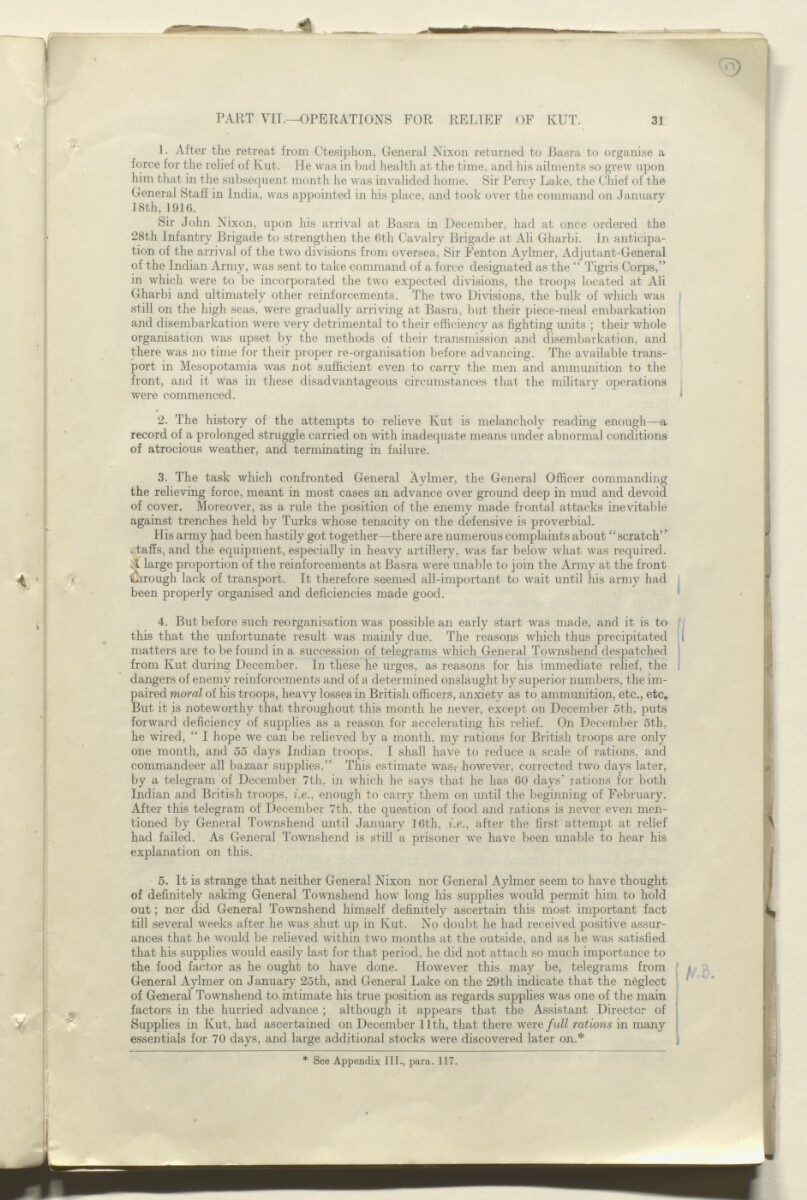
'Mesopotamia Commission. Report of the Commission Appointed by Act of Parliament to Enquire into the Operations of War in Mesopotamia, together with a Special Report by Commander J Wedgwood, DSO, MP, and Appendices. London: HMSO, 1917.' [17r] (33/248)
The record is made up of 1 volume (122 folios). It was created in 1906-1918. It was written in English. The original is part of the British Library: India Office The department of the British Government to which the Government of India reported between 1858 and 1947. The successor to the Court of Directors. Records and Private Papers Documents collected in a private capacity. .
Transcription
This transcription is created automatically. It may contain errors.
PART VIL—OPERATIONS FOR RELIEF OF KUT.
31
* See Appendix III., para. 117.
1 . After the retreat from Ctesiphon, General Nixon returned to Basra to organise a
force for the relief of Kut. He was in bad health at the time, and his ailments so grew upon
him that in the subsequent month he was invalided home. Sir Percy Lake, the Chief of the
General Staff in India, was appointed in his place, and took over the command on January
18th, 1916.
Sir John Nixon, upon his arrival at Basra in December, had at once ordered the
28th Infantry Brigade to strengthen the 6 th Cavalry Brigade at Ali Gharbi. In anticipa
tion of the arrival of the two divisions from oversea, Sir Fenton Aylmer, Adjutant-General
of the Indian Army, was sent to take command of a force designated as the “ Tigris Corps,”
in which were to be incorporated the two expected divisions, the troops located at Ali
Gharbi and ultimately other reinforcements. The two Divisions, the bulk of which was
still on the high seas, were gradually arriving at Basra, but their piece-meal embarkation
and disembarkation were very detrimental to their efficiency as fighting units ; their whole
organisation was upset by the methods of their transmission and disembarkation, and
there was no time for their proper re-organisation before advancing. The available trans
port in Mesopotamia was not sufficient even to carry the men and ammunition to the
front, and it was in these disadvantageous circumstances that the military operations
were commenced.
2 . The history of the attempts to relieve Kut is melancholy reading enough—a
record of a prolonged struggle carried on with inadequate means under abnormal conditions
of atrocious weather, and terminating in failure.
3. The task which confronted General Aylmer, the General Officer commanding
the relieving force, meant in most cases an advance over ground deep in mud and devoid
of cover. Moreover, as a rule the position of the enemy made frontal attacks inevitable
against trenches held by Turks whose tenacity on the defensive is proverbial.
His army Jiad been hastily got together—there are numerous complaints about “scratch”
ctaffs, and the equipment, especially in heavy artillery, was far below what was required.
A large proportion of the reinforcements at Basra were unable to join the Army at the front
Larough lack of transport. It therefore seemed all-important to wait until his army had
been properly organised and deficiencies made good.
4. But before such reorganisation was possible an early start was made, and it is to
this that the unfortunate result was mainly due. The reasons which thus precipitated
matters are to be found in a succession of telegrams which General Townshend despatched
from Kut during December. In these he urges, as reasons for his immediate relief, the
dangers of enemy reinforcements and of a determined onslaught by superior numbers, the im
paired moral of his troops, heavy losses in British officers, anxiety as to ammunition, etc., etc.
But it is noteworthy that throughout this month he never, except on December oth, puts
forward deficiency of supplies as a reason for accelerating his relief. On December 5th,
he wired, “ I hope we can be relieved by a month, my rations for British troops are only
one month, and 55 days Indian troops. I shall have to reduce a scale of rations, and
commandeer all bazaar supplies.” This estimate was? however, corrected two days later,
by a telegram of December 7th, in which he says that he has 60 days’ rations for both
Indian and British troops, i.e., enough to carry them on until the beginning of February.
After this telegram of December 7th, the question of food and rations is never even men
tioned by General Townshend until January 16th, i.e., after the first attempt at relief
had failed. As General Townshend is still a prisoner we have been unable to hear his
explanation on this.
5. It is strange that neither General Nixon nor General Aylmer seem to have thought
of definitely asking General Townshend how long his supplies would permit him to hold
out; nor did General Townshend himself definitely ascertain this most important fact
till several weeks after he was shut up in Kut. No doubt he had received positive assur
ances that he would be relieved within two months at the outside, and as he was satisfied
that his supplies would easily last for that period, he did not attach so much importance to
the food factor as he ought to have done. However this may be, telegrams from
General Aylmer on January 25th, and General Lake on the 29th indicate that the neglect
of General Townshend to intimate his true position as regards supplies was one of the main
factors in the hurried advance ; although it appears that the Assistant Director of
Supplies in Kut, had ascertained on December 11 th, that there were full rations in many
essentials for 70 days, and large additional stocks were discovered later on.*
About this item
- Content
A signed proof, folios 1-100, plus additional material, folios 101-124. The cover bears the signature of Sir Arthur Hirtzel, Assistant Under-Secretary of State. The report has been annotated in blue pencil at various points.
Contents:
- 'Part I. Preface.
- 'Part II. Origin of Mesopotamia [Iraq] Expedition.'
- 'Part III. Advance from Basra to Kurna.'
- 'Part IV. The Advance to Amara [Al-'Amārah] and Kut [Al-Kūt].'
- 'Part V. Correspondence and Telegrams as to Advance on Baghdad.'
- 'Part VI. The Advance from Kut to Ctesiphon.'
- 'Part VII. Operations for Relief of Kut.'
- 'Part VIII. Armament, Equipment, Reinforcements, &c.'
- 'Part IX. Transport.'
- 'Part X. Medical Breakdown.'
- 'Part XI. Causes Contributing to the Errors of Judgement and Shortcomings of Responsible Authorities.'
- 'Part XII. Findings and Conclusions. Recommendations.'
- 'Separate Report by Commander J Wedgwood, DSO, MP.'
- 'Appendix I. Vincent-Bingley Report.'
- 'Appendix II. Memorandum by Sir Beauchamp Duff.'
- 'Appendix III. Colonel Hehir's Account of the Siege of Kut-el-Amara.'
Additional material:
- Folio 101. Manuscript note [by Arthur Hirtzel] on net military expenditure.
- Folios 102-109. Copy of the East India (Army Administration), Further Papers regarding the Administration of the Army in India , 1906.
- Folios 110-115. Manuscript notes, titled 'Suggested redraft & amplification of second half of parag 1' [unknown hand].
- Folio 116. A clipping from the Daily Telegraph , Wednesday 4 July 1917, featuring an article titled 'Mesopotamia. Ex-Viceroy's Statement. The Medical Breakdown.'
- Folios 117-124. An expanded typescript version of Hirtzel's manuscript notes (folio 101).
- Extent and format
- 1 volume (122 folios)
- Arrangement
A table of contents can be found at folio 4v.
An index can be found at folios 93-97.
- Physical characteristics
Foliation: the foliation sequence commences at the front cover with 1, and terminates at the last folio with 124; these numbers are written in pencil, are circled, and are located in the top right corner of the recto The front of a sheet of paper or leaf, often abbreviated to 'r'. side of each folio. An additional foliation sequence is present in parallel between ff 110-115; these numbers are also written in pencil, but are not circled. Pagination: the file also contains an original printed pagination sequence. The volume comprises a stitched pamphlet, and other stitched and loose-leaf material.
- Written in
- English in Latin script View the complete information for this record
Use and share this item
- Share this item
'Mesopotamia Commission. Report of the Commission Appointed by Act of Parliament to Enquire into the Operations of War in Mesopotamia, together with a Special Report by Commander J Wedgwood, DSO, MP, and Appendices. London: HMSO, 1917.' [17r] (33/248), British Library: India Office Records and Private Papers, IOR/L/PS/20/257, in Qatar Digital Library <https://www.qdl.qa/archive/81055/vdc_100036338403.0x000022> [accessed 13 August 2026]
https://www.qdl.qa/en/archive/81055/vdc_100036338403.0x000022
Copy and paste the code below into your web page where you would like to embed the image.
<meta charset="utf-8"><a href="https://www.qdl.qa/en/archive/81055/vdc_100036338403.0x000022">'Mesopotamia Commission. Report of the Commission Appointed by Act of Parliament to Enquire into the Operations of War in Mesopotamia, together with a Special Report by Commander J Wedgwood, DSO, MP, and Appendices. London: HMSO, 1917.' [‎17r] (33/248)</a> <a href="https://www.qdl.qa/en/archive/81055/vdc_100036338403.0x000022"> <img src="https://iiif.qdl.qa/iiif/images/81055/vdc_100000000912.0x0000b2/IOR_L_PS_20_257_0033.jp2/full/!280,240/0/default.jpg" alt="" /> </a>
This record has a IIIF manifest available as follows. If you have a compatible viewer you can drag the icon to load it.https://www.qdl.qa/en/iiif/81055/vdc_100000000912.0x0000b2/manifestOpen in Universal viewerOpen in Mirador viewerMore options for embedding images
Copyright: How to use this content
- Reference
- IOR/L/PS/20/257
- Title
- 'Mesopotamia Commission. Report of the Commission Appointed by Act of Parliament to Enquire into the Operations of War in Mesopotamia, together with a Special Report by Commander J Wedgwood, DSO, MP, and Appendices. London: HMSO, 1917.'
- Pages
- front, front-i, 2r:115v, 117r:124v
- Author
- East India Company, the Board of Control, the India Office, or other British Government Department
- Usage terms
- Open Government Licence