
!['History of the Indian Navy. (1613-1863).' [‎372] (391/622)](https://iiif.qdl.qa/iiif/images/81055/vdc_100023550043.0x000001/IOL.1947.a.1844 vol.2_0391.jp2/full/!1200,1200/0/default.jpg "'History of the Indian Navy. (1613-1863).' [‎372] (391/622)")
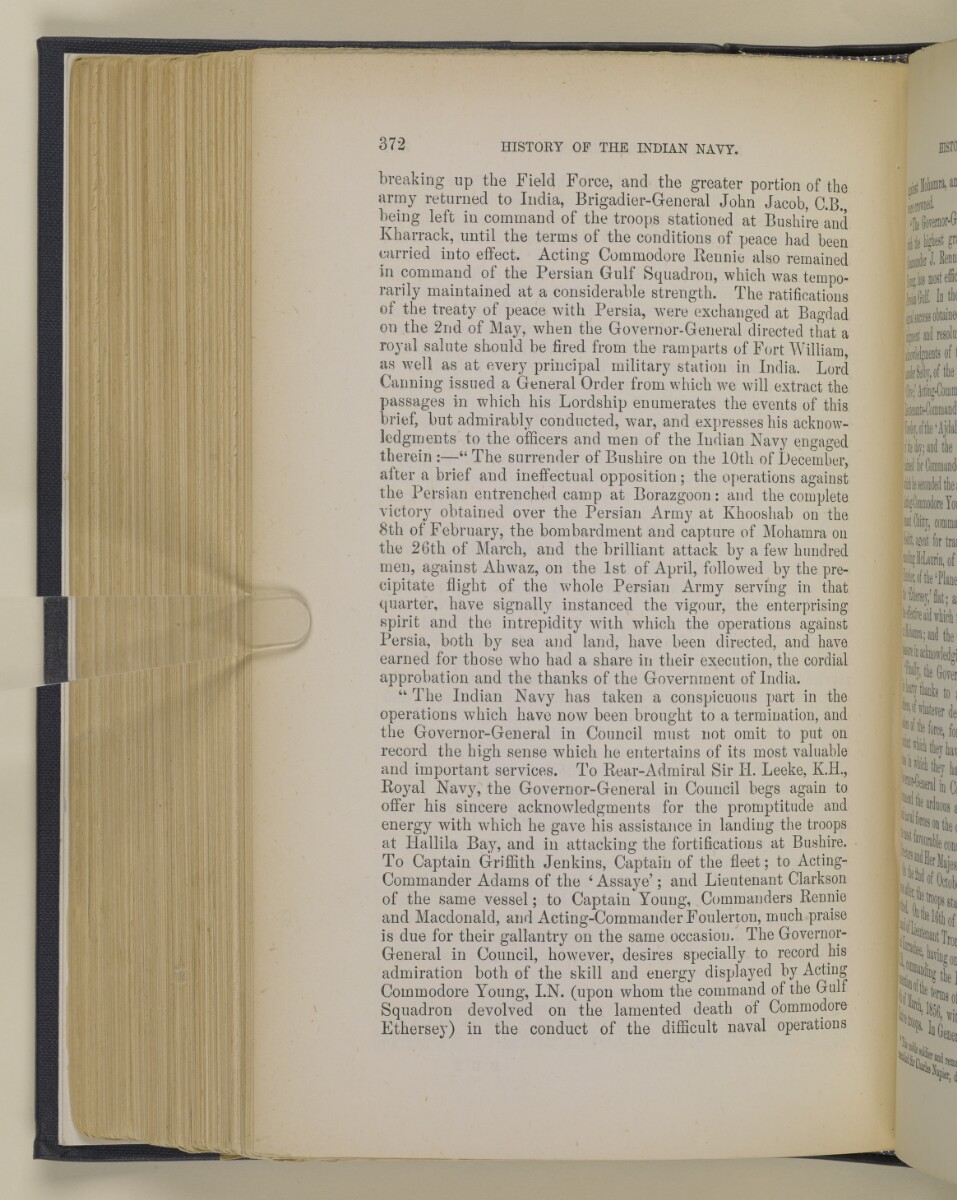
'History of the Indian Navy. (1613-1863).' [372] (391/622)
The record is made up of 1 volume (575 pages). It was created in 1877. It was written in English. The original is part of the British Library: Printed Collections.
Transcription
This transcription is created automatically. It may contain errors.
372
HISTORY OF THE INDIAN NAVY.
breaking up the Field Force, and the greater portion of the
army returned to India, Brigadier-General John Jacob, C.B.,
being left in command of the troops stationed at Bushire and
Kharrack, until the terms of the conditions of peace had been
carried into effect. Acting Commodore Rennie also remained
in command of the
Persian Gulf
The historical term used to describe the body of water between the Arabian Peninsula and Iran.
Squadron, which was tempo
rarily maintained at a considerable strength. The ratifications
of the treaty of peace with Persia, were exchanged at Bagdad
on the 2nd of May, when the Governor-General directed that a
royal salute should be fired from the ramparts of Fort William,
as well as at every principal military station in India. Lord
Canning issued a General Order from which we will extract the
passages in which his Lordship enumerates the events of this
brief, but admirably conducted, war, and expresses his acknow
ledgments to the officers and men of the Indian Navy engaged
therein :—" The surrender of Bushire on the 10th of December,
after a brief and ineffectual opposition; the operations against
the Persian entrenched camp at Borazgoon: and the complete
victory obtained over the Persian Army at Khooshab on the
8th of February, the bombardment and capture of Mohamra on
the 26th of March, and the brilliant attack by a few hundred
men, against Ahwaz, on the 1st of April, followed by the pre
cipitate flight of the w^hole Persian Army serving in that
quarter, have signally instanced the vigour, the enterprising
spirit and the intrepidity with which the operations against
Persia, both by sea and land, have been directed, and have
earned for those who had a share in their execution, the cordial
approbation and the thanks of the Government of India.
" The Indian Navy has taken a conspicuous part in the
operations which have now been brought to a termination, and
the Governor-General in Council must not omit to put on
record the high sense which he entertains of its most valuable
and important services. To Rear-Admiral Sir li. Leeke, K.H.,
Royal Navy, the Governor-General in Council begs again to
offer his sincere acknowledgments for the promptitude and
energy with which he gave his assistance in landing the troops
at Hallila Bay, and in attacking the fortifications at Bushire.
To Captain Griffith Jenkins, Captain of the fleet; to Acting-
Commander Adams of the 6 Assaye'; and Lieutenant Clarkson
of the same vessel; to Captain Young, Commanders Rennie
and Macdonald, and Acting-Commander Foulerton, much praise
is due for their gallantry on the same occasion. The Governor-
General in Council, however, desires specially to record his
admiration both of the skill and energy displayed by Acting
Commodore Young, I.N. (upon whom the command of the Gulf
Squadron devolved on the lamented death of Commodore
Ethersey) in the conduct of the difficult naval operations
About this item
- Content
History of the Indian Navy. (1613-1863).
Author: Charles Rathbone Low.
Publication Details: London: Richard Bentley and Son, New Burlington Street.
Physical Description: initial Roman numeral pagination (i-vi); octavo.
- Extent and format
- 1 volume (575 pages)
- Arrangement
This volume contains a table of contents giving chapter headings and page references. Each chapter heading is followed by a detailed breakdown of the contents of that chapter.
- Physical characteristics
Dimensions: 229mm x 140mm
- Written in
- English in Latin script View the complete information for this record
Use and share this item
- Share this item
'History of the Indian Navy. (1613-1863).' [372] (391/622), British Library: Printed Collections, IOL.1947.a.1844 vol. 2, in Qatar Digital Library <https://www.qdl.qa/archive/81055/vdc_100023958180.0x0000c0> [accessed 18 August 2026]
https://www.qdl.qa/en/archive/81055/vdc_100023958180.0x0000c0
Copy and paste the code below into your web page where you would like to embed the image.
<meta charset="utf-8"><a href="https://www.qdl.qa/en/archive/81055/vdc_100023958180.0x0000c0">'History of the Indian Navy. (1613-1863).' [‎372] (391/622)</a> <a href="https://www.qdl.qa/en/archive/81055/vdc_100023958180.0x0000c0"> <img src="https://iiif.qdl.qa/iiif/images/81055/vdc_100023550043.0x000001/IOL.1947.a.1844 vol.2_0391.jp2/full/!280,240/0/default.jpg" alt="" /> </a>
This record has a IIIF manifest available as follows. If you have a compatible viewer you can drag the icon to load it.https://www.qdl.qa/en/iiif/81055/vdc_100023550043.0x000001/manifestOpen in Universal viewerOpen in Mirador viewerMore options for embedding images
Copyright: How to use this content
- Reference
- IOL.1947.a.1844 vol. 2
- Title
- 'History of the Indian Navy. (1613-1863).'
- Pages
- front, back, spine, edge, head, tail, front-i, i-r:iii-v, 1:6, 1:596, iv-r:vi-v, back-i
- Author
- Low. Charles Rathbone
- Usage terms
- Public Domain