
!['History of the Indian Navy. (1613-1863).' [‎168] (187/622)](https://iiif.qdl.qa/iiif/images/81055/vdc_100023550043.0x000001/IOL.1947.a.1844 vol.2_0187.jp2/full/!1200,1200/0/default.jpg "'History of the Indian Navy. (1613-1863).' [‎168] (187/622)")
'History of the Indian Navy. (1613-1863).' [168] (187/622)
The record is made up of 1 volume (575 pages). It was created in 1877. It was written in English. The original is part of the British Library: Printed Collections.
Transcription
This transcription is created automatically. It may contain errors.
168
HISTORY OF THE INDIAN NAVY.
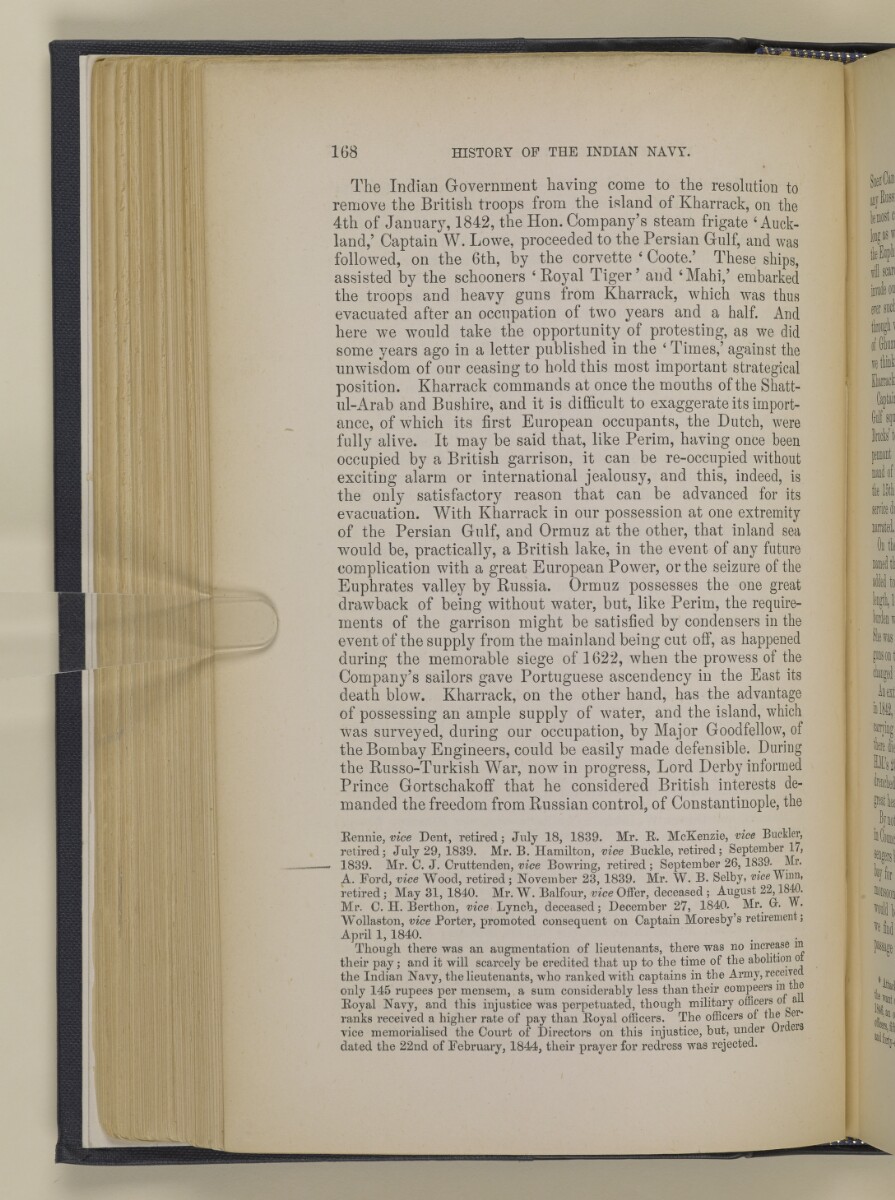
The Indian Government having come to the resolution to
remove the British troops from the island of Kharrack, on the
4th of January, 1842, the Hon. Company's steam frigate 'Auck
land,' Captain W. Lowe, proceeded to the
Persian Gulf
The historical term used to describe the body of water between the Arabian Peninsula and Iran.
, and was
followed, on the 6th, by the corvette 4 Coote.' These ships,
assisted by the schooners 4 Royal Tiger' and 6 Mahi,' embarked
the troops and heavy guns from Kharrack, which was thus
evacuated after an occupation of two years and a half. And
here we would take the opportunity of protesting, as we did
some years ago in a letter published in the 4 Times,' against the
unwisdom of our ceasing to hold this most important strategical
position. Kharrack commands at once the mouths of the Shatt-
ul-Arab and Bushire, and it is difficult to exaggerate its import
ance, of which its first European occupants, the Dutch, were
fully alive. It may be said that, like Perim, having once been
occupied by a British garrison, it can be re-occupied without
exciting alarm or international jealousy, and this, indeed, is
the only satisfactory reason that can be advanced for its
evacuation. With Kharrack in our possession at one extremity
of the
Persian Gulf
The historical term used to describe the body of water between the Arabian Peninsula and Iran.
, and Ormuz at the other, that inland sea
would be, practically, a British lake, in the event of any future
complication with a great European Power, or the seizure of the
Euphrates valley by Russia. Ormuz possesses the one great
drawback of being without water, but, like Perim, the require
ments of the garrison might be satisfied by condensers in the
event of the supply from the mainland being cut off, as happened
during the memorable siege of 1622, when the prowess of the
Company's sailors gave Portuguese ascendency in the East its
death blow. Kharrack, on the other hand, has the advantage
of possessing an ample supply of water, and the island, which
w^as surveyed, during our occupation, by Major Goodfellow, of
the Bombay Engineers, could be easily made defensible. During
the Russo-Turkish War, now in progress. Lord Derby informed
Prince Gortschakoff that he considered British interests de
manded the freedom from Russian control, of Constantinople, the
Rennie, vice Dent, retired; July 18, 1839. Mr. E. McKenzie, vice Buckler,
retired; July 29, 1839. Mr. B. Hamilton, vice Buckle, retired; September 17,
1839. Mr. C. J. Cruttenden, vice Bowring, retired; September 26, 1839- Mr.
A. Ford, vice Wood, retired; November 23, 1839. Mr. W. B. Selby, vice Winn,
retired; May 31, 1840. Mr. W. Balfour, vice Offer, deceased ; August 22,18^.
Mr. C. H. Berthon, vice Lyncb, deceased; December 27, 1840. ^ Mr. G-. W.
Wollaston, vice Porter, promoted consequent on Captain Moresby's retirement;
April 1, 1840.
Though, there was an augmentation of lieutenants, there was no increase in
their pay; and it will scarcely be credited that up to the time of the abolition o
the Indian Navy, the lieutenants, who ranked with captains in the Army, receive
only 145
rupees
Indian silver coin also widely used in the Persian Gulf.
per mensem, a sum considerably less than their compeers m tne
Eoyal Navy, and this injustice was perpetuated, though military officers oi a
ranks received a higher rate of pay than Royal officers. The officers of the ber-
vice memorialised the
Court of Directors
The London-based directors of the East India Company who dealt with the daily conduct of the Company's affairs.
on this injustice, but, under Orders
dated the 22nd of February, 1844, their prayer for redress was rejected.
About this item
- Content
History of the Indian Navy. (1613-1863).
Author: Charles Rathbone Low.
Publication Details: London: Richard Bentley and Son, New Burlington Street.
Physical Description: initial Roman numeral pagination (i-vi); octavo.
- Extent and format
- 1 volume (575 pages)
- Arrangement
This volume contains a table of contents giving chapter headings and page references. Each chapter heading is followed by a detailed breakdown of the contents of that chapter.
- Physical characteristics
Dimensions: 229mm x 140mm
- Written in
- English in Latin script View the complete information for this record
Use and share this item
- Share this item
'History of the Indian Navy. (1613-1863).' [168] (187/622), British Library: Printed Collections, IOL.1947.a.1844 vol. 2, in Qatar Digital Library <https://www.qdl.qa/archive/81055/vdc_100023958179.0x0000bc> [accessed 12 June 2026]
https://www.qdl.qa/en/archive/81055/vdc_100023958179.0x0000bc
Copy and paste the code below into your web page where you would like to embed the image.
<meta charset="utf-8"><a href="https://www.qdl.qa/en/archive/81055/vdc_100023958179.0x0000bc">'History of the Indian Navy. (1613-1863).' [‎168] (187/622)</a> <a href="https://www.qdl.qa/en/archive/81055/vdc_100023958179.0x0000bc"> <img src="https://iiif.qdl.qa/iiif/images/81055/vdc_100023550043.0x000001/IOL.1947.a.1844 vol.2_0187.jp2/full/!280,240/0/default.jpg" alt="" /> </a>
This record has a IIIF manifest available as follows. If you have a compatible viewer you can drag the icon to load it.https://www.qdl.qa/en/iiif/81055/vdc_100023550043.0x000001/manifestOpen in Universal viewerOpen in Mirador viewerMore options for embedding images
Copyright: How to use this content
- Reference
- IOL.1947.a.1844 vol. 2
- Title
- 'History of the Indian Navy. (1613-1863).'
- Pages
- front, back, spine, edge, head, tail, front-i, i-r:iii-v, 1:6, 1:596, iv-r:vi-v, back-i
- Author
- Low. Charles Rathbone
- Usage terms
- Public Domain