
!['History of the Indian Navy. (1613-1863).' [‎75] (94/622)](https://iiif.qdl.qa/iiif/images/81055/vdc_100023550043.0x000001/IOL.1947.a.1844 vol.2_0094.jp2/full/!1200,1200/0/default.jpg "'History of the Indian Navy. (1613-1863).' [‎75] (94/622)")
'History of the Indian Navy. (1613-1863).' [75] (94/622)
The record is made up of 1 volume (575 pages). It was created in 1877. It was written in English. The original is part of the British Library: Printed Collections.
Transcription
This transcription is created automatically. It may contain errors.
HISTORY OF THE INDIAN NAVY.
75
5 "anil
IV
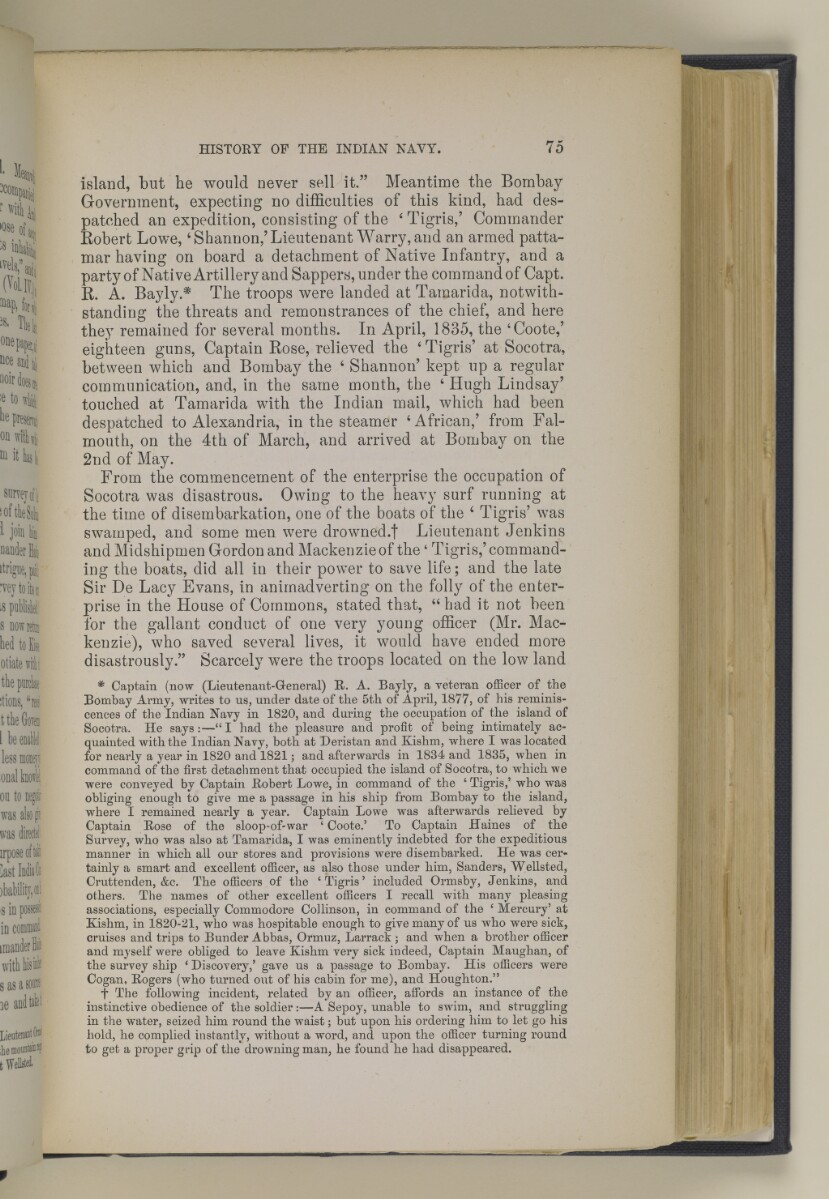
island, but he would never sell it." Meantime the Bombay
Government, expecting no difficulties of this kind, had des
patched an expedition, consisting of the 'Tigris/ Commander
Eobert Lowe, 6 Shannon,'Lieutenant Warry, and an armed patta-
mar having on board a detachment of Native Infantry, and a
party of Native Artillery and Sappers, under the commandof Capt.
E. A. Bayly. # The troops were landed at Tamarida, notwith
standing the threats and remonstrances of the chief, and here
they remained for several months. In April, 1835, the 'Coote,'
eighteen guns, Captain Rose, relieved the 'Tigris' at Socotra,
between which and Bombay the 6 Shannon' kept up a regular
communication, and, in the same month, the 6 Hugh Lindsay'
touched at Tamarida with the Indian mail, which had been
despatched to Alexandria, in the steamer 'African,' from Fal
mouth, on the 4th of March, and arrived at Bombay on the
2nd of May.
From the commencement of the enterprise the occupation of
Socotra was disastrous. Owing to the heavy surf running at
the time of disembarkation, one of the boats of the 6 Tigris' was
swamped, and some men were drowned.f Lieutenant Jenkins
and
Midshipmen
An experienced sailor, but not a commissioned officer.
Gordon and Mackenzie of the 4 Tigris,' command
ing the boats, did all in their power to save life; and the late
Sir De Lacy Evans, in animadverting on the folly of the enter
prise in the House of Commons, stated that, " had it not been
for the gallant conduct of one very young officer (Mr. Mac
kenzie), who saved several lives, it would have ended more
disastrously." Scarcely were the troops located on the low land
* Captain (now (Lieutenant-Greneral) R. A. Bayly, a veteran officer of the
Bombay Army, writes to us, under date of the 5th of April, 1877, of his reminis
cences of the Indian Navy in 1820, and during the occupation of the island of
Socotra. He says:—"I had the pleasure and profit of being intimately ac
quainted with the Indian Navy, both at Deristan and Kishm, where I was located
for nearly a year in 1820 and 1821; and afterwards in 1834 and 1835, when in
command of the first detachment that occupied the island of Socotra, to which we
were conveyed by Captain Robert Lowe, in command of the ' Tigris,' who was
obliging enough to give me a passage in his ship from Bombay to the island,
where I remained nearly a year. Captain Lowe was afterwards relieved by
Captain Rose of the sloop-of-war ' Coote.' To Captain Haines of the
Survey, who was also at Tamarida, I was eminently indebted for the expeditious
manner in which all our stores and provisions were disembarked. He was cer
tainly a smart and excellent officer, as also those under him, Sanders, Wellsted,
Cruttenden, &c. The officers of the 'Tigris' included Ormsby, Jenkins, and
others. The names of other excellent officers I recall with many pleasing
associations, especially Commodore Collinson, in command of the 4 Mercury' at
Kishm, in 1820-21, who was hospitable enough to give many of us who were sick,
cruises and trips to Bunder Abbas, Ormuz, Larrack ; and when a brother officer
and myself were obliged to leave Kishm very sick indeed. Captain Maughan, of
the survey ship 4 Discovery,' gave us a passage to Bombay. His officers were
Cogan, Rogers (who turned out of his cabin for me), and Houghton."
t The following incident, related by an officer, affords an instance of the
instinctive obedience of the soldier:—A
Sepoy
Term used in English to refer to an Indian infantryman. Carries some derogatory connotations as sometimes used as a means of othering and emphasising race, colour, origins, or rank.
, unable to swim, and struggling
in the water, seized him round the waist; but upon his ordering him to let go his
hold, he complied instantly, without a word, and upon the officer turning round
to get a proper grip of the drowning man, he found he had disappeared.
f
About this item
- Content
History of the Indian Navy. (1613-1863).
Author: Charles Rathbone Low.
Publication Details: London: Richard Bentley and Son, New Burlington Street.
Physical Description: initial Roman numeral pagination (i-vi); octavo.
- Extent and format
- 1 volume (575 pages)
- Arrangement
This volume contains a table of contents giving chapter headings and page references. Each chapter heading is followed by a detailed breakdown of the contents of that chapter.
- Physical characteristics
Dimensions: 229mm x 140mm
- Written in
- English in Latin script View the complete information for this record
Use and share this item
- Share this item
'History of the Indian Navy. (1613-1863).' [75] (94/622), British Library: Printed Collections, IOL.1947.a.1844 vol. 2, in Qatar Digital Library <https://www.qdl.qa/archive/81055/vdc_100023958179.0x00005f> [accessed 20 August 2026]
https://www.qdl.qa/en/archive/81055/vdc_100023958179.0x00005f
Copy and paste the code below into your web page where you would like to embed the image.
<meta charset="utf-8"><a href="https://www.qdl.qa/en/archive/81055/vdc_100023958179.0x00005f">'History of the Indian Navy. (1613-1863).' [‎75] (94/622)</a> <a href="https://www.qdl.qa/en/archive/81055/vdc_100023958179.0x00005f"> <img src="https://iiif.qdl.qa/iiif/images/81055/vdc_100023550043.0x000001/IOL.1947.a.1844 vol.2_0094.jp2/full/!280,240/0/default.jpg" alt="" /> </a>
This record has a IIIF manifest available as follows. If you have a compatible viewer you can drag the icon to load it.https://www.qdl.qa/en/iiif/81055/vdc_100023550043.0x000001/manifestOpen in Universal viewerOpen in Mirador viewerMore options for embedding images
Copyright: How to use this content
- Reference
- IOL.1947.a.1844 vol. 2
- Title
- 'History of the Indian Navy. (1613-1863).'
- Pages
- front, back, spine, edge, head, tail, front-i, i-r:iii-v, 1:6, 1:596, iv-r:vi-v, back-i
- Author
- Low. Charles Rathbone
- Usage terms
- Public Domain