
!['History of the Indian Navy. (1613-1863).' [‎32] (51/622)](https://iiif.qdl.qa/iiif/images/81055/vdc_100023550043.0x000001/IOL.1947.a.1844 vol.2_0051.jp2/full/!1200,1200/0/default.jpg "'History of the Indian Navy. (1613-1863).' [‎32] (51/622)")
'History of the Indian Navy. (1613-1863).' [32] (51/622)
The record is made up of 1 volume (575 pages). It was created in 1877. It was written in English. The original is part of the British Library: Printed Collections.
Transcription
This transcription is created automatically. It may contain errors.
32
HISTORY OF THE INDIAN NAVY.
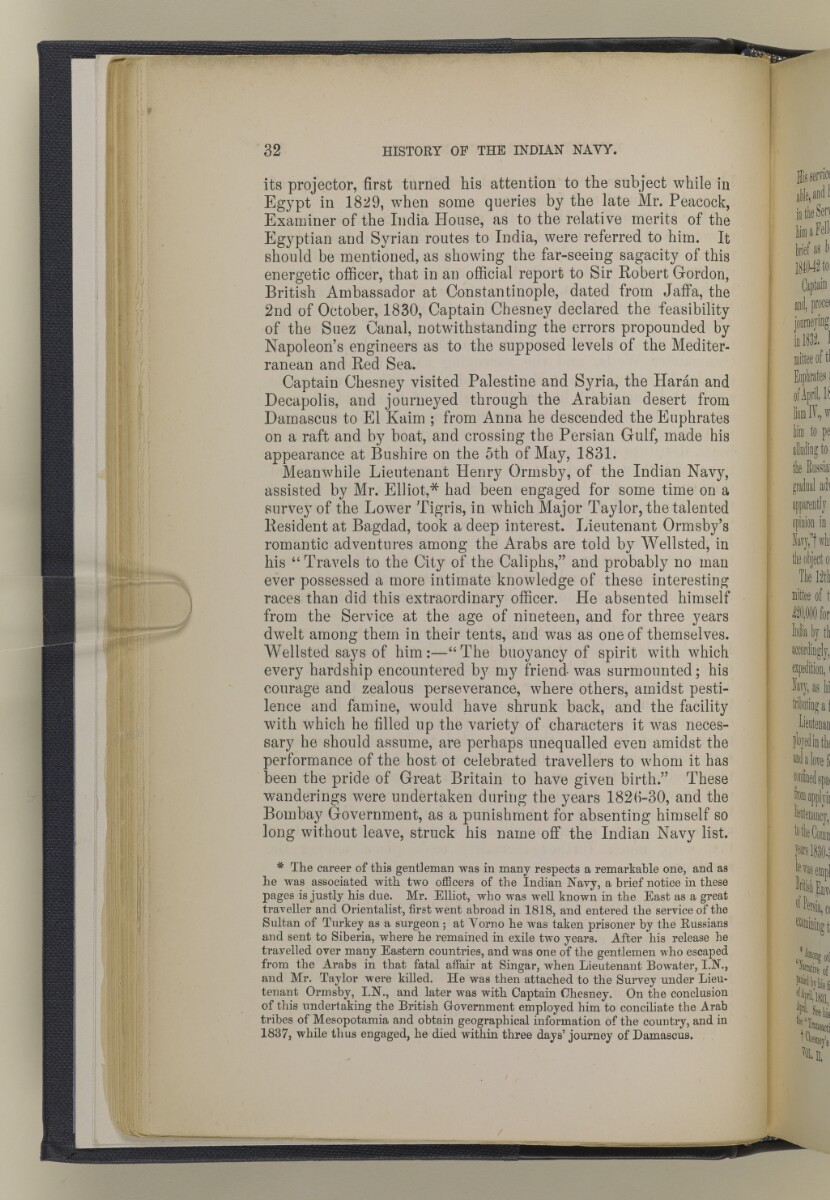
its projector, first turned his attention to the subject while in
Egypt in 1829, when some queries by the late Mr. Peacock,
Examiner of the India House, as to the relative merits of the
Egyptian and Syrian routes to India, were referred to him. It
should be mentioned, as showing the far-seeing sagacity of this
energetic officer, that in an official report to Sir Robert Gordon,
British Ambassador at Constantinople, dated from Jaffa, the
2nd of October, 1830, Captain Chesney declared the feasibility
of the Suez Canal, notwithstanding the errors propounded by
Napoleon's engineers as to the supposed levels of the Mediter
ranean and Red Sea.
Captain Chesney visited Palestine and Syria, the Haran and
Decapolis, and journeyed through the Arabian desert from
Damascus to El Kaim ; from Anna he descended the Euphrates
on a raft and by boat, and crossing the
Persian Gulf
The historical term used to describe the body of water between the Arabian Peninsula and Iran.
, made his
appearance at Bushire on the 5th of May, 1831.
Meanwhile Lieutenant Henry Ormsby, of the Indian Navy,
assisted by Mr. Elliot,*" had been engaged for some time on a
survey of the Lower Tigris, in which Major Taylor, the talented
Resident at Bagdad, took a deep interest. Lieutenant Ormsby's
romantic adventures among the Arabs are told by Wellsted, in
his 64 Travels to the City of the Caliphs," and probably no man
ever possessed a more intimate knowledge of these interesting
races than did this extraordinary officer. He absented himself
from the Service at the age of nineteen, and for three years
dwelt among them in their tents, and w T as as one of themselves.
Wellsted says of him:—"The buoyancy of spirit with which
every hardship encountered by my friend was surmounted; his
courage and zealous perseverance, where others, amidst pesti
lence and famine, would have shrunk back, and the facility
with which he filled up the variety of characters it was neces
sary he should assume, are perhaps unequalled even amidst the
performance of the host ot celebrated travellers to whom it has
been the pride of Great Britain to have given birth." These
wanderings were undertaken during the years 182B-30, and the
Bombay Government, as a punishment for absenting himself so
long without leave, struck his name off the Indian Navy list.
* The career of this gentleman was in many respects a remarkable one, and as
lie was associated with two officers of the Indian Navy, a brief notice in these
pages is justly his due. Mr. Elliot, who was well known in the East as a great
traveller and Orientalist, first went abroad in 1818, and entered the service of the
Sultan of Turkey as a surgeon; at Vorno he was taken prisoner by the Russians
and sent to Siberia, where he remained in exile two years. After his release he
travelled over many Eastern countries, and was one of the gentlemen who escaped
from the Arabs in that fatal affair at Singar, when Lieutenant Bowater, I.N.,
and Mr. Taylor were killed. He was then attached to the Survey under Lieu
tenant Ormsby, I.N., and later was with Captain Chesney. On the conclusion
of this undertaking the British Grovernment employed him to conciliate the Arab
tribes of Mesopotamia and obtain geographical information of the country, and in
1837, while thus engaged, he died within three days' journey of Damascus.
About this item
- Content
History of the Indian Navy. (1613-1863).
Author: Charles Rathbone Low.
Publication Details: London: Richard Bentley and Son, New Burlington Street.
Physical Description: initial Roman numeral pagination (i-vi); octavo.
- Extent and format
- 1 volume (575 pages)
- Arrangement
This volume contains a table of contents giving chapter headings and page references. Each chapter heading is followed by a detailed breakdown of the contents of that chapter.
- Physical characteristics
Dimensions: 229mm x 140mm
- Written in
- English in Latin script View the complete information for this record
Use and share this item
- Share this item
'History of the Indian Navy. (1613-1863).' [32] (51/622), British Library: Printed Collections, IOL.1947.a.1844 vol. 2, in Qatar Digital Library <https://www.qdl.qa/archive/81055/vdc_100023958179.0x000034> [accessed 12 June 2026]
https://www.qdl.qa/en/archive/81055/vdc_100023958179.0x000034
Copy and paste the code below into your web page where you would like to embed the image.
<meta charset="utf-8"><a href="https://www.qdl.qa/en/archive/81055/vdc_100023958179.0x000034">'History of the Indian Navy. (1613-1863).' [‎32] (51/622)</a> <a href="https://www.qdl.qa/en/archive/81055/vdc_100023958179.0x000034"> <img src="https://iiif.qdl.qa/iiif/images/81055/vdc_100023550043.0x000001/IOL.1947.a.1844 vol.2_0051.jp2/full/!280,240/0/default.jpg" alt="" /> </a>
This record has a IIIF manifest available as follows. If you have a compatible viewer you can drag the icon to load it.https://www.qdl.qa/en/iiif/81055/vdc_100023550043.0x000001/manifestOpen in Universal viewerOpen in Mirador viewerMore options for embedding images
Copyright: How to use this content
- Reference
- IOL.1947.a.1844 vol. 2
- Title
- 'History of the Indian Navy. (1613-1863).'
- Pages
- front, back, spine, edge, head, tail, front-i, i-r:iii-v, 1:6, 1:596, iv-r:vi-v, back-i
- Author
- Low. Charles Rathbone
- Usage terms
- Public Domain