
!['Travels in Assyria, Media, and Persia, including a journey from Bagdad by Mount Zagros, to Hamadan, the ancient Ecbatana, researches in Ispahan and the ruins of Persepolis, and journey from thence by Shiraz and Shapoor to the sea-shore. Description of Bussorah, Bushire, Bahrein, Ormuz, and Muscat, narrative of an expedition against the pirates of the Persian Gulf, with illustrations of the voyage of Nearchus, and passage by the Arabian Sea to Bombay.' [‎527] (558/582)](https://iiif.qdl.qa/iiif/images/81055/vdc_100023554058.0x000001/567.g.5._0560.jp2/full/!1200,1200/0/default.jpg "'Travels in Assyria, Media, and Persia, including a journey from Bagdad by Mount Zagros, to Hamadan, the ancient Ecbatana, researches in Ispahan and the ruins of Persepolis, and journey from thence by Shiraz and Shapoor to the sea-shore. Description of Bussorah, Bushire, Bahrein, Ormuz, and Muscat, narrative of an expedition against the pirates of the Persian Gulf, with illustrations of the voyage of Nearchus, and passage by the Arabian Sea to Bombay.' [‎527] (558/582)")
'Travels in Assyria, Media, and Persia, including a journey from Bagdad by Mount Zagros, to Hamadan, the ancient Ecbatana, researches in Ispahan and the ruins of Persepolis, and journey from thence by Shiraz and Shapoor to the sea-shore. Description of Bussorah, Bushire, Bahrein, Ormuz, and Muscat, narrative of an expedition against the pirates of the Persian Gulf, with illustrations of the voyage of Nearchus, and passage by the Arabian Sea to Bombay.' [527] (558/582)
The record is made up of 1 volume (545 pages). It was created in 1829. It was written in English. The original is part of the British Library: Printed Collections.
Transcription
This transcription is created automatically. It may contain errors.
CAPE OF RAS-EL-HAD. ^7
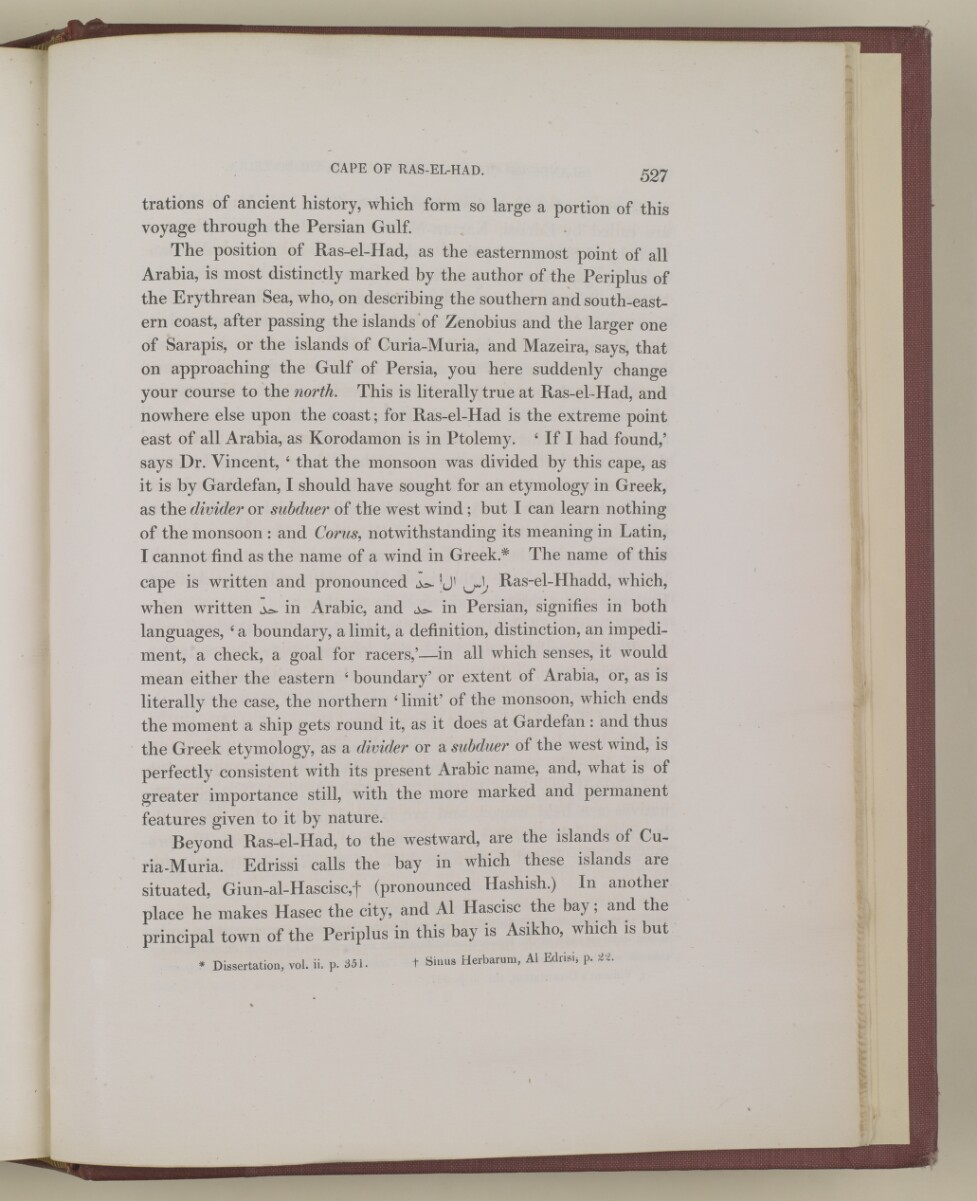
trations of ancient history, which form so large a portion of this
voyage through the
Persian Gulf
The historical term used to describe the body of water between the Arabian Peninsula and Iran.
.
The position of Ras-el-Had, as the easternmost point of all
Arabia, is most distinctly marked by the author of the Periplus of
the Erythrean Sea, who, on describing the southern and south-east
ern coast, after passing the islands of Zenobius and the larger one
of Sarapis, or the islands of Curia-Muria, and Mazeira, says, that
on approaching the Gulf of Persia, you here suddenly change
your course to the north. This is literally true at Ras-el-Had, and
nowhere else upon the coast; for Ras-el-Had is the extreme point
east of all Arabia, as Korodamon is in Ptolemy. 4 If I had found,'
says Dr. Vincent, ' that the monsoon was divided by this cape, as
it is by Gardefan, I should have sought for an etymology in Greek,
as the divider or subduer of the west wind; but I can learn nothing
of the monsoon : and Corns, notwithstanding its meaning in Latin,
I cannot find as the name of a wind in Greek. # The name of this
cape is written and pronounced ^ ^ Ras-el-Hhadd, which,
when written ^ in Arabic, and ^ in Persian, signifies in both
languages, 4 a boundary, a limit, a definition, distinction, an impedi
ment, a check, a goal for racers,'—in all which senses, it would
mean either the eastern 4 boundary' or extent of Arabia, or, as is
literally the case, the northern 4 limit' of the monsoon, which ends
the moment a ship gets round it, as it does at Gardefan : and thus
the Greek etymology, as a divider or a subduer of the west wind, is
perfectly consistent with its present Arabic name, and, what is of
greater importance still, with the more marked and permanent
features given to it by nature.
Beyond Ras-el-Had, to the westward, are the islands of Cu
ria-Muria. Edrissi calls the bay in which these islands are
situated, Giun-al-Hascisc,t (pronounced Hashish.) In another
place he makes Hasec the city, and A1 Hascisc the bay; and the
principal town of the Periplus in this bay is Asikho, which is but
* Dissertation, vol. ii. p. 351. t Sinus Herbarum, Al Edris.i p. ^2.
About this item
- Content
Travels in Assyria, Media, and Persia, including a journey from Bagdad by Mount Zagros, to Hamadan, the ancient Ecbatana, researches in Ispahan and the ruins of Persepolis, and journey from thence by Shiraz and Shapoor to the sea-shore. Description of Bussorah, Bushire, Bahrein, Ormuz, and Muscat, narrative of an expedition against the pirates of the Persian Gulf The historical term used to describe the body of water between the Arabian Peninsula and Iran. , with illustrations of the voyage of Nearchus, and passage by the Arabian Sea to Bombay.
The book is written by James Silk Buckingham and contains illustrations and a map at the beginning, entitled "General map of Persia, with the routes pursued by Mr Buckingham in his travels from Bagdad across the mountains of Zagros, through Assyria, Media & Persia, incuding the chief positions of all the ancient cities & modern towns, from the banks of the Tigris to the shores of the Persian Gulf The historical term used to describe the body of water between the Arabian Peninsula and Iran. " and signed "Sidy. Hall, sculpt."
Buckingham is identified on title page as "author of Travels in Palestine and the countries east of the Jordan; Travels among the Arab tribes; and Travels in Mesopotamia; member of the Literary Societies of Bombay and Madras, and of the Asiatic Society of Bengal." Name of manufacturer from p. ii. Portrait of the author signed as follows: "Drawn and Etched by W.H. Brooke, A.R.H.A." and "Aquatinted by R. Havell Jnr." Dedication to Sir Charles Forbes on p. v. Vignette on p. 545. With publication announcement of the second edition of Buckingham's Travels in Mesopotamia on last unnumbered page.
Publication Details: London : Henry Colburn, New Burlington Street, 1829. Printed by S. and R. Bentley, Dorset Street, Fleet Street.
- Extent and format
- 1 volume (545 pages)
- Arrangement
There is a table of contents at the beginning (vii-xvi) and an index at the end of the volume (539-545).
- Physical characteristics
Dimensions: 283 mm x 220 mm.
Pagination: xvi, 545, [1] p., [2] leaves of plates (1 folded).
- Written in
- English in Latin script View the complete information for this record
Use and share this item
- Share this item
'Travels in Assyria, Media, and Persia, including a journey from Bagdad by Mount Zagros, to Hamadan, the ancient Ecbatana, researches in Ispahan and the ruins of Persepolis, and journey from thence by Shiraz and Shapoor to the sea-shore. Description of Bussorah, Bushire, Bahrein, Ormuz, and Muscat, narrative of an expedition against the pirates of the Persian Gulf, with illustrations of the voyage of Nearchus, and passage by the Arabian Sea to Bombay.' [527] (558/582), British Library: Printed Collections, 567.g.5., in Qatar Digital Library <https://www.qdl.qa/archive/81055/vdc_100023859738.0x00009f> [accessed 30 August 2026]
https://www.qdl.qa/en/archive/81055/vdc_100023859738.0x00009f
Copy and paste the code below into your web page where you would like to embed the image.
<meta charset="utf-8"><a href="https://www.qdl.qa/en/archive/81055/vdc_100023859738.0x00009f">'Travels in Assyria, Media, and Persia, including a journey from Bagdad by Mount Zagros, to Hamadan, the ancient Ecbatana, researches in Ispahan and the ruins of Persepolis, and journey from thence by Shiraz and Shapoor to the sea-shore. Description of Bussorah, Bushire, Bahrein, Ormuz, and Muscat, narrative of an expedition against the pirates of the Persian Gulf, with illustrations of the voyage of Nearchus, and passage by the Arabian Sea to Bombay.' [‎527] (558/582)</a> <a href="https://www.qdl.qa/en/archive/81055/vdc_100023859738.0x00009f"> <img src="https://iiif.qdl.qa/iiif/images/81055/vdc_100023554058.0x000001/567.g.5._0560.jp2/full/!280,240/0/default.jpg" alt="" /> </a>
This record has a IIIF manifest available as follows. If you have a compatible viewer you can drag the icon to load it.https://www.qdl.qa/en/iiif/81055/vdc_100023554058.0x000001/manifestOpen in Universal viewerOpen in Mirador viewerMore options for embedding images
Copyright: How to use this content
- Reference
- 567.g.5.
- Title
- 'Travels in Assyria, Media, and Persia, including a journey from Bagdad by Mount Zagros, to Hamadan, the ancient Ecbatana, researches in Ispahan and the ruins of Persepolis, and journey from thence by Shiraz and Shapoor to the sea-shore. Description of Bussorah, Bushire, Bahrein, Ormuz, and Muscat, narrative of an expedition against the pirates of the Persian Gulf, with illustrations of the voyage of Nearchus, and passage by the Arabian Sea to Bombay.'
- Pages
- front, back, spine, edge, head, tail, front-i, i-r:iii-v, 1:18, 1:546, iv-r:v-v, back-i
- Author
- Buckingham, James Silk
- Usage terms
- Public Domain