
!['Report on Najd Mission 1917-1918' [‎6r] (11/60)](https://iiif.qdl.qa/iiif/images/81055/vdc_100000000193.0x0002d3/IOR_R_15_1_747_0011.jp2/full/!1200,1200/0/default.jpg "'Report on Najd Mission 1917-1918' [‎6r] (11/60)")
'Report on Najd Mission 1917-1918' [6r] (11/60)
The record is made up of 1 volume (28 folios). It was created in 1918. It was written in English. The original is part of the British Library: India Office The department of the British Government to which the Government of India reported between 1858 and 1947. The successor to the Court of Directors. Records and Private Papers Documents collected in a private capacity. .
Transcription
This transcription is created automatically. It may contain errors.
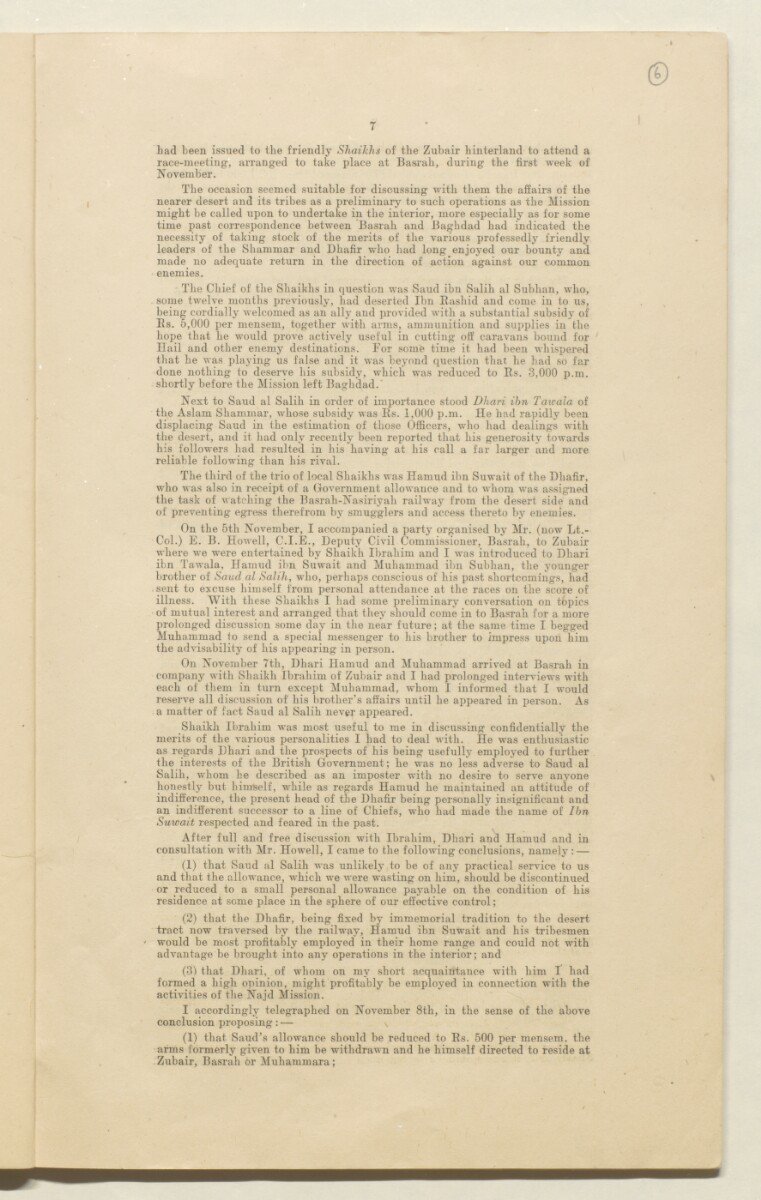
had been issued to the friendly Shaikhs of the Zubair hinterland to attend a
race-meeting, arranged to take place at Basrah, during the first week of
November.
The occasion seemed suitable for discussing with them the affairs of the
nearer desert and its tribes as a preliminary to such operations as the Mission
might be called upon to undertake in the interior, more especially as for some
time past correspondence between Basrah and Baghdad had indicated the
necessity of taking stock of the merits of the various professedly friendly
leaders of the Shammar and Dhafir who had long enjoyed our bounty and
made no adequate return in the direction of action against our common
enemies.
The Chief of the Shaikhs in question was Saud ibn Salih al Subhan, who,
some twelve months previously, had deserted Ibn Eashid and come in to us,
being cordially welcomed as an ally and provided with a substantial subsidy of
Es. 5,000 per mensem, together with arms, ammunition and supplies in the
hope that he would prove actively useful in cutting off caravans bound for
Hail and other enemy destinations. For some time it had been whispered
that he was playing us false and it was beyond question that he had so far
done nothing to deserve his subsidy, which was reduced to Es. 3,000 p.m.
shortly before the Mission left Baghdad.
Next to Saud al Salih in order of importance stood Dhari ihn Tawala of
the Aslam Shammar, whose subsidy was Es. 1,000 p.m. He had rapidly been
displacing Saud in the estimation of those Officers, who had dealings with
the desert, and it had only recently been reported that his generosity towards
his followers had resulted in his having at his call a far larger and more
reliable following than his rival.
The third of the trio of local Shaikhs was Hamud ibn Suwait of the Dhafir,
who was also in receipt of a Government allowance and to whom was assigned
the task of watching the Basrah-Nasiriyah railway from the desert side and
of preventing egress therefrom by smugglers and access thereto by enemies.
On the 5th November, I accompanied a party organised by Mr. (now Lt.-
Col.) E. B. Howell, C.I.E., Deputy Civil Commissioner, Basrah, to Zubair
where we were entertained by Shaikh Ibrahim and I was introduced to Dhari
ibn Tawala, Hamud ibn Suwait and Muhammad ibn Subhan, the younger
brother of Saud al Salih, who, perhaps conscious of his past shortcomings, had
sent to excuse himself from personal attendance at the races on the score of
illness. With these Shaikhs I had some preliminary conversation on topics
of mutual interest and arranged that they should come in to Basrah for a more
prolonged discussion some day in the near future; at the same time I begged
Muhammad to send a special messenger to his brother to impress upon him
the advisability of his appearing in person.
On November Tth, Dhari Hamud and Muhammad arrived at Basrah in
company with Shaikh Ibrahim of Zubair and I had prolonged interviews with
each of them in turn except Muhammad, whom I informed that I would
reserve all discussion of his brother's affairs until he appeared in person. As
a matter of fact Sand al Salih never appeared.
Shaikh Ibrahim was most useful to me in discussing confidentially the
merits of the various personalities I had to deal with. He was enthusiastic
as regards Dhari and the prospects of his being usefully employed to further
the interests of the British Government ; he was no less adverse to Saud al
Salih, whom he described as an imposter with no desire to serve anyone
honestly but himself, while as regards Hamud he maintained an attitude of
indifference, the present head of the Dhafir being personally insignificant and
an indifferent successor to a line of Chiefs, who had made the name of Ihn
Suwait respected and feared in the past.
After full and free discussion with Ibrahim, Dhari and Hamud and in
consultation with Mr. Howell, I came to the following conclusions, namely: —
(1) that Saud al Salih was unlikely to be of any practical service to us
and that the allowance, which we were wasting on him, should be discontinued
or reduced to a small personal allowance payable on the condition of his
residence at some place in the sphere of our effective control;
(2) that the Dhafir, being fixed by immemorial tradition to the desert
tract now traversed by the railway, Hamud ibn Suwait and his tribesmen
' would be most profitably employed in their home range and could not with
advantage be brought into any operations in the interior; and
(3) that Dhari, of whom on my short acquaintance with him I had
formed a high opinion, might profitably be employed in connection with the
activities of the Najd Mission.
I accordingly telegraphed on November 8th, in the sense of the above
conclusion proposing: —
(1) that Sand's allowance should be reduced to Es. 500 per mensem, the
arms formerly given to him be withdrawn and he himself directed to reside at
Zubair, Basrah or Muhammara;
About this item
- Content
The volume is entitled Report on Najd Mission, 1917-1918 (Baghdad: Government Press, 1918).
The report describes the mission headed by Harry St John Bridger Philby to Ibn Saud [‘Abd al-‘Azīz bin ‘Abd al-Raḥman bin Fayṣal Āl Sa‘ūd (Ibn Sa‘ūd)], ruler of Najd and Imam of the Wahahbi [Wahhabi] sect of Islam, 29 October 1917 - 1 November 1918. The report contains a section on the previous relations between Britain and Najd; describes the personnel, objects and itinerary of the mission; and includes sections on relations between Najd and Kuwait, the Ajman problem, Ibn Saud's operations against Hail [Ha'il], the Wahhabi revival, arms in Najd, and pilgrimage to the Shia Holy Places.
- Extent and format
- 1 volume (28 folios)
- Arrangement
There is a summary of contents on folio 2.
- Physical characteristics
Foliation: the foliation sequence commences at 1 on the front cover and terminates at 30 on the back cover. These numbers are written in pencil, are enclosed in a circle, and can be found in the top right hand corner of the recto The front of a sheet of paper or leaf, often abbreviated to 'r'. page of each folio. An original printed pagination sequence is also present.
- Written in
- English in Latin script View the complete information for this record
Use and share this item
- Share this item
'Report on Najd Mission 1917-1918' [6r] (11/60), British Library: India Office Records and Private Papers, IOR/R/15/1/747, in Qatar Digital Library <https://www.qdl.qa/archive/81055/vdc_100022698600.0x00000c> [accessed 19 July 2026]
https://www.qdl.qa/en/archive/81055/vdc_100022698600.0x00000c
Copy and paste the code below into your web page where you would like to embed the image.
<meta charset="utf-8"><a href="https://www.qdl.qa/en/archive/81055/vdc_100022698600.0x00000c">'Report on Najd Mission 1917-1918' [‎6r] (11/60)</a> <a href="https://www.qdl.qa/en/archive/81055/vdc_100022698600.0x00000c"> <img src="https://iiif.qdl.qa/iiif/images/81055/vdc_100000000193.0x0002d3/IOR_R_15_1_747_0011.jp2/full/!280,240/0/default.jpg" alt="" /> </a>
This record has a IIIF manifest available as follows. If you have a compatible viewer you can drag the icon to load it.https://www.qdl.qa/en/iiif/81055/vdc_100000000193.0x0002d3/manifestOpen in Universal viewerOpen in Mirador viewerMore options for embedding images
Copyright: How to use this content
- Reference
- IOR/R/15/1/747
- Title
- 'Report on Najd Mission 1917-1918'
- Pages
- front, front-i, 2r:29v, back-i, back
- Author
- East India Company, the Board of Control, the India Office, or other British Government Department
- Usage terms
- Open Government Licence