
![تقرير البعثة الخاصة إلى مصر بقيادة اللورد ميلنر، وأوراق ذات صلة [<span dir="ltr">و١٦٠</span>] (٤٧٣/٣٢٢)](https://iiif.qdl.qa/iiif/images/81055/vdc_100000001491.0x000295/Mss Eur F112_260_0322.jp2/full/!1200,1200/0/default.jpg "تقرير البعثة الخاصة إلى مصر بقيادة اللورد ميلنر، وأوراق ذات صلة [<span dir=\"ltr\">و١٦٠</span>] (٤٧٣/٣٢٢)")
تقرير البعثة الخاصة إلى مصر بقيادة اللورد ميلنر، وأوراق ذات صلة [و١٦٠] (٤٧٣/٣٢٢)
محتويات السجل: ملف واحد (٢٣٧ ورقة). يعود تاريخه إلى ١٥ مايو ١٩٢٠-١٤ أكتوبر ١٩٢١. اللغة أو اللغات المستخدمة: الإنجليزية. النسخة الأصلية محفوظة في المكتبة البريطانية: أوراق خاصة وثائق جُمعت بصفة شخصية. وسجلات من مكتب الهند إدارة الحكومة البريطانية التي كانت الحكومة في الهند ترفع إليها تقاريرها بين عامي ١٨٥٨ و١٩٤٧، حيث خلِفت مجلس إدارة شركة الهند الشرقية. .
نسخ
النسخ مستحدث آليًا ومن المرجّح أن يحتوي على أخطاء.
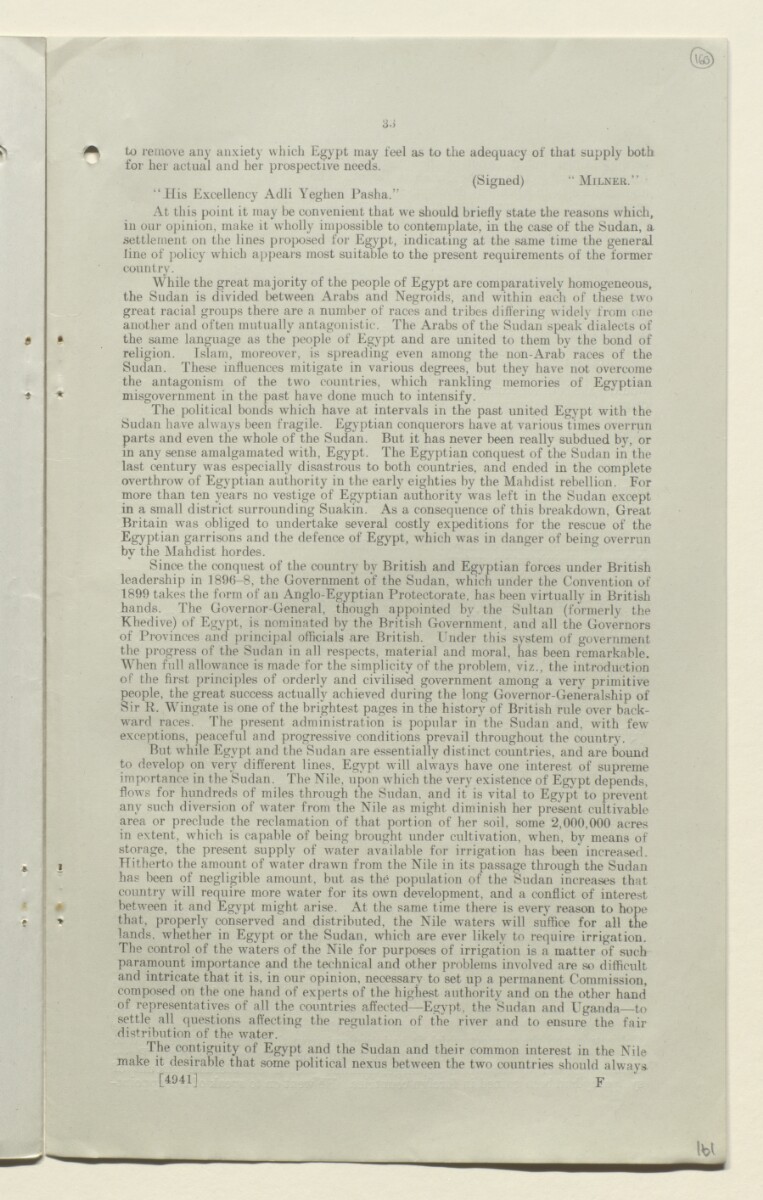
to remove any anxiety which Egypt may feel as to the adequacy of that supply both
for her actual and her prospective needs.
(Signed) “ Milner.”
“ His Excellency Adli Yeghen Pasha.”
At this point it may be convenient that we should briefly state the reasons which,
in our opinion, make it wholly impossible to contemplate, in the case of the Sudan, a
settlement on the lines proposed for Egypt, indicating at the same time the general
line of policy which appears most suitable to the present requirements of the former
country.
While the great majority of the people of Egypt are comparatively homogeneous,
the Sudan is divided between Arabs and Negroids, and within each of these two
great racial groups there are a number of races and tribes differing widely from one
another and often mutually antagonistic. The Arabs of the Sudan speak dialects of
the same language as the people of Egypt and are united to them by the bond of
religion. Islam, moreover, is spreading even among the non-Arab races of the
Sudan. These influences mitigate in various degrees, but they have not overcome
the antagonism of the two countries, which rankling memories of Egyptian
misgovernment in the past have done much to intensify.
The political bonds which have at intervals in the past united Egypt with the
Sudan have always been fragile. Egyptian conquerors have at various times overrun
parts and even the whole of the Sudan. But it has never been really subdued by, or
in any sense amalgamated with, Egypt. The Egyptian conquest of the Sudan in the
last century was especially disastrous to both countries, and ended in the complete
overthrow of Egyptian authority in the early eighties by the Mahdist rebellion. For
more than ten years no vestige of Egyptian authority was left in the Sudan except
in a small district surrounding Suakin. As a consequence of this breakdown, Great
Britain was obliged to undertake several costly expeditions for the rescue of the
Egyptian garrisons and the defence of Egypt, which was in danger of being overrun
by the Mahdist hordes.
Since the conquest of the country by British and Egyptian forces under British
leadership in 1896-8, the Government of the Sudan, which under the Convention of
1899 takes the form of an Anglo-Egyptian Protectorate, has been virtually in British
hands. The Governor-General, though appointed by the Sultan (formerly the
Khedive) of Egypt, is nominated by the British Government, and all the Governors
of Provinces and principal officials are British. Under this system of government
the progress of the Sudan in all respects, material and moral, has been remarkable.
When full allowance is made for the simplicity of the problem, viz., the introduction
o*‘ the first principles of orderly and civilised government among a very primitive
people, the great success actually achieved during the long Governor-Generalship of
Sir R. Wingate is one of the brightest pages in the history of British rule over back
ward races. The present administration is popular in the Sudan and. with few
exceptions, peaceful and progressive conditions prevail throughout the country.
But while Egypt and the Sudan are essentially distinct countries, and are bound
to develop on very different lines. Egypt will always have one interest of supreme
importance in the Sudan. The Nile, upon which the very existence of Egypt depends,
flows for hundreds of miles through the Sudan, and it is vital to Egypt to prevent
any such diversion of water from the Nile as might diminish her present cultivable
area or preclude the reclamation of that portion of her soil, some 2,000,000 acres
in extent, which is capable of being brought under cultivation, when, by means of
storage, the present supply of water available for irrigation has been increased.
Hitherto the amount of water drawn from the Nile in its passage through the Sudan
has been of negligible amount, but as the population of the Sudan increases that
country will require more water for its own development, and a conflict of interest
between it and Egypt might arise. At the same time there is every reason to hope
that, properly conserved and distributed, the Nile waters will suffice for all the
lands, whether in Egypt or the Sudan, which are ever likely to require irrigation.
The control of the waters of the Nile for purposes of irrigation is a matter of such
paramount importance and the technical and other problems involved are so difficult
and intricate that it is, in our opinion, necessary to set up a permanent Commission,
composed on the one hand of experts of the highest authority and on the other hand
of representatives of all the countries affected—Egypt, the Sudan and Uganda—to
settle all questions affecting the regulation of the river and to ensure the fair
distribution of the water.
The contiguity of Egypt and the Sudan and their common interest in the Nile
make it desirable that some political nexus between the two countries should always
[4941] y
حول هذه المادة
- المحتوى
يحتوي الملف على مراسلات ومذكرات وتقارير رسمية تتعلق بالشؤون السياسية في مصر. المتراسلون والكاتبون هم مسؤولون في وزارة الخارجية (كان اللورد كرزون وزير الدولة للشؤون الخارجية في ذلك الوقت)، مكتب الحرب البريطاني، وزارة الطيران، الأميرالية، مكتب المستعمرات البريطانية، مجلس التجارة، مجلس التعليم، بالإضافة إلى الخدمة المدنية المصرية.
يحتوي الملف على نسخ من تقارير البعثة الخاصة إلى مصر (الأوراق ١-٧، ٧٥-٩٣، ١٧٥-١٩٤) بقيادة اللورد ألفريد ميلنر، والتي كانت تهدف إلى إجراء التحقيقات وتقديم المشورة في أعقاب قيام الثورة المصرية في ١٩١٩. يأتي جزءٌ كبير من محتوى الملف ردًا على نتائج وتوصيات البعثة، ويناقش إمكانيات التوصل إلى تسوية سياسية مع مصر.
- الشكل والحيّز
- ملف واحد (٢٣٧ ورقة)
- الترتيب
الملف مرتب ترتيبًا زمنيًا من بدايته إلى نهايته.
- الخصائص المادية
ترقيم الأوراق: يبدأ تسلسل ترقيم الأوراق (المستخدم للأغراض المرجعية) على الغلاف الأمامي بالرقم ١، وينتهي داخل الغلاف الخلفي بالرقم ٢٣٥؛ هذه الأرقام مكتوبة بالقلم الرصاص ومحاطة بدائرة في أعلى يمين صفحة الوجه الجانب الأمامي للورقة أو لفرخٍ من الورق. كثيرًا ما يشار إليه اختصارًا بالحرف "و". من كل ورقة. يوجد في الملف استثناء واحد في ترقيم الأوراق، ص. ٧٦أ.
- لغة الكتابة
- الإنجليزية بالأحرف اللاتينية للاطّلاع على المعلومات الكاملة لهذا السجل
استخدام وإعادة نشر هذه المادة
- إعادة نشر هذه المادة
تقرير البعثة الخاصة إلى مصر بقيادة اللورد ميلنر، وأوراق ذات صلة [و١٦٠] (٤٧٣/٣٢٢)و المكتبة البريطانية: أوراق خاصة وسجلات من مكتب الهندو Mss Eur F112/260و مكتبة قطر الرقمية <https://www.qdl.qa/archive/81055/vdc_100080131820.0x00007b> [تم الوصول إليها في ١٦ غشت ٢٠٢٦]
https://www.qdl.qa/العربية/archive/81055/vdc_100080131820.0x00007b
يمكنك نسخ ولصق الفقرة التالية لتضمين الصورة في صفحة الويب الخاصة بك.
<meta charset="utf-8"><a href="https://www.qdl.qa/العربية/archive/81055/vdc_100080131820.0x00007b">تقرير البعثة الخاصة إلى مصر بقيادة اللورد ميلنر، وأوراق ذات صلة [<span dir="ltr">و١٦٠</span>] (٤٧٣/٣٢٢)</a> <a href="https://www.qdl.qa/العربية/archive/81055/vdc_100080131820.0x00007b"> <img src="https://iiif.qdl.qa/iiif/images/81055/vdc_100000001491.0x000295/Mss Eur F112_260_0322.jp2/full/!280,240/0/default.jpg" alt="" /> </a>
هذا التسجيل IIIF له ملف ظاهر متوفر كما يلي. إذا كان لديك عارض متوافق للصور يمكنك سحب الأيقونة لتحميله.https://www.qdl.qa/العربية/iiif/81055/vdc_100000001491.0x000295/manifestافتح في المتصفح العامافتح في عارض IIIF ميرادورطرق إضافية لاستخدام صور الأرشيف الرقمي
حقوق النسخ والتأليف: كيفية استخدام هذا المحتوى
- رقم الاستدعاء
- Mss Eur F112/260
- العنوان
- تقرير البعثة الخاصة إلى مصر بقيادة اللورد ميلنر، وأوراق ذات صلة
- الصفحات
- ظ٢٣٥:و١٤٤ ،وأ١٤٤ ،ظ١٤٣:و١٤٣ ،ظ١٤٠:و٧٧ ،ظأ٧٦:وأ٧٦ ،ظ٧٦:و٥٣ ،ظ٥٠:و٤٢ ،ظ٣٩:و٢ ،داخلي-أمامي ،أمامي
- المؤلف
- شركة الهند الشرقية ولجنة البرلمان البريطاني لشئون الهند ومكتب الهند وإدارات الحكومة البريطانية الأخرى
- شروط الاستخدام
- ترخيص حكومي عام