
![تقرير البعثة الخاصة إلى مصر بقيادة اللورد ميلنر، وأوراق ذات صلة [<span dir="ltr">و١٨٤</span>] (٤٧٣/٣٧٠)](https://iiif.qdl.qa/iiif/images/81055/vdc_100000001491.0x000295/Mss Eur F112_260_0370.jp2/full/!1200,1200/0/default.jpg "تقرير البعثة الخاصة إلى مصر بقيادة اللورد ميلنر، وأوراق ذات صلة [<span dir=\"ltr\">و١٨٤</span>] (٤٧٣/٣٧٠)")
تقرير البعثة الخاصة إلى مصر بقيادة اللورد ميلنر، وأوراق ذات صلة [و١٨٤] (٤٧٣/٣٧٠)
محتويات السجل: ملف واحد (٢٣٧ ورقة). يعود تاريخه إلى ١٥ مايو ١٩٢٠-١٤ أكتوبر ١٩٢١. اللغة أو اللغات المستخدمة: الإنجليزية. النسخة الأصلية محفوظة في المكتبة البريطانية: أوراق خاصة وثائق جُمعت بصفة شخصية. وسجلات من مكتب الهند إدارة الحكومة البريطانية التي كانت الحكومة في الهند ترفع إليها تقاريرها بين عامي ١٨٥٨ و١٩٤٧، حيث خلِفت مجلس إدارة شركة الهند الشرقية. .
نسخ
النسخ مستحدث آليًا ومن المرجّح أن يحتوي على أخطاء.
19
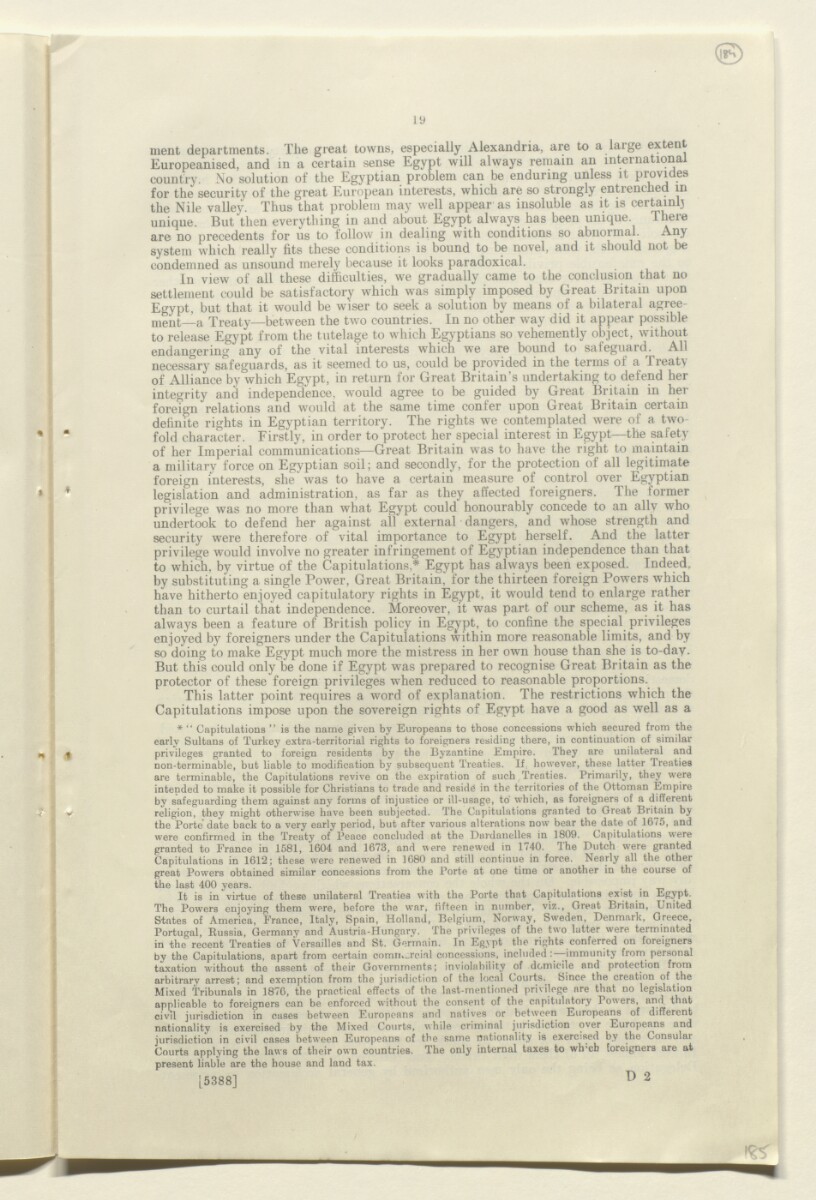
ment departments. The great towns, especially Alexandria, are to a laige extent
Europeanised, and in a certain sense Egypt will always remain an international
country. No solution of the Egyptian problem can be enduring unless it provides
for the security of the great European interests, which are so strongly entrenched in
the Nile valley. Thus that problem may well appear as insoluble as it is certainly
unique. But then everything in and about Egypt always has been unique There
are no precedents for us to follow in dealing with conditions so abnormal. Any
system which really fits these conditions is bound to be novel, and it should not be
condemned as unsound merely because it looks paradoxical.
In view of all these difficulties, we gradually came to the conclusion that no
settlement could be satisfactory which was simply imposed by Great Britain upon
Egypt, but that it would be wiser to seek a solution by means of a bilateral agree-
m ent—a Treaty—between the two countries. In no other way did it appear possible
to release Egypt from the tutelage to which Egyptians so vehemently object, without
endangering any of the vital interests which we are bound to safeguard. All
necessary safeguards, as it seemed to us, could be provided in the terms of a Treaty
of Alliance by which Egypt, in return for Great Britain’s undertaking to defend her
integrity and independence, would agree to be guided by Great Britain in hei
foreign relations and would at the same time confer upon Great Britain certain
definite rights in Egyptian territory. The rights we contemplated were of a two
fold character. Firstly, in order to protect her special interest in Egypt—the safety
of her Imperial communications—Great Britain was to have the right to maintain
a military force on Egyptian soil; and secondly, for the protection of all legitimate
foreign interests, she* was to have a certain measure of control over Egyptian
legislation and administration, as far as they affected foreigners. The former
privilege was no more than what Egypt could honourably concede to an allv who
undertook to defend her against all external • dangers, and whose strength and
security were therefore of vital importance to Egypt herself. And the latter
privilege would involve no greater infringement of Egyptian independence than that
to which, by virtue of the Capitulations,* Egypt has always been exposed. Indeed,
by substituting a single Power, Great Britain, for the thirteen foreign Powers which
have hitherto enjoyed capitulatory rights in Egypt, it would tend to enlarge rather
than to curtail that independence. Moreover, it was part of our scheme, as it has
always been a feature of British policy in Egypt, to confine the special privileges
enjoyed by foreigners under the Capitulations within more reasonable limits, and by
so doing to make Egypt much more the mistress in her own house than she is to-day.
But this could only be done if Egypt was prepared to recognise Great Britain as the
protector of these foreign privileges when reduced to reasonable proportions.
This latter point requires a word of explanation. The restrictions which the
Capitulations impose upon the sovereign rights of Egypt have a good as well as a
* “ Capitulations ” is the name given by Europeans to those concessions which secured from the
early Sultans of Turkey extra-territorial rights to foreigners residing there, in continuation of similar
privileges granted to foreign residents by the Byzantine Empire. They are unilateral and
non-terminable, but liable to modification by subsequent Treaties. If. however, these latter treaties
are terminable, the Capitulations revive on the expiration of such Treaties. Primarily, they were
intended to make it possible for Christians to trade and reside in the territories of the Ottoman Empire
by safeguarding them against any forms of injustice or ill-usage, to which, as foreigners of a different
religion, they might otherwise have been subjected. The Capitulations granted to Great Britain by
the Porte date back to a very early period, but after various alterations now bear the date of 1675, and
were confirmed in the Treaty of Peace concluded at the Dardanelles in 1809. Capitulations w r ere
granted to France in 1581, 1604 and 1673, and were renewed in 1740. Ihe Dutch w r ere granted
Capitulations in 1612; these were renewed in 1680 and still continue in force. Nearly all the other
great Powers obtained similar concessions from the Porte at one time or another in the course of
the last 400 years. . . . .
It is in virtue of these unilateral Treaties with the Porte that Capitulations exist in Egypt.
The Powers enjoying them were, before the war, fifteen in number, viz., Great Britain, United
States of America, France, Italy, Spain, Holland, Belgium, Norway, Sw r eden, Denmark, Greece,
Portugal, Russia, Germany and Austria-Hungary. The privileges of the two latter were terminated
in the recent Treaties of Versailles and St. Germain. In Egypt the rights conferred on foreigners
by the Capitulations, apart from certain commercial concessions, included immunity from personal
taxation without the assent of their Governments; inviolability of domicile and protection from
arbitrary arrest; and exemption from the jurisdiction of the local Courts. Since the creation of the
Mixed Tribunals in 1876, the practical effects of the last-mentioned privilege are that no legislation
applicable to foreigners can be enforced without the consent of the capitulatory Powers, and that
civil jurisdiction in cases between Europeans and natives or between Europeans of different
nationality is exercised by the Mixed Courts, while criminal jurisdiction over Europeans and
jurisdiction in civil cases betw’een Europeans of the same nationality is exercised by the Consular
Courts applying the laws of their own countries. The only internal taxes to wlvcb foreigners are at
present liable are the house and land tax.
[5388] D 2
حول هذه المادة
- المحتوى
يحتوي الملف على مراسلات ومذكرات وتقارير رسمية تتعلق بالشؤون السياسية في مصر. المتراسلون والكاتبون هم مسؤولون في وزارة الخارجية (كان اللورد كرزون وزير الدولة للشؤون الخارجية في ذلك الوقت)، مكتب الحرب البريطاني، وزارة الطيران، الأميرالية، مكتب المستعمرات البريطانية، مجلس التجارة، مجلس التعليم، بالإضافة إلى الخدمة المدنية المصرية.
يحتوي الملف على نسخ من تقارير البعثة الخاصة إلى مصر (الأوراق ١-٧، ٧٥-٩٣، ١٧٥-١٩٤) بقيادة اللورد ألفريد ميلنر، والتي كانت تهدف إلى إجراء التحقيقات وتقديم المشورة في أعقاب قيام الثورة المصرية في ١٩١٩. يأتي جزءٌ كبير من محتوى الملف ردًا على نتائج وتوصيات البعثة، ويناقش إمكانيات التوصل إلى تسوية سياسية مع مصر.
- الشكل والحيّز
- ملف واحد (٢٣٧ ورقة)
- الترتيب
الملف مرتب ترتيبًا زمنيًا من بدايته إلى نهايته.
- الخصائص المادية
ترقيم الأوراق: يبدأ تسلسل ترقيم الأوراق (المستخدم للأغراض المرجعية) على الغلاف الأمامي بالرقم ١، وينتهي داخل الغلاف الخلفي بالرقم ٢٣٥؛ هذه الأرقام مكتوبة بالقلم الرصاص ومحاطة بدائرة في أعلى يمين صفحة الوجه الجانب الأمامي للورقة أو لفرخٍ من الورق. كثيرًا ما يشار إليه اختصارًا بالحرف "و". من كل ورقة. يوجد في الملف استثناء واحد في ترقيم الأوراق، ص. ٧٦أ.
- لغة الكتابة
- الإنجليزية بالأحرف اللاتينية للاطّلاع على المعلومات الكاملة لهذا السجل
استخدام وإعادة نشر هذه المادة
- إعادة نشر هذه المادة
تقرير البعثة الخاصة إلى مصر بقيادة اللورد ميلنر، وأوراق ذات صلة [و١٨٤] (٤٧٣/٣٧٠)و المكتبة البريطانية: أوراق خاصة وسجلات من مكتب الهندو Mss Eur F112/260و مكتبة قطر الرقمية <https://www.qdl.qa/archive/81055/vdc_100080131820.0x0000ab> [تم الوصول إليها في ٤ يونيو ٢٠٢٦]
https://www.qdl.qa/العربية/archive/81055/vdc_100080131820.0x0000ab
يمكنك نسخ ولصق الفقرة التالية لتضمين الصورة في صفحة الويب الخاصة بك.
<meta charset="utf-8"><a href="https://www.qdl.qa/العربية/archive/81055/vdc_100080131820.0x0000ab">تقرير البعثة الخاصة إلى مصر بقيادة اللورد ميلنر، وأوراق ذات صلة [<span dir="ltr">و١٨٤</span>] (٤٧٣/٣٧٠)</a> <a href="https://www.qdl.qa/العربية/archive/81055/vdc_100080131820.0x0000ab"> <img src="https://iiif.qdl.qa/iiif/images/81055/vdc_100000001491.0x000295/Mss Eur F112_260_0370.jp2/full/!280,240/0/default.jpg" alt="" /> </a>
هذا التسجيل IIIF له ملف ظاهر متوفر كما يلي. إذا كان لديك عارض متوافق للصور يمكنك سحب الأيقونة لتحميله.https://www.qdl.qa/العربية/iiif/81055/vdc_100000001491.0x000295/manifestافتح في المتصفح العامافتح في عارض IIIF ميرادورطرق إضافية لاستخدام صور الأرشيف الرقمي
حقوق النسخ والتأليف: كيفية استخدام هذا المحتوى
- رقم الاستدعاء
- Mss Eur F112/260
- العنوان
- تقرير البعثة الخاصة إلى مصر بقيادة اللورد ميلنر، وأوراق ذات صلة
- الصفحات
- ظ٢٣٥:و١٤٤ ،وأ١٤٤ ،ظ١٤٣:و١٤٣ ،ظ١٤٠:و٧٧ ،ظأ٧٦:وأ٧٦ ،ظ٧٦:و٥٣ ،ظ٥٠:و٤٢ ،ظ٣٩:و٢ ،داخلي-أمامي ،أمامي
- المؤلف
- شركة الهند الشرقية ولجنة البرلمان البريطاني لشئون الهند ومكتب الهند وإدارات الحكومة البريطانية الأخرى
- شروط الاستخدام
- ترخيص حكومي عام