
![تقرير البعثة الخاصة إلى مصر بقيادة اللورد ميلنر، وأوراق ذات صلة [<span dir="ltr">ظ٨٧</span>] (٤٧٣/١٧٦)](https://iiif.qdl.qa/iiif/images/81055/vdc_100000001491.0x000295/Mss Eur F112_260_0176.jp2/full/!1200,1200/0/default.jpg "تقرير البعثة الخاصة إلى مصر بقيادة اللورد ميلنر، وأوراق ذات صلة [<span dir=\"ltr\">ظ٨٧</span>] (٤٧٣/١٧٦)")
تقرير البعثة الخاصة إلى مصر بقيادة اللورد ميلنر، وأوراق ذات صلة [ظ٨٧] (٤٧٣/١٧٦)
محتويات السجل: ملف واحد (٢٣٧ ورقة). يعود تاريخه إلى ١٥ مايو ١٩٢٠-١٤ أكتوبر ١٩٢١. اللغة أو اللغات المستخدمة: الإنجليزية. النسخة الأصلية محفوظة في المكتبة البريطانية: أوراق خاصة وثائق جُمعت بصفة شخصية. وسجلات من مكتب الهند إدارة الحكومة البريطانية التي كانت الحكومة في الهند ترفع إليها تقاريرها بين عامي ١٨٥٨ و١٩٤٧، حيث خلِفت مجلس إدارة شركة الهند الشرقية. .
نسخ
النسخ مستحدث آليًا ومن المرجّح أن يحتوي على أخطاء.
28
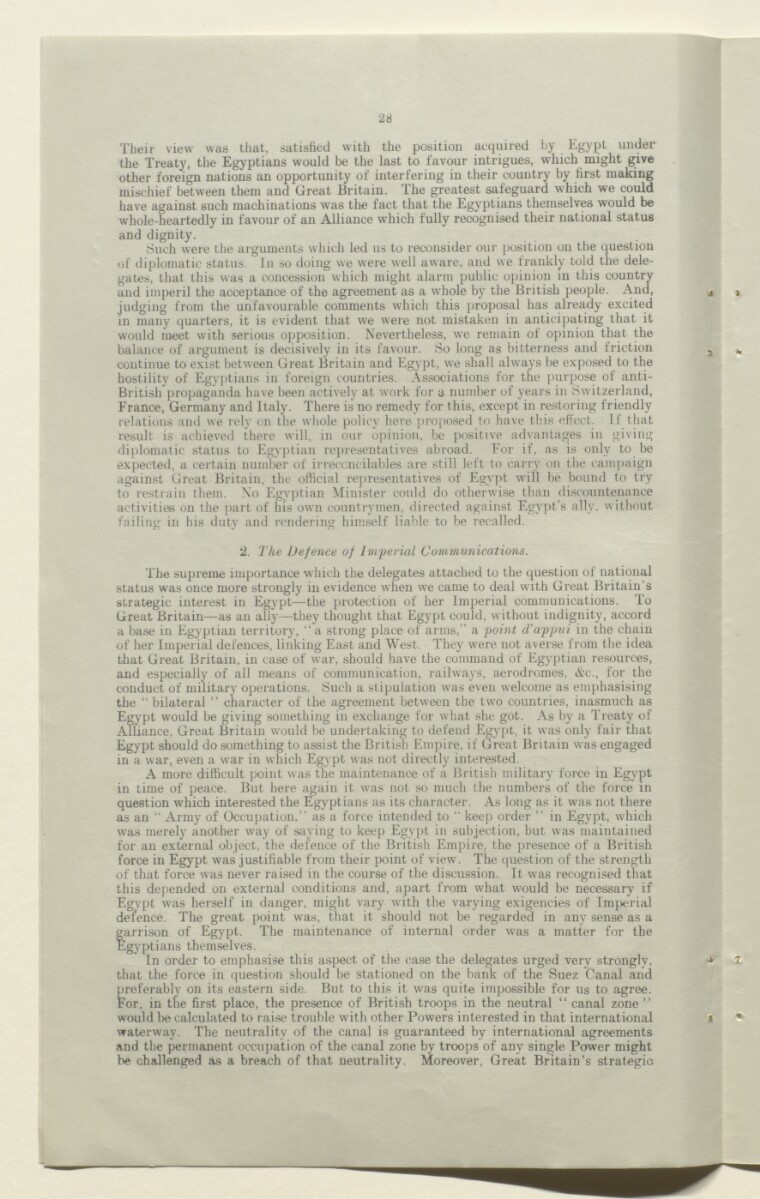
Their view was that, satisfied with the position acquired by Egypt under
the Treaty, the Egyptians would be the last to favour intrigues, which might give
other foreign nations an opportunity of interfering in their country by first making
mischief between them and Great Britain. The greatest safeguard which we could
have against such machinations was the fact that the Egyptians themselves would be
whole-heartedly in favour of an Alliance which fully recognised their national status
and dignity.
Such were the arguments which led us to reconsider our position on the question
of diplomatic status. In so doing we were well aware, and we frankly told the dele
gates, that this was a concession which might alarm public opinion in this country
and imperil the acceptance of the agreement as a whole by the British people. And, , ,
judging from the unfavourable comments which this proposal has already excited
in many quarters, it is evident that we were not mistaken in anticipating that it
would meet with serious opposition. Nevertheless, we remain of opinion that the
balance of argument is decisively in its favour. So long as bitterness and friction a %
continue to exist between Great Britain and Egypt, we shall always be exposed to the
hostility of Egyptians in foreign countries. Associations tor the purpose of anti-
British propaganda have been actively at work for a number of years in Switzerland,
France, Germany and Italy. There is no remedy for this, except in restoring friendly
relations and we rely cn the whole policy here proposed to have this effect. If that
result is achieved there will, in our opinion, be positive advantages in giving
diplomatic status to Egyptian representatives abroad. For if, as is only to be
expected, a certain number of irreecneilables are still left to carry on the campaign
against Great Britain, the official representatives of Egypt will be bound to try
to restrain them. No Egyptian Minister could do otherwise than discountenance
activities on the part of his own countrymen, directed against Egypt’s ally, without
failing in his duty and rendering himself liable to be recalled.
2. The Defence of Imferial Communications.
The supreme importance which the delegates attached to the question of national
status was once more strongly in evidence when we came to deal with Great Britain’s
strategic interest in Egypt—the protection of her Imperial communications. To
Great Britain—as an ally—they thought that Egypt could, without indignity, accord
a base in Egyptian territory, “a strong place of arms,” a foint d'affui in the chain
of her Imperial defences, linking East and West. They were not averse from the idea
that Great Britain, in case of war, should have the command of Egyptian resources,
and especially of all means of communication, railways, aerodromes, &c., for the
conduct of military operations. Such a stipulation was even welcome as emphasising
the “ bilateral ” character of the agreement between the two countries, inasmuch as
Egypt would be giving something in exchange for what she got. As by a Treaty of
Alliance, Great Britain would be undertaking to defend Egypt, it was only fair that
Egypt should do something to assist the British Empire, if Great Britain was engaged
in a war, even a war in which Egypt was not directly interested.
A more difficult point was the maintenance of a British military force in Egypt
in time of peace. But here again it was not so much the numbers of the force in
question which interested the Egyptians as its character. As long as it was not there
as an “ Army of Occupation,” as a force intended to “ keep order ” in Egypt, which
was merely another way of saying to keep Egypt in subjection, but w T as maintained
for an external object, the defence of the British Empire, the presence of a British
force in Egypt was justifiable from their point of view. The question of the strength
of that force was never raised in the course of the discussion. It was recognised that
this depended on external conditions and, apart from what would be necessary if
Egypt was herself in danger, might vary with the varying exigencies of Imperial
defence. The great point was, that it should not be regarded in any sense as a
f arrison of Egypt. The maintenance of internal order was a matter for the
Egyptians themselves.
In order to emphasise this aspect of the case the delegates urged very strongly, * I
that the force in question should be stationed on the bank of the Suez Canal and
preferably on its eastern side. But to this it was quite impossible for us to agree.
For, in the first place, the presence of British troops in the neutral “ canal zone ”
would be calculated to raise trouble with other Powers interested in that international s v
waterway. The neutrality of the canal is guaranteed by international agreements
and the permanent occupation of the canal zone by troops of any single Power might
be challenged as a breach of that neutrality. Moreover, Great Britain’s strategic
حول هذه المادة
- المحتوى
يحتوي الملف على مراسلات ومذكرات وتقارير رسمية تتعلق بالشؤون السياسية في مصر. المتراسلون والكاتبون هم مسؤولون في وزارة الخارجية (كان اللورد كرزون وزير الدولة للشؤون الخارجية في ذلك الوقت)، مكتب الحرب البريطاني، وزارة الطيران، الأميرالية، مكتب المستعمرات البريطانية، مجلس التجارة، مجلس التعليم، بالإضافة إلى الخدمة المدنية المصرية.
يحتوي الملف على نسخ من تقارير البعثة الخاصة إلى مصر (الأوراق ١-٧، ٧٥-٩٣، ١٧٥-١٩٤) بقيادة اللورد ألفريد ميلنر، والتي كانت تهدف إلى إجراء التحقيقات وتقديم المشورة في أعقاب قيام الثورة المصرية في ١٩١٩. يأتي جزءٌ كبير من محتوى الملف ردًا على نتائج وتوصيات البعثة، ويناقش إمكانيات التوصل إلى تسوية سياسية مع مصر.
- الشكل والحيّز
- ملف واحد (٢٣٧ ورقة)
- الترتيب
الملف مرتب ترتيبًا زمنيًا من بدايته إلى نهايته.
- الخصائص المادية
ترقيم الأوراق: يبدأ تسلسل ترقيم الأوراق (المستخدم للأغراض المرجعية) على الغلاف الأمامي بالرقم ١، وينتهي داخل الغلاف الخلفي بالرقم ٢٣٥؛ هذه الأرقام مكتوبة بالقلم الرصاص ومحاطة بدائرة في أعلى يمين صفحة الوجه الجانب الأمامي للورقة أو لفرخٍ من الورق. كثيرًا ما يشار إليه اختصارًا بالحرف "و". من كل ورقة. يوجد في الملف استثناء واحد في ترقيم الأوراق، ص. ٧٦أ.
- لغة الكتابة
- الإنجليزية بالأحرف اللاتينية للاطّلاع على المعلومات الكاملة لهذا السجل
استخدام وإعادة نشر هذه المادة
- إعادة نشر هذه المادة
تقرير البعثة الخاصة إلى مصر بقيادة اللورد ميلنر، وأوراق ذات صلة [ظ٨٧] (٤٧٣/١٧٦)و المكتبة البريطانية: أوراق خاصة وسجلات من مكتب الهندو Mss Eur F112/260و مكتبة قطر الرقمية <https://www.qdl.qa/archive/81055/vdc_100080131819.0x0000b1> [تم الوصول إليها في ٤ يونيو ٢٠٢٦]
https://www.qdl.qa/العربية/archive/81055/vdc_100080131819.0x0000b1
يمكنك نسخ ولصق الفقرة التالية لتضمين الصورة في صفحة الويب الخاصة بك.
<meta charset="utf-8"><a href="https://www.qdl.qa/العربية/archive/81055/vdc_100080131819.0x0000b1">تقرير البعثة الخاصة إلى مصر بقيادة اللورد ميلنر، وأوراق ذات صلة [<span dir="ltr">ظ٨٧</span>] (٤٧٣/١٧٦)</a> <a href="https://www.qdl.qa/العربية/archive/81055/vdc_100080131819.0x0000b1"> <img src="https://iiif.qdl.qa/iiif/images/81055/vdc_100000001491.0x000295/Mss Eur F112_260_0176.jp2/full/!280,240/0/default.jpg" alt="" /> </a>
هذا التسجيل IIIF له ملف ظاهر متوفر كما يلي. إذا كان لديك عارض متوافق للصور يمكنك سحب الأيقونة لتحميله.https://www.qdl.qa/العربية/iiif/81055/vdc_100000001491.0x000295/manifestافتح في المتصفح العامافتح في عارض IIIF ميرادورطرق إضافية لاستخدام صور الأرشيف الرقمي
حقوق النسخ والتأليف: كيفية استخدام هذا المحتوى
- رقم الاستدعاء
- Mss Eur F112/260
- العنوان
- تقرير البعثة الخاصة إلى مصر بقيادة اللورد ميلنر، وأوراق ذات صلة
- الصفحات
- ظ٢٣٥:و١٤٤ ،وأ١٤٤ ،ظ١٤٣:و١٤٣ ،ظ١٤٠:و٧٧ ،ظأ٧٦:وأ٧٦ ،ظ٧٦:و٥٣ ،ظ٥٠:و٤٢ ،ظ٣٩:و٢ ،داخلي-أمامي ،أمامي
- المؤلف
- شركة الهند الشرقية ولجنة البرلمان البريطاني لشئون الهند ومكتب الهند وإدارات الحكومة البريطانية الأخرى
- شروط الاستخدام
- ترخيص حكومي عام