
![تقرير البعثة الخاصة إلى مصر بقيادة اللورد ميلنر، وأوراق ذات صلة [<span dir="ltr">و٧</span>] (٤٧٣/١٣)](https://iiif.qdl.qa/iiif/images/81055/vdc_100000001491.0x000295/Mss Eur F112_260_0013.jp2/full/!1200,1200/0/default.jpg "تقرير البعثة الخاصة إلى مصر بقيادة اللورد ميلنر، وأوراق ذات صلة [<span dir=\"ltr\">و٧</span>] (٤٧٣/١٣)")
تقرير البعثة الخاصة إلى مصر بقيادة اللورد ميلنر، وأوراق ذات صلة [و٧] (٤٧٣/١٣)
محتويات السجل: ملف واحد (٢٣٧ ورقة). يعود تاريخه إلى ١٥ مايو ١٩٢٠-١٤ أكتوبر ١٩٢١. اللغة أو اللغات المستخدمة: الإنجليزية. النسخة الأصلية محفوظة في المكتبة البريطانية: أوراق خاصة وثائق جُمعت بصفة شخصية. وسجلات من مكتب الهند إدارة الحكومة البريطانية التي كانت الحكومة في الهند ترفع إليها تقاريرها بين عامي ١٨٥٨ و١٩٤٧، حيث خلِفت مجلس إدارة شركة الهند الشرقية. .
نسخ
النسخ مستحدث آليًا ومن المرجّح أن يحتوي على أخطاء.
11
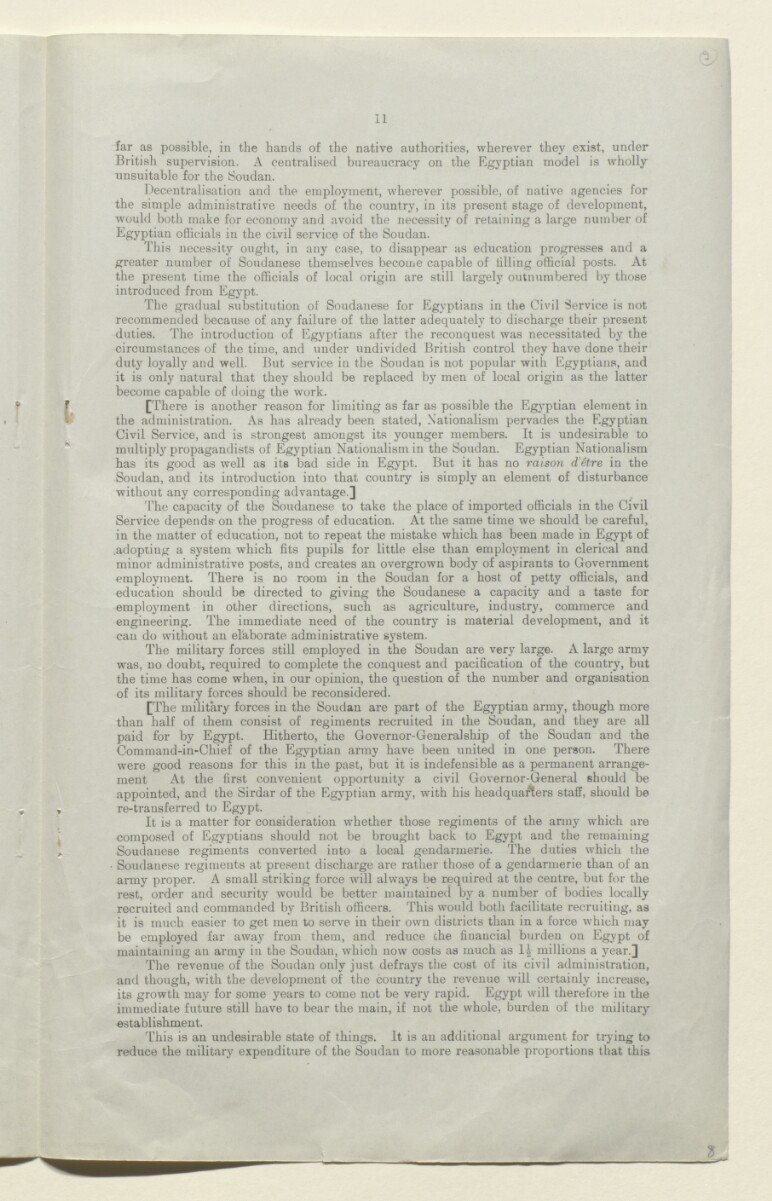
far as possible, in the hands of the native authorities, wherever they exist, under
British supervision. A centralised bureaucracy on the Egyptian model is wholly
unsuitable for the Soudan.
Decentralisation and the employment, wherever possible, of native agencies for
the simple administrative needs of the country, in its present stage of development,
would both make for economy and avoid the necessity of retaining a large number of
Egyptian officials in the civil service of the Soudan.
This necessity ought, in any case, to disappear as education progresses and a
greater number of Soudanese themselves become capable of tilling official posts. At
the present time the officials of local origin are still largely outnumbered by those
introduced from Egypt.
The gradual substitution of Soudanese for Egyptians in the Civil Service is not
recommended because of any failure of the latter adequately to discharge their present
duties. The introduction of Egyptians after the reconquest was necessitated by the
circumstances of the time, and under undivided British control they have done their
duty loyally and well. But service in the Soudan is not popular with Egyptians, and
it is only natural that they should be replaced by men of local origin as the latter
become capable of doing the work.
[There is another reason for limiting as far as possible the Egyptian element in
the administration. As has already been stated, Nationalism pervades the Egyptian
Civil Service, and is strongest amongst its younger members. It is undesirable to
multipl) 7 'propagandists of Egyptian Nationalism in the Soudan. Egyptian Nationalism
has its good as well as its bad side in Egypt. But it has no raisoyi d'etre in the
Soudan, and its introduction into that country is simply an element of disturbance
without any corresponding advantage.]
The capacity of the Soudanese to take the place of imported officials in the Civil
Service depends- on the progress of education. At the same time we should be careful,
in the matter of education, not to repeat the mistake which has been made in Egypt of
.adopting a system which fits pupils for little else than employment in clerical and
minor administrative posts, and creates an overgrown body of aspirants to Government
employment. There is no room in the Soudan for a host of petty officials, and
education should be directed to giving the Soudanese a capacity and a taste for
employment in other directions, such as agriculture, industry, commerce and
engineering. The immediate need of the country is material development, and it
can do without an elaborate administrative system.
The military forces still employed in the Soudan are very large. A large army
was, no doubt, required to complete the conquest and pacification of the country, but
the time has come when, in our opinion, the question of the number and organisation
of its military forces should be reconsidered.
[The military forces in the Soudan are part of the Egyptian army, though more
than half of them consist of regiments recruited in the Soudan, and they are all
paid for by Egypt. Hitherto, the Governor-Generalship of the Soudan and the
Command-in-Chief of the Egyptian army have been united in one person. There
were good reasons for this in the past, but it is indefensible as a permanent arrange
ment At the first convenient opportunity a civil Governor-General should be
appointed, and the Sirdar of the Egyptian army, with his headquarters staff, should be
re-transferred to Egypt.
It is a matter for consideration whether those regiments of the army which are
composed of Egyptians should not be brought back to Egypt and the remaining
Soudanese regiments converted into a local gendarmerie. The duties which the
• Soudanese regiments at present discharge are rather those of a gendarmerie than of an
army proper. A small striking force will always be required at the centre, but for the
rest, order and security would be better maintained by a number of bodies locally
recruited and commanded by British officers. This would both facilitate recruiting, as
it is much easier to get men to serve in their own districts than in a force which may
be employed far away from them, and reduce che financial burden on Egypt of
maintaining an army in the Soudan, which now costs as much as 1| millions a year.]
The revenue of the Soudan only just defrays the cost of its civil administration,
and though, with the development of the country the revenue will certainly increase,
its growth may for some years to come not be very rapid. Egypt will therefore in the
immediate future still have to bear the main, if not the whole, burden of the military
establishment.
This is an undesirable state of things. It is an additional argument for trying to
reduce the military expenditure of the Soudan to more reasonable proportions that this
حول هذه المادة
- المحتوى
يحتوي الملف على مراسلات ومذكرات وتقارير رسمية تتعلق بالشؤون السياسية في مصر. المتراسلون والكاتبون هم مسؤولون في وزارة الخارجية (كان اللورد كرزون وزير الدولة للشؤون الخارجية في ذلك الوقت)، مكتب الحرب البريطاني، وزارة الطيران، الأميرالية، مكتب المستعمرات البريطانية، مجلس التجارة، مجلس التعليم، بالإضافة إلى الخدمة المدنية المصرية.
يحتوي الملف على نسخ من تقارير البعثة الخاصة إلى مصر (الأوراق ١-٧، ٧٥-٩٣، ١٧٥-١٩٤) بقيادة اللورد ألفريد ميلنر، والتي كانت تهدف إلى إجراء التحقيقات وتقديم المشورة في أعقاب قيام الثورة المصرية في ١٩١٩. يأتي جزءٌ كبير من محتوى الملف ردًا على نتائج وتوصيات البعثة، ويناقش إمكانيات التوصل إلى تسوية سياسية مع مصر.
- الشكل والحيّز
- ملف واحد (٢٣٧ ورقة)
- الترتيب
الملف مرتب ترتيبًا زمنيًا من بدايته إلى نهايته.
- الخصائص المادية
ترقيم الأوراق: يبدأ تسلسل ترقيم الأوراق (المستخدم للأغراض المرجعية) على الغلاف الأمامي بالرقم ١، وينتهي داخل الغلاف الخلفي بالرقم ٢٣٥؛ هذه الأرقام مكتوبة بالقلم الرصاص ومحاطة بدائرة في أعلى يمين صفحة الوجه الجانب الأمامي للورقة أو لفرخٍ من الورق. كثيرًا ما يشار إليه اختصارًا بالحرف "و". من كل ورقة. يوجد في الملف استثناء واحد في ترقيم الأوراق، ص. ٧٦أ.
- لغة الكتابة
- الإنجليزية بالأحرف اللاتينية للاطّلاع على المعلومات الكاملة لهذا السجل
استخدام وإعادة نشر هذه المادة
- إعادة نشر هذه المادة
تقرير البعثة الخاصة إلى مصر بقيادة اللورد ميلنر، وأوراق ذات صلة [و٧] (٤٧٣/١٣)و المكتبة البريطانية: أوراق خاصة وسجلات من مكتب الهندو Mss Eur F112/260و مكتبة قطر الرقمية <https://www.qdl.qa/archive/81055/vdc_100080131819.0x00000e> [تم الوصول إليها في ٤ يونيو ٢٠٢٦]
https://www.qdl.qa/العربية/archive/81055/vdc_100080131819.0x00000e
يمكنك نسخ ولصق الفقرة التالية لتضمين الصورة في صفحة الويب الخاصة بك.
<meta charset="utf-8"><a href="https://www.qdl.qa/العربية/archive/81055/vdc_100080131819.0x00000e">تقرير البعثة الخاصة إلى مصر بقيادة اللورد ميلنر، وأوراق ذات صلة [<span dir="ltr">و٧</span>] (٤٧٣/١٣)</a> <a href="https://www.qdl.qa/العربية/archive/81055/vdc_100080131819.0x00000e"> <img src="https://iiif.qdl.qa/iiif/images/81055/vdc_100000001491.0x000295/Mss Eur F112_260_0013.jp2/full/!280,240/0/default.jpg" alt="" /> </a>
هذا التسجيل IIIF له ملف ظاهر متوفر كما يلي. إذا كان لديك عارض متوافق للصور يمكنك سحب الأيقونة لتحميله.https://www.qdl.qa/العربية/iiif/81055/vdc_100000001491.0x000295/manifestافتح في المتصفح العامافتح في عارض IIIF ميرادورطرق إضافية لاستخدام صور الأرشيف الرقمي
حقوق النسخ والتأليف: كيفية استخدام هذا المحتوى
- رقم الاستدعاء
- Mss Eur F112/260
- العنوان
- تقرير البعثة الخاصة إلى مصر بقيادة اللورد ميلنر، وأوراق ذات صلة
- الصفحات
- ظ٢٣٥:و١٤٤ ،وأ١٤٤ ،ظ١٤٣:و١٤٣ ،ظ١٤٠:و٧٧ ،ظأ٧٦:وأ٧٦ ،ظ٧٦:و٥٣ ،ظ٥٠:و٤٢ ،ظ٣٩:و٢ ،داخلي-أمامي ،أمامي
- المؤلف
- شركة الهند الشرقية ولجنة البرلمان البريطاني لشئون الهند ومكتب الهند وإدارات الحكومة البريطانية الأخرى
- شروط الاستخدام
- ترخيص حكومي عام