
![تقرير البعثة الخاصة إلى مصر بقيادة اللورد ميلنر، وأوراق ذات صلة [<span dir="ltr">ظ٢١٥</span>] (٤٧٣/٤٣٣)](https://iiif.qdl.qa/iiif/images/81055/vdc_100000001491.0x000295/Mss Eur F112_260_0433.jp2/full/!1200,1200/0/default.jpg "تقرير البعثة الخاصة إلى مصر بقيادة اللورد ميلنر، وأوراق ذات صلة [<span dir=\"ltr\">ظ٢١٥</span>] (٤٧٣/٤٣٣)")
تقرير البعثة الخاصة إلى مصر بقيادة اللورد ميلنر، وأوراق ذات صلة [ظ٢١٥] (٤٧٣/٤٣٣)
محتويات السجل: ملف واحد (٢٣٧ ورقة). يعود تاريخه إلى ١٥ مايو ١٩٢٠-١٤ أكتوبر ١٩٢١. اللغة أو اللغات المستخدمة: الإنجليزية. النسخة الأصلية محفوظة في المكتبة البريطانية: أوراق خاصة وثائق جُمعت بصفة شخصية. وسجلات من مكتب الهند إدارة الحكومة البريطانية التي كانت الحكومة في الهند ترفع إليها تقاريرها بين عامي ١٨٥٨ و١٩٤٧، حيث خلِفت مجلس إدارة شركة الهند الشرقية. .
نسخ
النسخ مستحدث آليًا ومن المرجّح أن يحتوي على أخطاء.
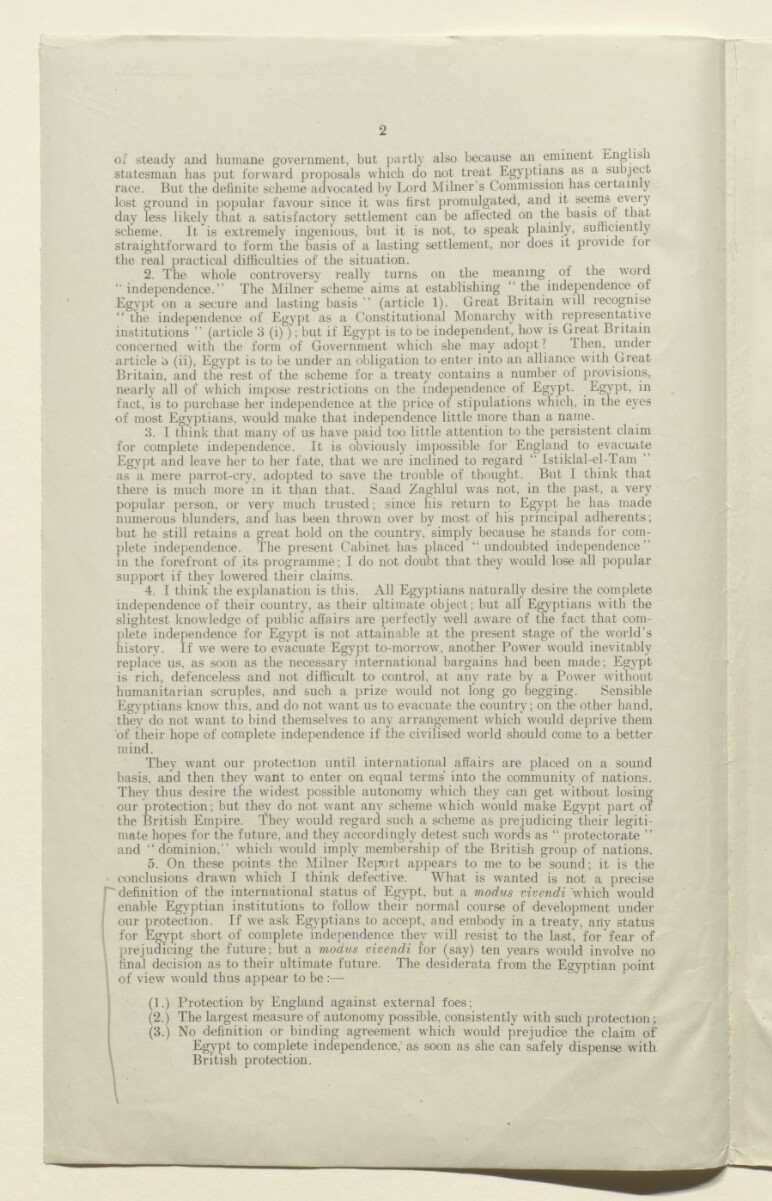
of steady and humane government, but partly also because an eminent English
statesman has put forward proposals which do not treat Egyptians as a subject
race. But the definite scheme advocated by Lord Milner s Commission has certainly
lost ground in popular favour since it was first promulgated, and it seems every
day less likely that a satisfactory settlement can be affected on the basis ot that
scheme. It is extremely ingenious, but it is not, to speak plainly, sufficiently
straightforward to form the basis of a lasting settlement, nor does it provide tor
the real practical difficulties of the situation.
2 . The whole controversy really turns on the meaning of the word
“independence." The Milner scheme aims at establishing “ the independence of
Egypt on a secure and lasting basis " (article 1). Great Britain will recognise
“ the independence of Egypt as a Constitutional Monarchy with representative
institutions " (article 3 (i)); but if Egypt is to be independent, how is Great Britain
concerned w ith the form of Government which she may adopt ? I hen, under
article i) (ii), Egypt is to be under an obligation to enter into an alliance with Great
Britain, and the rest of the scheme for a treaty contains a number of provisions,
nearly all of which impose restrictions on the independence of Egypt. Egypt, in
fact, is to purchase her independence at the price of stipulations which, in the eyes
of most Egyptians, would make that independence little more than a name.
3 . I think that many of us have paid too little attention to the persistent claim
for complete independence. It is obviously impossible for England to evacuate
Egypt and leave her to her fate, that we are inclined to regard “ Istiklal-el-Tam
as a mere parrot-cry, adopted to save the trouble of thought. But I think that
there is much more in it than that. Saad Zaghlul was not, in the past, a very
popular person, or very much trusted; since his return to Egypt he has made
numerous blunders, and has been thrown over by most of his principal adherents;
but he still retains a great hold on the country, simply because he stands for com
plete independence. The present Cabinet has placed “undoubted independence"
in the forefront of its programme; I do not doubt that they would lose all popular
support if they lowered their claims.
4. I think the explanation is this. All Egyptians naturally desire the complete
independence of their country, as their ultimate object; but all Egyptians with the
slightest knowledge of public affairs are perfectly well aware of the fact that com
plete independence for Egypt is not attainable at the present stage of the world’s
history. If we were to evacuate Egypt to-morrow, another Powder would inevitably
replace us, as soon as the necessary international bargains had been made; Egypt
is rich, defenceless and not difficult to control, at any rate by a Power without
humanitarian scruples, and such a prize would not long go begging. Sensible
Egyptians know 7 this, and do not want us to evacuate the country; on the other hand,
they do not want to bind themselves to any arrangement which would deprive them
of their hope of complete independence if the civilised world should come to a better
mind.
They w 7 ant our protection until international affairs are placed on a sound
basis, and then they want to enter on equal terms’ into the community of nations.
They thus desire the widest possible autonomy which they can get without losing
our protection; but they do not w 7 ant any scheme which would make Egypt part of
the British Empire. They w T ould regard such a scheme as prejudicing their legiti
mate hopes for the future, and they accordingly detest such words as “ protectorate ”
and “dominion," wdiich would imply membership of the British group of nations.
5. On these points the Milner Report appears to me to be sound; it is the
conclusions drawn which I think defective. What is wanted is not a precise
r definition of the international status of Egypt, but a modus vivendi which would
enable Egyptian institutions to follow their normal course of development under
our protection. If w 7 e ask Egyptians to accept, and embody in a treaty, any status
for Egypt short of complete independence thev w 7 ill resist to the last, for fear of
prejudicing the future; but a modus vivendi for (say) ten years would involve no
final decision as to their ultimate future. The desiderata from the Egyptian point
of view 7 would thus appear to be :—
(1.) Protection by England against external foes;
(2.) The largest measure of autonomy possible, consistently with such protection;
(3.) No definition or binding agreement w T hich would prejudice the claim of
Egypt to complete independence, as soon as she can safely dispense with
British protection.
حول هذه المادة
- المحتوى
يحتوي الملف على مراسلات ومذكرات وتقارير رسمية تتعلق بالشؤون السياسية في مصر. المتراسلون والكاتبون هم مسؤولون في وزارة الخارجية (كان اللورد كرزون وزير الدولة للشؤون الخارجية في ذلك الوقت)، مكتب الحرب البريطاني، وزارة الطيران، الأميرالية، مكتب المستعمرات البريطانية، مجلس التجارة، مجلس التعليم، بالإضافة إلى الخدمة المدنية المصرية.
يحتوي الملف على نسخ من تقارير البعثة الخاصة إلى مصر (الأوراق ١-٧، ٧٥-٩٣، ١٧٥-١٩٤) بقيادة اللورد ألفريد ميلنر، والتي كانت تهدف إلى إجراء التحقيقات وتقديم المشورة في أعقاب قيام الثورة المصرية في ١٩١٩. يأتي جزءٌ كبير من محتوى الملف ردًا على نتائج وتوصيات البعثة، ويناقش إمكانيات التوصل إلى تسوية سياسية مع مصر.
- الشكل والحيّز
- ملف واحد (٢٣٧ ورقة)
- الترتيب
الملف مرتب ترتيبًا زمنيًا من بدايته إلى نهايته.
- الخصائص المادية
ترقيم الأوراق: يبدأ تسلسل ترقيم الأوراق (المستخدم للأغراض المرجعية) على الغلاف الأمامي بالرقم ١، وينتهي داخل الغلاف الخلفي بالرقم ٢٣٥؛ هذه الأرقام مكتوبة بالقلم الرصاص ومحاطة بدائرة في أعلى يمين صفحة الوجه الجانب الأمامي للورقة أو لفرخٍ من الورق. كثيرًا ما يشار إليه اختصارًا بالحرف "و". من كل ورقة. يوجد في الملف استثناء واحد في ترقيم الأوراق، ص. ٧٦أ.
- لغة الكتابة
- الإنجليزية بالأحرف اللاتينية للاطّلاع على المعلومات الكاملة لهذا السجل
استخدام وإعادة نشر هذه المادة
- إعادة نشر هذه المادة
تقرير البعثة الخاصة إلى مصر بقيادة اللورد ميلنر، وأوراق ذات صلة [ظ٢١٥] (٤٧٣/٤٣٣)و المكتبة البريطانية: أوراق خاصة وسجلات من مكتب الهندو Mss Eur F112/260و مكتبة قطر الرقمية <https://www.qdl.qa/archive/81055/vdc_100080131821.0x000022> [تم الوصول إليها في ٤ يونيو ٢٠٢٦]
https://www.qdl.qa/العربية/archive/81055/vdc_100080131821.0x000022
يمكنك نسخ ولصق الفقرة التالية لتضمين الصورة في صفحة الويب الخاصة بك.
<meta charset="utf-8"><a href="https://www.qdl.qa/العربية/archive/81055/vdc_100080131821.0x000022">تقرير البعثة الخاصة إلى مصر بقيادة اللورد ميلنر، وأوراق ذات صلة [<span dir="ltr">ظ٢١٥</span>] (٤٧٣/٤٣٣)</a> <a href="https://www.qdl.qa/العربية/archive/81055/vdc_100080131821.0x000022"> <img src="https://iiif.qdl.qa/iiif/images/81055/vdc_100000001491.0x000295/Mss Eur F112_260_0433.jp2/full/!280,240/0/default.jpg" alt="" /> </a>
هذا التسجيل IIIF له ملف ظاهر متوفر كما يلي. إذا كان لديك عارض متوافق للصور يمكنك سحب الأيقونة لتحميله.https://www.qdl.qa/العربية/iiif/81055/vdc_100000001491.0x000295/manifestافتح في المتصفح العامافتح في عارض IIIF ميرادورطرق إضافية لاستخدام صور الأرشيف الرقمي
حقوق النسخ والتأليف: كيفية استخدام هذا المحتوى
- رقم الاستدعاء
- Mss Eur F112/260
- العنوان
- تقرير البعثة الخاصة إلى مصر بقيادة اللورد ميلنر، وأوراق ذات صلة
- الصفحات
- ظ٢٣٥:و١٤٤ ،وأ١٤٤ ،ظ١٤٣:و١٤٣ ،ظ١٤٠:و٧٧ ،ظأ٧٦:وأ٧٦ ،ظ٧٦:و٥٣ ،ظ٥٠:و٤٢ ،ظ٣٩:و٢ ،داخلي-أمامي ،أمامي
- المؤلف
- شركة الهند الشرقية ولجنة البرلمان البريطاني لشئون الهند ومكتب الهند وإدارات الحكومة البريطانية الأخرى
- شروط الاستخدام
- ترخيص حكومي عام