
![تقرير البعثة الخاصة إلى مصر بقيادة اللورد ميلنر، وأوراق ذات صلة [<span dir="ltr">ظ٨٨</span>] (٤٧٣/١٧٨)](https://iiif.qdl.qa/iiif/images/81055/vdc_100000001491.0x000295/Mss Eur F112_260_0178.jp2/full/!1200,1200/0/default.jpg "تقرير البعثة الخاصة إلى مصر بقيادة اللورد ميلنر، وأوراق ذات صلة [<span dir=\"ltr\">ظ٨٨</span>] (٤٧٣/١٧٨)")
تقرير البعثة الخاصة إلى مصر بقيادة اللورد ميلنر، وأوراق ذات صلة [ظ٨٨] (٤٧٣/١٧٨)
محتويات السجل: ملف واحد (٢٣٧ ورقة). يعود تاريخه إلى ١٥ مايو ١٩٢٠-١٤ أكتوبر ١٩٢١. اللغة أو اللغات المستخدمة: الإنجليزية. النسخة الأصلية محفوظة في المكتبة البريطانية: أوراق خاصة وثائق جُمعت بصفة شخصية. وسجلات من مكتب الهند إدارة الحكومة البريطانية التي كانت الحكومة في الهند ترفع إليها تقاريرها بين عامي ١٨٥٨ و١٩٤٧، حيث خلِفت مجلس إدارة شركة الهند الشرقية. .
نسخ
النسخ مستحدث آليًا ومن المرجّح أن يحتوي على أخطاء.
30
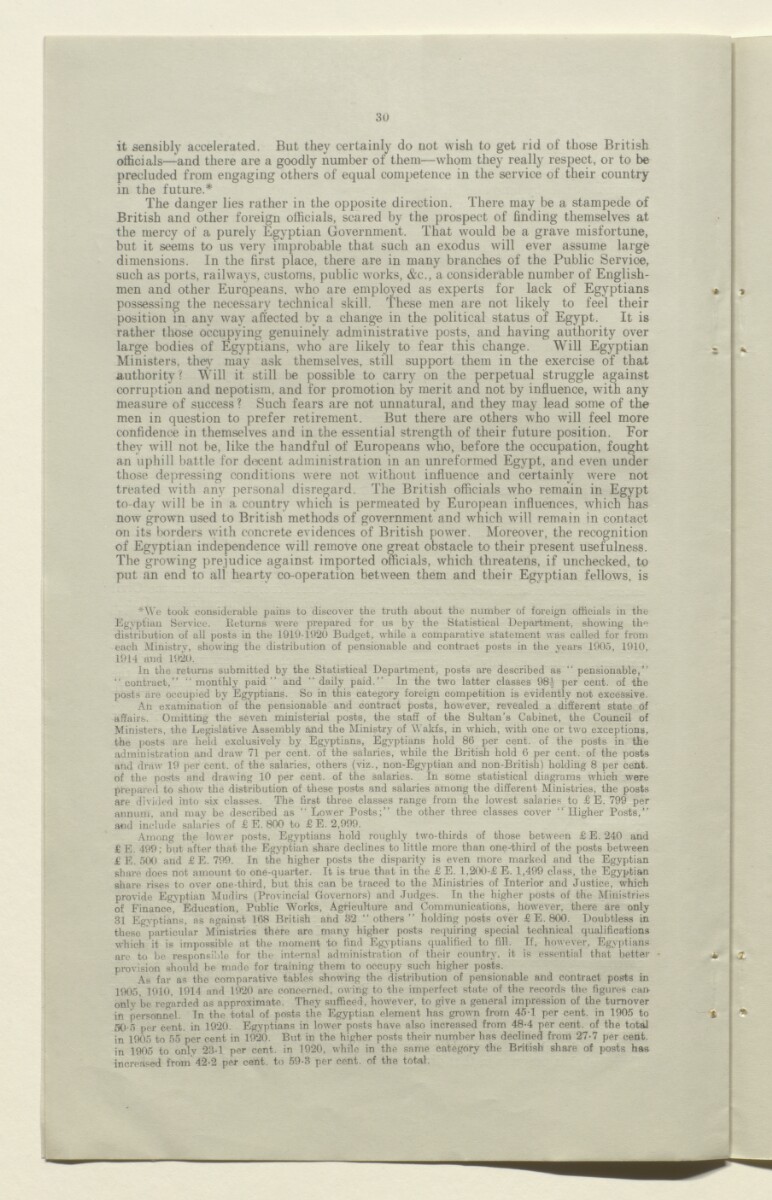
it sensibly accelerated. But they certainly do not wish to get rid of those British
officials—and there are a goodly number of them—whom they really respect, or to be
precluded from engaging others of equal competence in the service of their country
in the future.*
The danger lies rather in the opposite direction. There may be a stampede of
British and other foreign officials, scared by the prospect of finding themselves at
the mercy of a purely Egyptian Government. That would be a grave misfortune,
but it seems to us very improbable that such an exodus will ever assume large
dimensions. In the first place, there are in many branches of the Public Service,
such as ports, railways, customs, public works, &c., a considerable number of English
men and other Europeans, who are employed as experts for lack of Egyptians
possessing the necessary technical skill. These men are not likely to feel their
position in any way affected by a change in the political status of Egypt. It is
rather those occupying genuinely administrative posts, and having authority over
large bodies of Egyptians, who are likely to fear this change. Will Egyptian
Ministers, they may ask themselves, still support them in the exercise of that
authority? Will it still be possible to carry on the perpetual struggle against
corruption and nepotism, and for promotion by merit and not by influence, with any
measure of success ? Such fears are not unnatural, and they may lead some of the
men in question to prefer retirement. But there are others who will feel more
confidence in themselves and in the essential strength of their future position. For
they will not be, like the handful of Europeans who, before the occupation, fought
an uphill battle for decent administration in an unreformed Egypt, and even under
those depressing conditions were not without influence and certainly were not
treated with any personal disregard. The British officials who remain in Egypt
to-day will be in a country which is permeated by European influences, which has
now growm used to British methods of government and which will remain in contact
on its borders wdth concrete evidences of British powder. Moreover, the recognition
of Egyptian independence will remove one great obstacle to their present usefulness.
The growing prejudice against imported officials, which threatens, if unchecked, to
put an end to all hearty co-operation between them and their Egyptian fellows, is
-We took considerable pains to discover the truth about the number of foreign officials in the
Egyptian Service. Returns were prepared for us by the Statistical Department, showing the
distribution of all posts in the 1919-1920 Budget, while a comparative statement was called for from
each Ministry, showing the distribution of pensionable and contract posts in the years 1905, 1910,
1914 and 1920.
In the returns submitted by the Statistical Department, posts are described as “ pensionable,”
“contract,” “monthly paid” and “daily paid.” In the two latter classes 981 per cent, of the
posts are occupied by Egyptians. So in this category foreign competition is evidently not excessive.
An examination of the pensionable and contract posts, however, revealed a different state of
affairs. Omitting the seven ministerial posts, the staff of the Sultan's Cabinet, the Council of
Ministers, the Legislative Assembly and the Ministry of Wakfs, in which, with one or two exceptions,
the posts are held exclusively by Egyptians, Egyptians hold 86 per cent, of the posts in the
administration and draw 71 per cent, of the salaries, while the British hold 6 per cent, of the posts
and draw 19 per cent, of the salaries, others (viz., non-Egyptian and non-British) holding 8 per cent,
of the posts and drawing 10 per cent, of the salaries. In some statistical diagrams which were
prepared to show the distribution of these posts and salaries among the different Ministries, the posts
are divided into six classes. The first three classes range from the lowest salaries to £ E. 799 per
annum, and may be described as “ Lower Posts;” the other three classes cover “ Higher Posts,”
and include salaries of £ E. 800 to £ E. 2,999.
Among the lower posts. Egyptians hold roughly two-thirds of those between £ E. 240 and
£ E. 499; but after that the Egyptian share declines to little more than one-third of the posts between
£ E. 500 and £ E. 799. In the higher posts the disparity is even more marked and the Egyptian
share does not amount to one-quarter. It is true that in the £ E. l,200-£ E. 1,499 class, the Egyptian
share rises to over one-third, but this can be traced to the Ministries of Interior and Justice, which
provide Egyptian Mudirs (Provincial Governors) and Judges. In the higher posts of the Ministries
of Finance^ Education, Public Works, Agriculture and Communications, however, there are only
31 Egyptians, as against 168 British and 32 “others” holding posts over £ E. 800. Doubtless in
these particular Ministries there are many higher posts requiring special technical qualifications
which it is impossible at the moment to find Egyptians qualified to fill. If, however, Egyptians
are to be responsible for the internal administration of their country, it is essential that better
provision should be made for training them to occupy such higher posts.
As far as the comparative tables showing the distribution of pensionable and contract posts in
1905 1010, 1914 and 1920 are concerned, owing to the imperfect state of the records the figures can
only be regarded as approximate. They sufficed, however, to give a general impression of the turnover
in personnel. In the total of posts the Egyptian element has grown from 45-1 per cent, in 1905 to
50-5 per cent, in 1920. Egyptians in lower posts have also increased from 48-4 per cent, of the total
in 1905 to 55 per cent in 1920. But in the higher posts their number has declined from 27-7 per cent,
in 1905 to only 23-1 per cent, in 1920, while in the same category the British share of posts has
increased from 42-2 per cent, to 59-3 per cent, of the total.
حول هذه المادة
- المحتوى
يحتوي الملف على مراسلات ومذكرات وتقارير رسمية تتعلق بالشؤون السياسية في مصر. المتراسلون والكاتبون هم مسؤولون في وزارة الخارجية (كان اللورد كرزون وزير الدولة للشؤون الخارجية في ذلك الوقت)، مكتب الحرب البريطاني، وزارة الطيران، الأميرالية، مكتب المستعمرات البريطانية، مجلس التجارة، مجلس التعليم، بالإضافة إلى الخدمة المدنية المصرية.
يحتوي الملف على نسخ من تقارير البعثة الخاصة إلى مصر (الأوراق ١-٧، ٧٥-٩٣، ١٧٥-١٩٤) بقيادة اللورد ألفريد ميلنر، والتي كانت تهدف إلى إجراء التحقيقات وتقديم المشورة في أعقاب قيام الثورة المصرية في ١٩١٩. يأتي جزءٌ كبير من محتوى الملف ردًا على نتائج وتوصيات البعثة، ويناقش إمكانيات التوصل إلى تسوية سياسية مع مصر.
- الشكل والحيّز
- ملف واحد (٢٣٧ ورقة)
- الترتيب
الملف مرتب ترتيبًا زمنيًا من بدايته إلى نهايته.
- الخصائص المادية
ترقيم الأوراق: يبدأ تسلسل ترقيم الأوراق (المستخدم للأغراض المرجعية) على الغلاف الأمامي بالرقم ١، وينتهي داخل الغلاف الخلفي بالرقم ٢٣٥؛ هذه الأرقام مكتوبة بالقلم الرصاص ومحاطة بدائرة في أعلى يمين صفحة الوجه الجانب الأمامي للورقة أو لفرخٍ من الورق. كثيرًا ما يشار إليه اختصارًا بالحرف "و". من كل ورقة. يوجد في الملف استثناء واحد في ترقيم الأوراق، ص. ٧٦أ.
- لغة الكتابة
- الإنجليزية بالأحرف اللاتينية للاطّلاع على المعلومات الكاملة لهذا السجل
استخدام وإعادة نشر هذه المادة
- إعادة نشر هذه المادة
تقرير البعثة الخاصة إلى مصر بقيادة اللورد ميلنر، وأوراق ذات صلة [ظ٨٨] (٤٧٣/١٧٨)و المكتبة البريطانية: أوراق خاصة وسجلات من مكتب الهندو Mss Eur F112/260و مكتبة قطر الرقمية <https://www.qdl.qa/archive/81055/vdc_100080131819.0x0000b3> [تم الوصول إليها في ٢٠ يوليوز ٢٠٢٦]
https://www.qdl.qa/العربية/archive/81055/vdc_100080131819.0x0000b3
يمكنك نسخ ولصق الفقرة التالية لتضمين الصورة في صفحة الويب الخاصة بك.
<meta charset="utf-8"><a href="https://www.qdl.qa/العربية/archive/81055/vdc_100080131819.0x0000b3">تقرير البعثة الخاصة إلى مصر بقيادة اللورد ميلنر، وأوراق ذات صلة [<span dir="ltr">ظ٨٨</span>] (٤٧٣/١٧٨)</a> <a href="https://www.qdl.qa/العربية/archive/81055/vdc_100080131819.0x0000b3"> <img src="https://iiif.qdl.qa/iiif/images/81055/vdc_100000001491.0x000295/Mss Eur F112_260_0178.jp2/full/!280,240/0/default.jpg" alt="" /> </a>
هذا التسجيل IIIF له ملف ظاهر متوفر كما يلي. إذا كان لديك عارض متوافق للصور يمكنك سحب الأيقونة لتحميله.https://www.qdl.qa/العربية/iiif/81055/vdc_100000001491.0x000295/manifestافتح في المتصفح العامافتح في عارض IIIF ميرادورطرق إضافية لاستخدام صور الأرشيف الرقمي
حقوق النسخ والتأليف: كيفية استخدام هذا المحتوى
- رقم الاستدعاء
- Mss Eur F112/260
- العنوان
- تقرير البعثة الخاصة إلى مصر بقيادة اللورد ميلنر، وأوراق ذات صلة
- الصفحات
- ظ٢٣٥:و١٤٤ ،وأ١٤٤ ،ظ١٤٣:و١٤٣ ،ظ١٤٠:و٧٧ ،ظأ٧٦:وأ٧٦ ،ظ٧٦:و٥٣ ،ظ٥٠:و٤٢ ،ظ٣٩:و٢ ،داخلي-أمامي ،أمامي
- المؤلف
- شركة الهند الشرقية ولجنة البرلمان البريطاني لشئون الهند ومكتب الهند وإدارات الحكومة البريطانية الأخرى
- شروط الاستخدام
- ترخيص حكومي عام