
![تقرير البعثة الخاصة إلى مصر بقيادة اللورد ميلنر، وأوراق ذات صلة [<span dir="ltr">و٨٨</span>] (٤٧٣/١٧٧)](https://iiif.qdl.qa/iiif/images/81055/vdc_100000001491.0x000295/Mss Eur F112_260_0177.jp2/full/!1200,1200/0/default.jpg "تقرير البعثة الخاصة إلى مصر بقيادة اللورد ميلنر، وأوراق ذات صلة [<span dir=\"ltr\">و٨٨</span>] (٤٧٣/١٧٧)")
تقرير البعثة الخاصة إلى مصر بقيادة اللورد ميلنر، وأوراق ذات صلة [و٨٨] (٤٧٣/١٧٧)
محتويات السجل: ملف واحد (٢٣٧ ورقة). يعود تاريخه إلى ١٥ مايو ١٩٢٠-١٤ أكتوبر ١٩٢١. اللغة أو اللغات المستخدمة: الإنجليزية. النسخة الأصلية محفوظة في المكتبة البريطانية: أوراق خاصة وثائق جُمعت بصفة شخصية. وسجلات من مكتب الهند إدارة الحكومة البريطانية التي كانت الحكومة في الهند ترفع إليها تقاريرها بين عامي ١٨٥٨ و١٩٤٧، حيث خلِفت مجلس إدارة شركة الهند الشرقية. .
نسخ
النسخ مستحدث آليًا ومن المرجّح أن يحتوي على أخطاء.
29
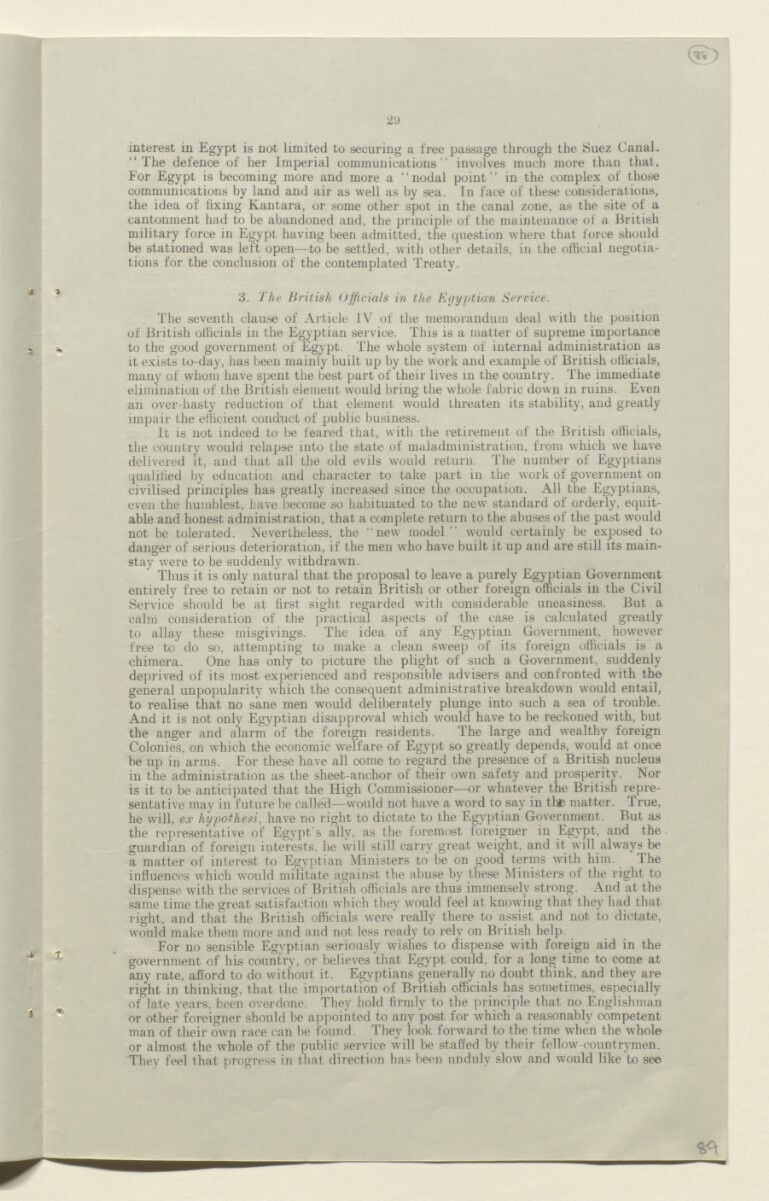
interest in Egypt is not limited to securing a free passage through the Suez Canal.
“The defence of her Imperial communications” involves much more than that.
For Egypt is becoming more and more a “nodal point” in the complex of those
communications by land and air as well as by sea. In face of these considerations,
the idea of fixing Kantara, or some other spot in the canal zone, as the site of a
cantonment had to be abandoned and, the principle of the maintenance of a British
military force in Egypt having been admitted, the question where that force should
be stationed was left open—to be settled, with other details, in the official negotia
tions for the conclusion of the contemplated Treaty.
3. I he British Officials in the Egyptian Service.
The seventh clause of Article IV of the memorandum deal with the position
of British officials in the Egyptian service. This is a matter of supreme importance
to the good government of Egypt. The whole system of internal administration as
it exists to-day, has been mainly built up by the work and example of British officials,
many of whom have spent the best part of their lives in the country. The immediate
elimination of the British element would bring the whole fabric down in ruins. Even
an over-hasty reduction of that element would threaten its stability, and greatly
impair the eiticient conduct of public business.
It is not indeed to be feared that, with the retirement of the British officials,
the country would relapse into the state of maladministration, from which we have
delivered it, and that all the old evils would return. The number of Egyptians
qualified by education and character to take part in the work of government on
civilised principles has greatly increased since the occupation. All the Egyptians,
even the humblest, have become so habituated to the new standard of orderly, equit
able and honest administration, that a complete return to the abuses of the past would
not be tolerated. Nevertheless, the “new model” would certainly be exposed to
danger of serious deterioration, if the men who have built it up and are still its main
stay were to be suddenly withdrawn.
Thus it is only natural that the proposal to leave a purely Egyptian Governmeoit
entirely free to retain or not to retain British or other foreign officials in the Civil
Service should be at first sight regarded with considerable uneasiness. But a
calm consideration of the practical aspects of the case is calculated greatly
to allay these misgivings. The idea of any Egyptian Government, however
free to do so, attempting to make a clean sweep of its foreign officials is a
chimera. One has only to picture the plight of such a Government, suddenly
deprived of its most experienced and responsible advisers and confronted with the
general unpopularity which the consequent administrative breakdown would entail,
to realise that no sane men would deliberately plunge into such a sea of trouble.
And it is not only Egyptian disapproval which would have to be reckoned with, but
the anger and alarm of the foreign residents. The large and wealthy foreign
Colonies, on which the economic welfare of Egypt so greatly depends, would at once
be up in arms. For these have all come to regard the presence of a British nucleus
in the administration as the sheet-anchor of their own safety and prosperity. Nor
is it to be anticipated that the High Commissioner—or whatever the British repre
sentative may in future be called—would not have a word to say in tin? matter. I rue,
he will, ex hypothesis have no right to dictate to the Egyptian Government. But as
the representative of Egypt's ally, as the foremost foreigner in Egypt, and the
guardian of foreign interests, he will still carry great weight, and it will always be
a matter of interest to Egyptian Ministers to be on good terms with him. The
influences which would militate against the abuse by these Ministers of the right to
dispense with the services of British officials are thus immensely strong. And at the
same time the great satisfaction which they would feel at knowing that they had that
right, and that the British officials were really there to assist and not to dictate,
would make them more and and not less ready to rely on British help.
For no sensible Egyptian seriously wishes to dispense with foreign aid in the
government of his country, or believes that Egypt could, for a long time to come at
any rate, afford to do without it, Egyptians generally no doubt think, and they are
right in thinking, that the importation of British officials has sometimes, especially
of late years, been overdone. They hold firmly to the principle that no Englishman
or other foreigner should be appointed to any post for which a reasonably competent
man of their own race can be found. They look forward to the time when the whole
or almost the whole of the public service will be staffed by their fellow-countrymen.
They feel that progress in that direction has been unduly slow and would like to see
<&\
حول هذه المادة
- المحتوى
يحتوي الملف على مراسلات ومذكرات وتقارير رسمية تتعلق بالشؤون السياسية في مصر. المتراسلون والكاتبون هم مسؤولون في وزارة الخارجية (كان اللورد كرزون وزير الدولة للشؤون الخارجية في ذلك الوقت)، مكتب الحرب البريطاني، وزارة الطيران، الأميرالية، مكتب المستعمرات البريطانية، مجلس التجارة، مجلس التعليم، بالإضافة إلى الخدمة المدنية المصرية.
يحتوي الملف على نسخ من تقارير البعثة الخاصة إلى مصر (الأوراق ١-٧، ٧٥-٩٣، ١٧٥-١٩٤) بقيادة اللورد ألفريد ميلنر، والتي كانت تهدف إلى إجراء التحقيقات وتقديم المشورة في أعقاب قيام الثورة المصرية في ١٩١٩. يأتي جزءٌ كبير من محتوى الملف ردًا على نتائج وتوصيات البعثة، ويناقش إمكانيات التوصل إلى تسوية سياسية مع مصر.
- الشكل والحيّز
- ملف واحد (٢٣٧ ورقة)
- الترتيب
الملف مرتب ترتيبًا زمنيًا من بدايته إلى نهايته.
- الخصائص المادية
ترقيم الأوراق: يبدأ تسلسل ترقيم الأوراق (المستخدم للأغراض المرجعية) على الغلاف الأمامي بالرقم ١، وينتهي داخل الغلاف الخلفي بالرقم ٢٣٥؛ هذه الأرقام مكتوبة بالقلم الرصاص ومحاطة بدائرة في أعلى يمين صفحة الوجه الجانب الأمامي للورقة أو لفرخٍ من الورق. كثيرًا ما يشار إليه اختصارًا بالحرف "و". من كل ورقة. يوجد في الملف استثناء واحد في ترقيم الأوراق، ص. ٧٦أ.
- لغة الكتابة
- الإنجليزية بالأحرف اللاتينية للاطّلاع على المعلومات الكاملة لهذا السجل
استخدام وإعادة نشر هذه المادة
- إعادة نشر هذه المادة
تقرير البعثة الخاصة إلى مصر بقيادة اللورد ميلنر، وأوراق ذات صلة [و٨٨] (٤٧٣/١٧٧)و المكتبة البريطانية: أوراق خاصة وسجلات من مكتب الهندو Mss Eur F112/260و مكتبة قطر الرقمية <https://www.qdl.qa/archive/81055/vdc_100080131819.0x0000b2> [تم الوصول إليها في ٥ يونيو ٢٠٢٦]
https://www.qdl.qa/العربية/archive/81055/vdc_100080131819.0x0000b2
يمكنك نسخ ولصق الفقرة التالية لتضمين الصورة في صفحة الويب الخاصة بك.
<meta charset="utf-8"><a href="https://www.qdl.qa/العربية/archive/81055/vdc_100080131819.0x0000b2">تقرير البعثة الخاصة إلى مصر بقيادة اللورد ميلنر، وأوراق ذات صلة [<span dir="ltr">و٨٨</span>] (٤٧٣/١٧٧)</a> <a href="https://www.qdl.qa/العربية/archive/81055/vdc_100080131819.0x0000b2"> <img src="https://iiif.qdl.qa/iiif/images/81055/vdc_100000001491.0x000295/Mss Eur F112_260_0177.jp2/full/!280,240/0/default.jpg" alt="" /> </a>
هذا التسجيل IIIF له ملف ظاهر متوفر كما يلي. إذا كان لديك عارض متوافق للصور يمكنك سحب الأيقونة لتحميله.https://www.qdl.qa/العربية/iiif/81055/vdc_100000001491.0x000295/manifestافتح في المتصفح العامافتح في عارض IIIF ميرادورطرق إضافية لاستخدام صور الأرشيف الرقمي
حقوق النسخ والتأليف: كيفية استخدام هذا المحتوى
- رقم الاستدعاء
- Mss Eur F112/260
- العنوان
- تقرير البعثة الخاصة إلى مصر بقيادة اللورد ميلنر، وأوراق ذات صلة
- الصفحات
- ظ٢٣٥:و١٤٤ ،وأ١٤٤ ،ظ١٤٣:و١٤٣ ،ظ١٤٠:و٧٧ ،ظأ٧٦:وأ٧٦ ،ظ٧٦:و٥٣ ،ظ٥٠:و٤٢ ،ظ٣٩:و٢ ،داخلي-أمامي ،أمامي
- المؤلف
- شركة الهند الشرقية ولجنة البرلمان البريطاني لشئون الهند ومكتب الهند وإدارات الحكومة البريطانية الأخرى
- شروط الاستخدام
- ترخيص حكومي عام