
![تقرير البعثة الخاصة إلى مصر بقيادة اللورد ميلنر، وأوراق ذات صلة [<span dir="ltr">ظ٢٢</span>] (٤٧٣/٤٤)](https://iiif.qdl.qa/iiif/images/81055/vdc_100000001491.0x000295/Mss Eur F112_260_0044.jp2/full/!1200,1200/0/default.jpg "تقرير البعثة الخاصة إلى مصر بقيادة اللورد ميلنر، وأوراق ذات صلة [<span dir=\"ltr\">ظ٢٢</span>] (٤٧٣/٤٤)")
تقرير البعثة الخاصة إلى مصر بقيادة اللورد ميلنر، وأوراق ذات صلة [ظ٢٢] (٤٧٣/٤٤)
محتويات السجل: ملف واحد (٢٣٧ ورقة). يعود تاريخه إلى ١٥ مايو ١٩٢٠-١٤ أكتوبر ١٩٢١. اللغة أو اللغات المستخدمة: الإنجليزية. النسخة الأصلية محفوظة في المكتبة البريطانية: أوراق خاصة وثائق جُمعت بصفة شخصية. وسجلات من مكتب الهند إدارة الحكومة البريطانية التي كانت الحكومة في الهند ترفع إليها تقاريرها بين عامي ١٨٥٨ و١٩٤٧، حيث خلِفت مجلس إدارة شركة الهند الشرقية. .
نسخ
النسخ مستحدث آليًا ومن المرجّح أن يحتوي على أخطاء.
4
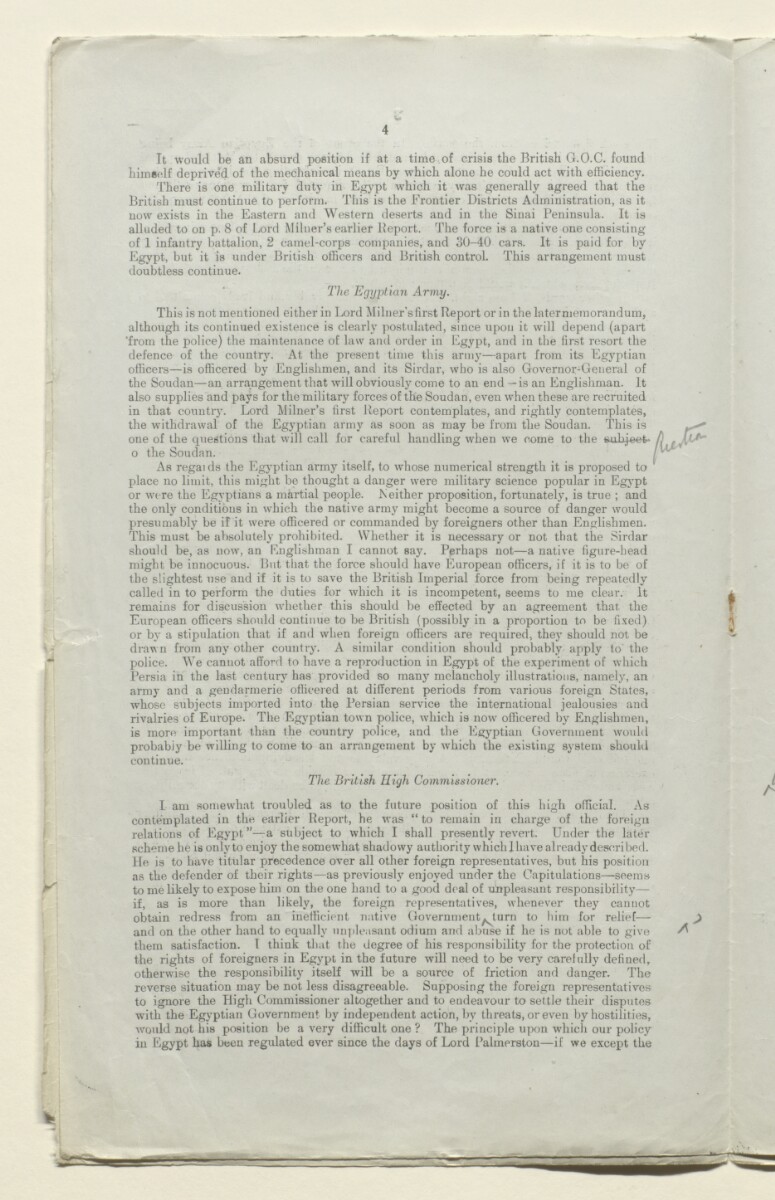
It would be an absurd position if at a time of crisis the British G.O.C. found
himself deprived of the mechanical means by which alone he could act with efficiency.
There is one military duty in Egypt which it was generally agreed that the
British must continue to perform. This is the Frontier Districts Administration, as it
now exists in the Eastern and Western deserts and in the Sinai Peninsula. It is
alluded to on p. 8 of Lord Milner’s earlier Deport. The force is a native one consisting
of 1 infantry battalion, 2 camel-corps companies, and 30-40 cars. It is paid for by
Egypt, but it is under British officers and British control. This arrangement must
doubtless continue.
The Egyptian Army.
This is not mentioned either in Lord Milner’sfirst Report or in the latermemorandum,
although its continued existence is clearly postulated, since upon it will depend (apart
'from the police) the maintenance of law and order in Egypt, and in the first resort the
defence of the country. At the present time this army—apart from its Egyptian
officers—is officered by Englishmen, and its Sirdar, who is also Governor-General of
the Soudan—an arrangement that will obviously come to an end — is an Englishman. It
also supplies and pays for the military forces of the Soudan, even when these are recruited
in that country. Lord Milner’s first Report contemplates, and rightly contemplates,
the withdrawal of the Egyptian army as soon as may be from the Soudan. This is
one of the questions that will call for careful handling when we come to the fcubjeet-
o the Soudan.
As regai ds the Egyptian army itself, to whose numerical strength it is proposed to
place no limit, this might be thought a danger were military science popular in Egypt
or were the Egyptians a martial people. Neither proposition, fortunately, is true ; and
the only conditions in which the native army might become a source of danger would
presumably be if it were officered or commanded by foreigners other than Englishmen.
This must be absolutely prohibited. Whether it is necessary or not that the Sirdar
should be, as now, an Englishman I cannot say. Perhaps not—a native figure-head
might be innocuous. But that the force should have European officers, if it is to be of
the slightest use and if it is to save the British Imperial force from being repeatedly
called in to perform the duties for which it is incompetent, seems to me clear. It
remains for discussion whether this should be effected by an agreement that the
European officers should continue to be British (possibly in a proportion to be fixed)
or by a stipulation that if and when foreign officers are required, they should not be
drawn from any other country. A similar condition should probably apply to the
police. We cannot afford to have a reproduction in Egypt of the experiment of which
Persia in the last century has provided so many melancholy illustrations, namely, an
army and a gendarmerie officered at different periods from various foreign States,
whose subjects imported into the Persian service the international jealousies and
rivalries of Europe. The Egyptian town police, which is now officered by Englishmen,
is more important than the country police, and the Egyptian Government would
probably be willing to come to an arrangement by which the existing system should
continue.
The British High Commissioner.
I am somewhat troubled as to the future position of this high official. As
contemplated in the earlier Report, he was “ to remain in charge of the foreign
relations of Egypt”—a subject to which I shall presently revert. Under the later
scheme he is only to enjoy the somewhat shadowy authority whichlhave already described.
He is to have titular precedence over all other foreign representatives, but his position
as the defender of their rights—as previously enjoyed under the Capitulations—seems
to me likely to expose him on the one hand to a good deal of unpleasant responsibility—
if, as is more than likely, the foreign representatives, whenever they cannot
obtain redress from an inefficient native Government^turn to him for relief—
and on the other hand to equally unpleasant odium and abuse if he is not able to give
them satisfaction. I think that the degree of his responsibility for the protection of
the rights of foreigners in Egypt in the future will need to be very carefully defined,
otherwise the responsibility itself will be a source of friction and danger. The
reverse situation may be not less disagreeable. Supposing the foreign representatives
to ignore the High Commissioner altogether and to endeavour to settle their disputes
with the Egyptian Government by independent action, by threats, or even by hostilities,
would not his position be a very difficult one ? The principle upon which our policy
in Egypt has been regulated ever since the days of Lord Palmerston—if we except the
حول هذه المادة
- المحتوى
يحتوي الملف على مراسلات ومذكرات وتقارير رسمية تتعلق بالشؤون السياسية في مصر. المتراسلون والكاتبون هم مسؤولون في وزارة الخارجية (كان اللورد كرزون وزير الدولة للشؤون الخارجية في ذلك الوقت)، مكتب الحرب البريطاني، وزارة الطيران، الأميرالية، مكتب المستعمرات البريطانية، مجلس التجارة، مجلس التعليم، بالإضافة إلى الخدمة المدنية المصرية.
يحتوي الملف على نسخ من تقارير البعثة الخاصة إلى مصر (الأوراق ١-٧، ٧٥-٩٣، ١٧٥-١٩٤) بقيادة اللورد ألفريد ميلنر، والتي كانت تهدف إلى إجراء التحقيقات وتقديم المشورة في أعقاب قيام الثورة المصرية في ١٩١٩. يأتي جزءٌ كبير من محتوى الملف ردًا على نتائج وتوصيات البعثة، ويناقش إمكانيات التوصل إلى تسوية سياسية مع مصر.
- الشكل والحيّز
- ملف واحد (٢٣٧ ورقة)
- الترتيب
الملف مرتب ترتيبًا زمنيًا من بدايته إلى نهايته.
- الخصائص المادية
ترقيم الأوراق: يبدأ تسلسل ترقيم الأوراق (المستخدم للأغراض المرجعية) على الغلاف الأمامي بالرقم ١، وينتهي داخل الغلاف الخلفي بالرقم ٢٣٥؛ هذه الأرقام مكتوبة بالقلم الرصاص ومحاطة بدائرة في أعلى يمين صفحة الوجه الجانب الأمامي للورقة أو لفرخٍ من الورق. كثيرًا ما يشار إليه اختصارًا بالحرف "و". من كل ورقة. يوجد في الملف استثناء واحد في ترقيم الأوراق، ص. ٧٦أ.
- لغة الكتابة
- الإنجليزية بالأحرف اللاتينية للاطّلاع على المعلومات الكاملة لهذا السجل
استخدام وإعادة نشر هذه المادة
- إعادة نشر هذه المادة
تقرير البعثة الخاصة إلى مصر بقيادة اللورد ميلنر، وأوراق ذات صلة [ظ٢٢] (٤٧٣/٤٤)و المكتبة البريطانية: أوراق خاصة وسجلات من مكتب الهندو Mss Eur F112/260و مكتبة قطر الرقمية <https://www.qdl.qa/archive/81055/vdc_100080131819.0x00002d> [تم الوصول إليها في ٤ يونيو ٢٠٢٦]
https://www.qdl.qa/العربية/archive/81055/vdc_100080131819.0x00002d
يمكنك نسخ ولصق الفقرة التالية لتضمين الصورة في صفحة الويب الخاصة بك.
<meta charset="utf-8"><a href="https://www.qdl.qa/العربية/archive/81055/vdc_100080131819.0x00002d">تقرير البعثة الخاصة إلى مصر بقيادة اللورد ميلنر، وأوراق ذات صلة [<span dir="ltr">ظ٢٢</span>] (٤٧٣/٤٤)</a> <a href="https://www.qdl.qa/العربية/archive/81055/vdc_100080131819.0x00002d"> <img src="https://iiif.qdl.qa/iiif/images/81055/vdc_100000001491.0x000295/Mss Eur F112_260_0044.jp2/full/!280,240/0/default.jpg" alt="" /> </a>
هذا التسجيل IIIF له ملف ظاهر متوفر كما يلي. إذا كان لديك عارض متوافق للصور يمكنك سحب الأيقونة لتحميله.https://www.qdl.qa/العربية/iiif/81055/vdc_100000001491.0x000295/manifestافتح في المتصفح العامافتح في عارض IIIF ميرادورطرق إضافية لاستخدام صور الأرشيف الرقمي
حقوق النسخ والتأليف: كيفية استخدام هذا المحتوى
- رقم الاستدعاء
- Mss Eur F112/260
- العنوان
- تقرير البعثة الخاصة إلى مصر بقيادة اللورد ميلنر، وأوراق ذات صلة
- الصفحات
- ظ٢٣٥:و١٤٤ ،وأ١٤٤ ،ظ١٤٣:و١٤٣ ،ظ١٤٠:و٧٧ ،ظأ٧٦:وأ٧٦ ،ظ٧٦:و٥٣ ،ظ٥٠:و٤٢ ،ظ٣٩:و٢ ،داخلي-أمامي ،أمامي
- المؤلف
- شركة الهند الشرقية ولجنة البرلمان البريطاني لشئون الهند ومكتب الهند وإدارات الحكومة البريطانية الأخرى
- شروط الاستخدام
- ترخيص حكومي عام