
![تقرير البعثة الخاصة إلى مصر بقيادة اللورد ميلنر، وأوراق ذات صلة [<span dir="ltr">و٢٢</span>] (٤٧٣/٤٣)](https://iiif.qdl.qa/iiif/images/81055/vdc_100000001491.0x000295/Mss Eur F112_260_0043.jp2/full/!1200,1200/0/default.jpg "تقرير البعثة الخاصة إلى مصر بقيادة اللورد ميلنر، وأوراق ذات صلة [<span dir=\"ltr\">و٢٢</span>] (٤٧٣/٤٣)")
تقرير البعثة الخاصة إلى مصر بقيادة اللورد ميلنر، وأوراق ذات صلة [و٢٢] (٤٧٣/٤٣)
محتويات السجل: ملف واحد (٢٣٧ ورقة). يعود تاريخه إلى ١٥ مايو ١٩٢٠-١٤ أكتوبر ١٩٢١. اللغة أو اللغات المستخدمة: الإنجليزية. النسخة الأصلية محفوظة في المكتبة البريطانية: أوراق خاصة وثائق جُمعت بصفة شخصية. وسجلات من مكتب الهند إدارة الحكومة البريطانية التي كانت الحكومة في الهند ترفع إليها تقاريرها بين عامي ١٨٥٨ و١٩٤٧، حيث خلِفت مجلس إدارة شركة الهند الشرقية. .
نسخ
النسخ مستحدث آليًا ومن المرجّح أن يحتوي على أخطاء.
3
1
c
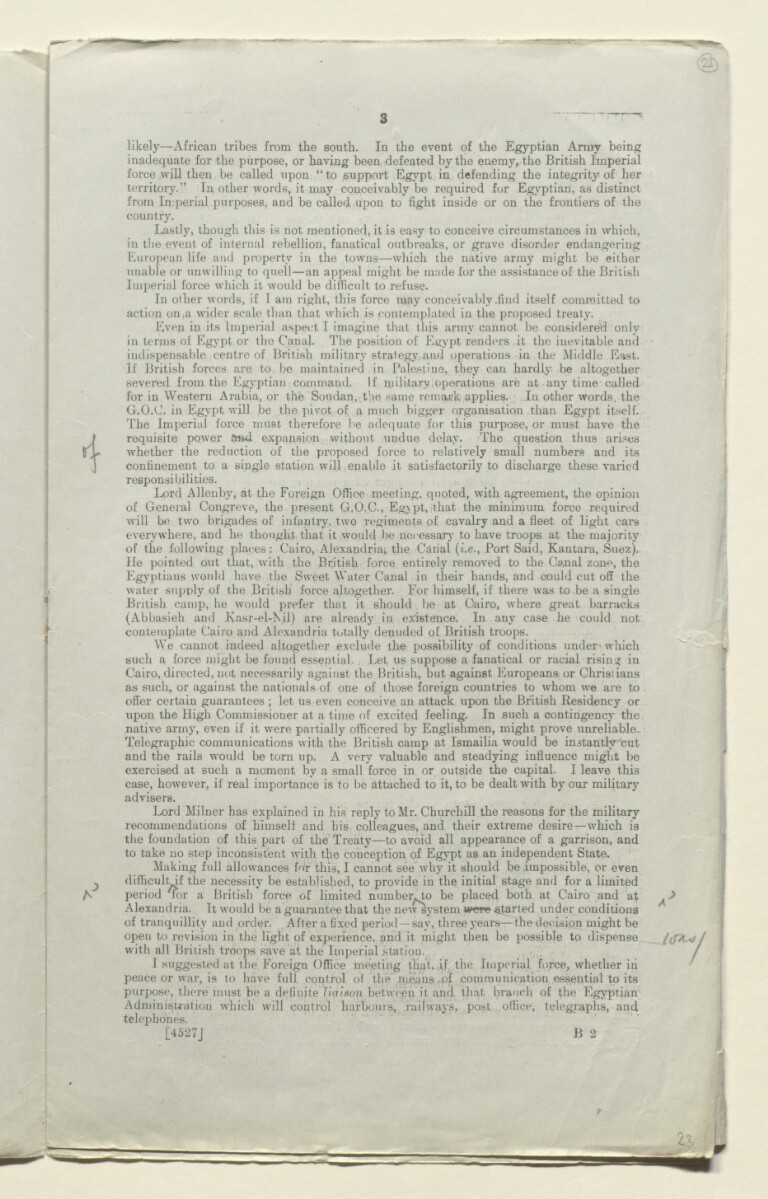
likely—African tribes from the south. In the event of the Egyptian Army being
inadequate for the purpose, or having been defeated by the enemy, the British Imperial
force will then be called upon “to support Egypt in defending the integrity of her
territory.” In other words, it may conceivably be required for Egyptian, as distinct
from Imperial purposes, and be called upon to fight inside or on the frontiers of the
country.
Lastly, though this is not mentioned, it is easy to conceive circumstances in which,
in the event of internal rebellion, fanatical outbreaks, or grave disorder endangering
European life and property in the towns—which the native army might be either
unable or unwilling to quell—an appeal might be made for the assistance of the British
Imperial force which it would be difficult to refuse.
In other words, if I am right, this force may conceivably .find itself committed to
action oma wider scale than that which is contemplated in the proposed treaty.
Even in its Imperial aspeet I imagine that this army cannot be considered only
in terms of Egypt or the Canal. The position of Egypt renders it the inevitable and
indispensable centre of British military strategy and operations in the Middle East.
If British forces are to be maintained in Palestine, they can hardly be altogether
severed from the Egyptian command. If military .Operations are at any time called
for in Western Arabia, or the Soudan, the same remark applies. In other words, the
G.O.C. in Egypt will be the pivot of a much bigger organisation than Egypt itself.
The Imperial force must therefore be adequate for this purpose, or must have the
requisite power trad expansion without undue delay. The question thus arises
whether the reduction of the proposed force to relatively small numbers and its
confinement to a single station will enable it satisfactorily to discharge these varied
responsibilities.
Lord Allenby, at the Foreign Office meeting, quoted, with agreement, the opinion
of General Congreve, the present G.O.C., Eg\pt, that the minimum force required,
will be two brigades of infantry, two regiments of cavalry and a fleet of light cars
everywhere, and he thought that it would be necessary to have troops at the majority
of the following places : Cairo, Alexandria, the Canal (v’.e., Port Said, Kantara, Suez).
He pointed out that, with the British force entirely removed to the Canal zone, the
Egyptians would have the Sweet Water Canal in their hands, and could cut off the
water supply of the British force altogether. For himself, if there was to be a single
British camp, he would prefer that it should be at Cairo, where great barracks
(Abbasieh and Kasr-el-lSil) are already in existence. In any case he could not
contemplate Cairo and Alexandria totally denuded of British troops.
We cannot indeed altogether exclude the possibility of conditions under which
such a force might be found essential. Let us suppose a fanatical or racial rising in
Cairo, directed, not necessarily against the British, but against Europeans or Christians
as such, or against the nationals of one of those foreign countries to whom we are to
offer certain guarantees ; let us even conceive an attack upon the British Residency or
upon the High Commissioner at a time of excited feeling. In such a contingency the
native army, even if it were partially officered by Englishmen, might prove unreliable.
Telegraphic communications with the British camp at Ismailia would be instantly cut
and the rails would be torn up. A very valuable and steadying influence might be
exercised at such a moment by a small force in or outside the capital. I leave this
case, however, if real importance is to be attached to it, to be dealt with by our military
advisers.
Lord Milner has explained in his reply to Mr. Churchill the reasons for the military
recommendations of himself and his colleagues, and their extreme desire—which is
the foundation of this part of the Treaty—to avoid all appearance of a garrison, and
to take no step inconsistent with the conception of Egypt as an independent State.
Making full allowances for this, I cannot see why it should be impossible, or even
difficult^if the necessity be established, to provide in the initial stage and for a limited
period Tor a British force of limited number^o be placed both at Cairo and at
Alexandria. It would be a guarantee that the new system wwe started under conditions
of tranquillity and order. After a fixed period — say, three years—the decision might be
open to revision in the light of experience, and it might then be possible to dispense /(p*
with all British troops save at the Imperial station.
I suggested at the Foreign Office meeting that, yf the Imperial force, whether in
peace or war, is to have full control of the means .of communication essential to its
purpose, there must be a definite liaison between it and that branch of the Egyptian
Administration which will control harbours, railways, post office, telegraphs, and
telephones.
[4527J B 2
حول هذه المادة
- المحتوى
يحتوي الملف على مراسلات ومذكرات وتقارير رسمية تتعلق بالشؤون السياسية في مصر. المتراسلون والكاتبون هم مسؤولون في وزارة الخارجية (كان اللورد كرزون وزير الدولة للشؤون الخارجية في ذلك الوقت)، مكتب الحرب البريطاني، وزارة الطيران، الأميرالية، مكتب المستعمرات البريطانية، مجلس التجارة، مجلس التعليم، بالإضافة إلى الخدمة المدنية المصرية.
يحتوي الملف على نسخ من تقارير البعثة الخاصة إلى مصر (الأوراق ١-٧، ٧٥-٩٣، ١٧٥-١٩٤) بقيادة اللورد ألفريد ميلنر، والتي كانت تهدف إلى إجراء التحقيقات وتقديم المشورة في أعقاب قيام الثورة المصرية في ١٩١٩. يأتي جزءٌ كبير من محتوى الملف ردًا على نتائج وتوصيات البعثة، ويناقش إمكانيات التوصل إلى تسوية سياسية مع مصر.
- الشكل والحيّز
- ملف واحد (٢٣٧ ورقة)
- الترتيب
الملف مرتب ترتيبًا زمنيًا من بدايته إلى نهايته.
- الخصائص المادية
ترقيم الأوراق: يبدأ تسلسل ترقيم الأوراق (المستخدم للأغراض المرجعية) على الغلاف الأمامي بالرقم ١، وينتهي داخل الغلاف الخلفي بالرقم ٢٣٥؛ هذه الأرقام مكتوبة بالقلم الرصاص ومحاطة بدائرة في أعلى يمين صفحة الوجه الجانب الأمامي للورقة أو لفرخٍ من الورق. كثيرًا ما يشار إليه اختصارًا بالحرف "و". من كل ورقة. يوجد في الملف استثناء واحد في ترقيم الأوراق، ص. ٧٦أ.
- لغة الكتابة
- الإنجليزية بالأحرف اللاتينية للاطّلاع على المعلومات الكاملة لهذا السجل
استخدام وإعادة نشر هذه المادة
- إعادة نشر هذه المادة
تقرير البعثة الخاصة إلى مصر بقيادة اللورد ميلنر، وأوراق ذات صلة [و٢٢] (٤٧٣/٤٣)و المكتبة البريطانية: أوراق خاصة وسجلات من مكتب الهندو Mss Eur F112/260و مكتبة قطر الرقمية <https://www.qdl.qa/archive/81055/vdc_100080131819.0x00002c> [تم الوصول إليها في ٦ يونيو ٢٠٢٦]
https://www.qdl.qa/العربية/archive/81055/vdc_100080131819.0x00002c
يمكنك نسخ ولصق الفقرة التالية لتضمين الصورة في صفحة الويب الخاصة بك.
<meta charset="utf-8"><a href="https://www.qdl.qa/العربية/archive/81055/vdc_100080131819.0x00002c">تقرير البعثة الخاصة إلى مصر بقيادة اللورد ميلنر، وأوراق ذات صلة [<span dir="ltr">و٢٢</span>] (٤٧٣/٤٣)</a> <a href="https://www.qdl.qa/العربية/archive/81055/vdc_100080131819.0x00002c"> <img src="https://iiif.qdl.qa/iiif/images/81055/vdc_100000001491.0x000295/Mss Eur F112_260_0043.jp2/full/!280,240/0/default.jpg" alt="" /> </a>
هذا التسجيل IIIF له ملف ظاهر متوفر كما يلي. إذا كان لديك عارض متوافق للصور يمكنك سحب الأيقونة لتحميله.https://www.qdl.qa/العربية/iiif/81055/vdc_100000001491.0x000295/manifestافتح في المتصفح العامافتح في عارض IIIF ميرادورطرق إضافية لاستخدام صور الأرشيف الرقمي
حقوق النسخ والتأليف: كيفية استخدام هذا المحتوى
- رقم الاستدعاء
- Mss Eur F112/260
- العنوان
- تقرير البعثة الخاصة إلى مصر بقيادة اللورد ميلنر، وأوراق ذات صلة
- الصفحات
- ظ٢٣٥:و١٤٤ ،وأ١٤٤ ،ظ١٤٣:و١٤٣ ،ظ١٤٠:و٧٧ ،ظأ٧٦:وأ٧٦ ،ظ٧٦:و٥٣ ،ظ٥٠:و٤٢ ،ظ٣٩:و٢ ،داخلي-أمامي ،أمامي
- المؤلف
- شركة الهند الشرقية ولجنة البرلمان البريطاني لشئون الهند ومكتب الهند وإدارات الحكومة البريطانية الأخرى
- شروط الاستخدام
- ترخيص حكومي عام