
![أوراق بقلم كرزون بشأن الشرق الأدنى والأوسط [<span dir="ltr">و١٣٩</span>] (٣٤٨/٢٧٧)](https://iiif.qdl.qa/iiif/images/81055/vdc_100000001491.0x00028c/Mss Eur F112_278_0285.jp2/full/!1200,1200/0/default.jpg "أوراق بقلم كرزون بشأن الشرق الأدنى والأوسط [<span dir=\"ltr\">و١٣٩</span>] (٣٤٨/٢٧٧)")
أوراق بقلم كرزون بشأن الشرق الأدنى والأوسط [و١٣٩] (٣٤٨/٢٧٧)
محتويات السجل: ملف واحد (١٧٤ ورقة). يعود تاريخه إلى ١٦ نوفمبر ١٩١٧-١٧ يناير ١٩٢٤. اللغة أو اللغات المستخدمة: الإنجليزية والفرنسية. النسخة الأصلية محفوظة في المكتبة البريطانية: أوراق خاصة وثائق جُمعت بصفة شخصية. وسجلات من مكتب الهند إدارة الحكومة البريطانية التي كانت الحكومة في الهند ترفع إليها تقاريرها بين عامي ١٨٥٨ و١٩٤٧، حيث خلِفت مجلس إدارة شركة الهند الشرقية. .
نسخ
النسخ مستحدث آليًا ومن المرجّح أن يحتوي على أخطاء.
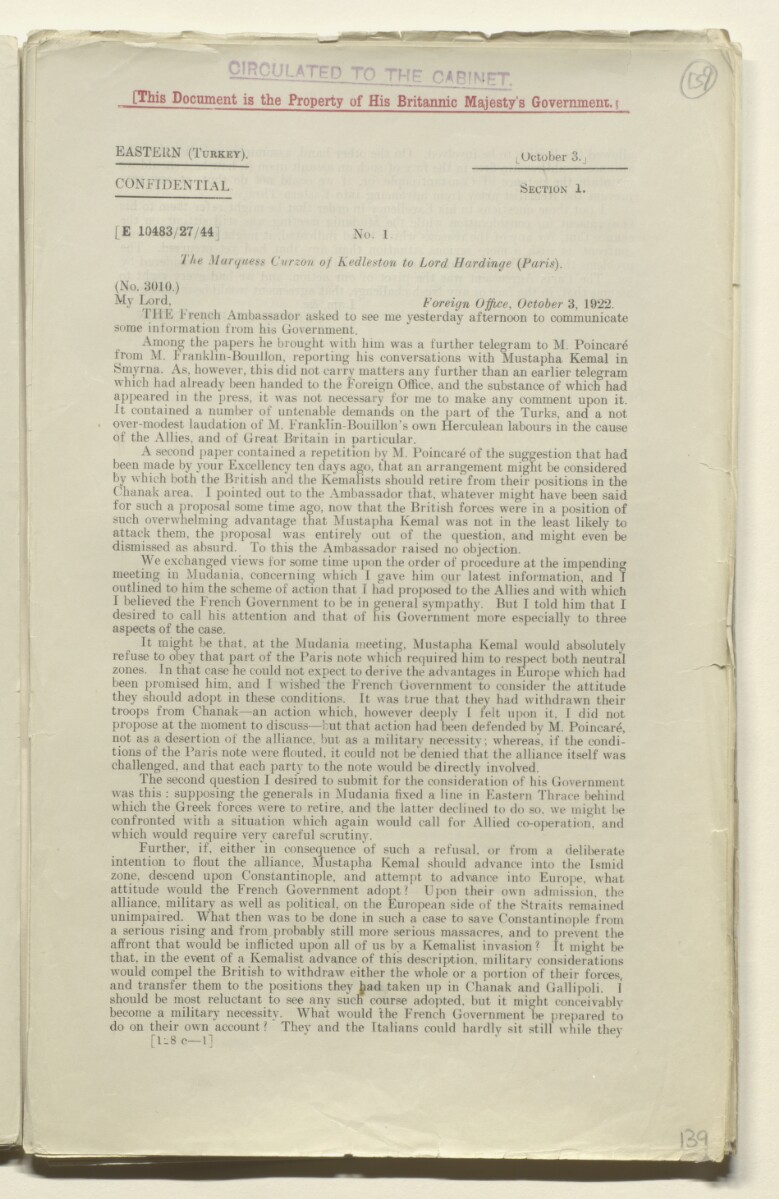
OmC ULATED TO THE 1 C ^PfMrr
[This Document is the Property of His Britannic Majesty's Government, j
EASTERN (Turkey). l October 3.
CONFIDENTIAL Section 1.
[E 10483/27/44] No. 1
1 he Marquess Citrzon of Kedleston to Lord Hardinge [Paris).
(No. 3010.)
My Lord, Poreign Office, October 3, 1922.
IHE French Ambassador asked to see me yesterday afternoon to communicate
some information from his Government.
Among the papers he brought with him was a further telegram to M. Poincare
from M. Franklin-Bouillon, reporting his conversations with Mustapha Kemal in
Smyrna. As, however, this did not carry matters any further than an earlier telegram
which had ali’eady been handed to the Foreign Office, and the substance of which had
appeared in the press, it was not necessary for me to make any comment upon it.
It contained a number of untenable demands on the part of the Turks, and a not
over-modest laudation of M. Franklin-Bouillon’s own Herculean labours in the cause
of the Allies, and of Great Britain in particular.
A second paper contained a repetition by M. Poincare of the suggestion that had
been made by your Excellency ten days ago, that an arrangement might be considered
by which both the British and the Kemalists should retire from their positions in the
Chanak area. I pointed out to the Ambassador that, whatever might have been said
for such a proposal some time ago, now that the British forces were in a position of
such overwhelming advantage that Mustapha Kemal was not in the least likely to
attack them, the proposal was entirely out of the question, and might even be
dismissed as absurd. To this the Ambassador raised no objection.
We exchanged views for some time upon the order of procedure at the impending
meeting in Mudania, concerning which I gave him our latest information, and I
outlined to him the scheme of action that I had proposed to the Allies and with which
J believed the French Government to be in general sympathy. But I told him that I
desired to call his attention and that of his Government more especially to three
aspects of the case.
It might be that, at the Mudania meeting, Mustapha Kemal would absolutely
refuse to obey that part of the Paris note which required him to respect both neutral
zones. In that case he could not expect to derive the advantages in Europe which had
been promised him, and I wished the French Government to consider the attitude
they should adopt in these conditions. It was true that they had withdrawn their
troops from Ghanak—an action which, however deeply I felt upon it, 1 did not
propose at the moment to discuss—but that action had been defended by M. Poincare,
not as a desertion of the alliance, but as a military necessity; whereas, if the condi
tions of the Paris note were flouted, it could not be denied that the alliance itself was
challenged, and that each party to the note would be directly involved.
The second question I desired to submit for the consideration of his Government
was this : supposing the generals in Mudania fixed a line in Eastern Thrace behind
which the Greek forces were to retire, and the latter declined to do so, we might be
confronted with a situation which again would call for Allied co-operation, and
which would require very careful scrutiny.
Further, if, either in consequence of such a refusal, or from a deliberate
intention to flout the alliance, Mustapha Kemal should advance into the Ismid
zone, descend upon Constantinople, and attempt to advance into Europe, what
attitude would the French Government adopt? Upon their own admission, the
alliance, military as well as political, on the European side of the Straits remained
unimpaired. What then was to be done in such a case to save Constantinople from
a serious rising and from probably still more serious massacres, and to prevent the
affront that would be inflicted upon all of us by a Kemalist invasion ? It might be
that, in the event of a Kemalist advance of this description, militarv considerations
would compel the British to withdraw either the whole or a portion of their forces,
and transfer them to the positions they {iad taken up in Chanak and Gallipoli. I
should be most reluctant to see any such course adopted, but it might conceivably
become a military necessity. What would the French Government be prepared to
do on their own account ? They and the Italians could hardly sit still while they
[1 l 8 o—1] ‘ v J
حول هذه المادة
- المحتوى
يحتوي الملف على مراسلات ومذكرات وخرائط وملاحظات حول موضوعات مختلفة تتعلق بالشرق الأدنى والشرق الأوسط. كتب جورج كرزون أغلب هذه الأوراق بنفسه، وهي تتعلق بتسوية الأراضي السابقة للدولة العثمانية بعد تفككها في أعقاب الحرب العالمية الأولى. وتُناقش مسائل مثل الاحتلال اليوناني لسميرنا، وتقسيم تراقيا، والحرب اليونانية التركية، واستقلال جورجيا، ومعاهدات سيفر ولوزان.
وتشمل المسائل الأخرى التي يتناولها الملف مسائل متعلقة بالأراضي العربية للدولة العثمانية السابقة، والمستشارين الأمريكيين في بلاد فارس، ومستقبل فلسطين، بما في ذلك تقرير لجنة فلسطين (مكتب المستعمرات البريطانية) بتاريخ ٢٧ يوليو ١٩٢٣ (الأوراق ١٦٨-١٧١).
أغلب المراسلات داخل الملف تدور بين كرزون وممثلين عن قوى الحلفاء الأخرى، وكذلك مسؤولين في الإدارات الحكومية والمكاتب الدبلوماسية الأخرى.
- الشكل والحيّز
- ملف واحد (١٧٤ ورقة)
- الترتيب
الملف مرتب ترتيبًا زمنيًا من بدايته إلى نهايته.
- الخصائص المادية
ترقيم الأوراق: يبدأ تسلسل ترقيم الأوراق (المُستخدم للأغراض المرجعية) على الورقة الأولى بالرقم ١ وينتهي على الورقة الأخيرة بالرقم ١٧٤؛ هذه الأرقام مكتوبة بالقلم الرصاص ومحاطة بدائرة في أعلى يمين صفحة الوجه الجانب الأمامي للورقة أو لفرخٍ من الورق. كثيرًا ما يشار إليه اختصارًا بالحرف "و". من كل ورقة.
- لغة الكتابة
- الإنجليزية والفرنسية بالأحرف اللاتينية للاطّلاع على المعلومات الكاملة لهذا السجل
استخدام وإعادة نشر هذه المادة
- إعادة نشر هذه المادة
أوراق بقلم كرزون بشأن الشرق الأدنى والأوسط [و١٣٩] (٣٤٨/٢٧٧)و المكتبة البريطانية: أوراق خاصة وسجلات من مكتب الهندو Mss Eur F112/278و مكتبة قطر الرقمية <https://www.qdl.qa/archive/81055/vdc_100076917036.0x00004e> [تم الوصول إليها في ٢٣ غشت ٢٠٢٦]
https://www.qdl.qa/العربية/archive/81055/vdc_100076917036.0x00004e
يمكنك نسخ ولصق الفقرة التالية لتضمين الصورة في صفحة الويب الخاصة بك.
<meta charset="utf-8"><a href="https://www.qdl.qa/العربية/archive/81055/vdc_100076917036.0x00004e">أوراق بقلم كرزون بشأن الشرق الأدنى والأوسط [<span dir="ltr">و١٣٩</span>] (٣٤٨/٢٧٧)</a> <a href="https://www.qdl.qa/العربية/archive/81055/vdc_100076917036.0x00004e"> <img src="https://iiif.qdl.qa/iiif/images/81055/vdc_100000001491.0x00028c/Mss Eur F112_278_0285.jp2/full/!280,240/0/default.jpg" alt="" /> </a>
هذا التسجيل IIIF له ملف ظاهر متوفر كما يلي. إذا كان لديك عارض متوافق للصور يمكنك سحب الأيقونة لتحميله.https://www.qdl.qa/العربية/iiif/81055/vdc_100000001491.0x00028c/manifestافتح في المتصفح العامافتح في عارض IIIF ميرادورطرق إضافية لاستخدام صور الأرشيف الرقمي
حقوق النسخ والتأليف: كيفية استخدام هذا المحتوى
- رقم الاستدعاء
- Mss Eur F112/278
- العنوان
- أوراق بقلم كرزون بشأن الشرق الأدنى والأوسط
- الصفحات
- داخلي-خلفي ،خلفي ،ظ١٧٣:و١٦٣ ،ظ١٦١:و١٥٦ ،ظ١٥٤ ،و١٥٣:ظ١٤٧ ،و١٤٥:و١١٨ ،ظ١٠٥:و٩٥ ،ظ٩٣:و٥٤ ،ظ٤٨:و١٥ ،ظ١٢:و٢
- المؤلف
- شركة الهند الشرقية ولجنة البرلمان البريطاني لشئون الهند ومكتب الهند وإدارات الحكومة البريطانية الأخرى
- شروط الاستخدام
- ترخيص حكومي عام