
!["تقرير عن المسح الأولي لمسار خط التلغراف الفارسي المركزي الممتد من كويته إلى بم وفهرة" [<span dir="ltr">ظ٥٨</span>] (١٦٢/١٢١)](https://iiif.qdl.qa/iiif/images/81055/vdc_100000001491.0x00011e/Mss Eur F111_377_0123.jp2/full/!1200,1200/0/default.jpg "\"تقرير عن المسح الأولي لمسار خط التلغراف الفارسي المركزي الممتد من كويته إلى بم وفهرة\" [<span dir=\"ltr\">ظ٥٨</span>] (١٦٢/١٢١)")
"تقرير عن المسح الأولي لمسار خط التلغراف الفارسي المركزي الممتد من كويته إلى بم وفهرة" [ظ٥٨] (١٦٢/١٢١)
محتويات السجل: مجلد واحد (٧٧ ورقة). يعود تاريخه إلى ١٩٠١. اللغة أو اللغات المستخدمة: الإنجليزية. النسخة الأصلية محفوظة في المكتبة البريطانية: أوراق خاصة وثائق جُمعت بصفة شخصية. وسجلات من مكتب الهند إدارة الحكومة البريطانية التي كانت الحكومة في الهند ترفع إليها تقاريرها بين عامي ١٨٥٨ و١٩٤٧، حيث خلِفت مجلس إدارة شركة الهند الشرقية. .
نسخ
النسخ مستحدث آليًا ومن المرجّح أن يحتوي على أخطاء.
22
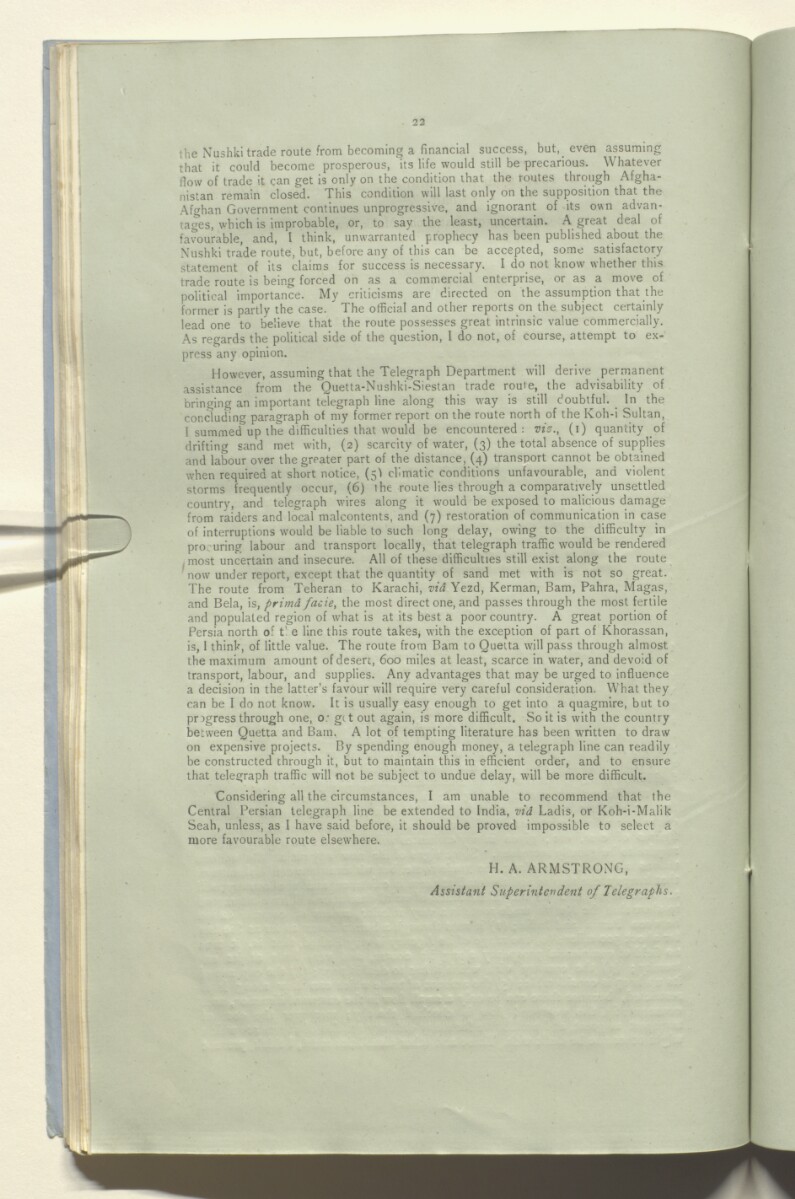
the Nushki trade route from becoming a financial success, but,_ even assuming
that it could become prosperous, its life would still be precarious. Whatever
flow of trade it can get is only on the condition that the routes through Afgha
nistan remain closed. This condition will last only on the supposition that the
Afghan Government continues unprogressive, and ignorant of its own advan
tages, which is improbable, or, to say the least, uncertain. A great deal of
favourable, and, 1 think, unwarranted prophecy has been published about the
Xushki trade route, but, before any of this can be accepted, some satisfactory
statement of its claims for success is necessary. I do not know whether this
trade route is being forced on as a commercial enterprise, or as a move of
political importance. My criticisms are directed on the assumption that the
former is partly the case. The official and other reports on the subject certainly
lead one to believe that the route possesses great intrinsic value commercially.
As regards the political side of the question, I do not, of course, attempt to ex
press any opinion.
However, assuming that the Telegraph Department will derive permanent
assistance from the Quetta-Nushki-Siestan trade rouie, the advisability of
bringing an important telegraph line along this way is still doubtful. In the
concluding paragraph of my former report on the route north of the Koh-i Sultan,
I summed^up the difficulties that would be encountered : viz., (i) quantity of
drifting sand met with, (2) scarcity of water, (3) the total absence of supplies
and labour over the greater part of the distance, (4) transport cannot be obtained
when required at short notice, (5^ climatic conditions unfavourable, and violent
storms frequently occur, (6) "the route lies through a comparatively unsettled
country, and telegraph wires along it would be exposed to malicious damage
from raiders and local malcontents, and (7) restoration of communication in case
of interruptions would be liable to such long delay, owing to the difficulty in
procuring labour and transport locally, that telegraph traffic would be rendered
most uncertain and insecure. All of these difficulties still exist along the route
now under report, except that the quantity of sand met wuth is not so great.
The route from Teheran to Karachi, m& Yezd, Kerman, Bam, Pahra, Magas,
and Bela, is, primd facie, the most direct one, and passes through the most fertile
and populated region of what is at its best a poor country. A great portion of
Persia north of t’ e line this route takes, with the exception of part of Khorassan,
is, I think, of little value. The route from Bam to Quetta will pass through almost
the maximum amount of desert, 600 miles at least, scarce in water, and devoid of
transport, labour, and supplies. Any advantages that may be urged to influence
a decision in the latter’s favour will require very careful consideration. What they
can be I do not know. It is usually easy enough to get into a quagmire, but to
progress through one, 0: git out again, is more difficult. So it is with the country
between Quetta and Bam. A lot of tempting literature has been written to draw
on expensive projects. By spending enough money, a telegraph line can readily
be constructed through it, but to maintain this in efficient order, and to ensure
that telegraph traffic will not be subject to undue delay, will be more difficult.
Considering all the circumstances, I am unable to recommend that the
Central Persian telegraph line be extended to India, md Ladis, or Koh-i-Malik
Seah, unless, as I have said before, it should be proved impossible to select a
more favourable route elsewhere.
H. A. ARMSTRONG,
Assistant Superintendent of Telegraphs.
حول هذه المادة
- المحتوى
تقرير بقلم مستر هـ. أ. آرمسترونج، مساعد المشرف في إدارة التلغراف الهندية. طُبع في مكتب الطباعة الحكومية المركزية في شيملا، ١٩٠١. التقرير عبارة عن مسح لمسار محتمل لتوسيع خط التلغراف من الهند إلى بلاد فارس، يمتد من كويته إلى بم، مع مسار بديل يمتد إلى فهرة. يحتوي المجلد على وصف للطرق التي تم اتخاذها، وتقديرات للتكلفة، وملاحظات حول الامتدادات، تحديد المسار، موقع المكاتب، الأكواخ المستخدمة لاستراحة الموظفين، الصيانة، المياه، الرمال، الإمدادات، المناخ، وطريق كويته-سيستان التجاري.
يحتوي التقرير على صور للمسار باللونين الأبيض والأسود مرافقة للأوصاف (الأوراق ٢٦، ٢٨، ٣٠، ٣٢، ٣٤، ٣٧، ٣٩، ٤١، ٤٦، ٤٩، ٥١، ٥٢، ٦٣، ٦٧، ٧٠، ٧١). الورقة ٢٣ عبارة عن خريطة توضح الطريق الذي سلكه. مرفق في بداية المجلد نسخة من "معاهدة بين المملكة المتحدة وبلاد فارس بتمديد نظام الاتصالات البرقية بين أوروبا والهند عبر بلاد فارس"، ١٩٠٢ (الأوراق ٢-٦)، واثنتا عشرة ورقة منفصلة من الملاحظات المخطوطة عن التقرير التي كتبها جورج كرزون (الأوراق ٧-١٨).
- الشكل والحيّز
- مجلد واحد (٧٧ ورقة)
- الخصائص المادية
ترقيم الأوراق: يبدأ تسلسل ترقيم الأوراق (المستخدم للأغراض المرجعية) على الغلاف الأمامي بالرقم ١، وينتهي داخل الغلاف الخلفي بالرقم ٧٩؛ هذه الأرقام مكتوبة بالقلم الرصاص ومحاطة بدائرة في أعلى يمين صفحة الوجه الجانب الأمامي للورقة أو لفرخٍ من الورق. كثيرًا ما يشار إليه اختصارًا بالحرف "و". من كل ورقة.
- لغة الكتابة
- الإنجليزية بالأحرف اللاتينية للاطّلاع على المعلومات الكاملة لهذا السجل
استخدام وإعادة نشر هذه المادة
- إعادة نشر هذه المادة
"تقرير عن المسح الأولي لمسار خط التلغراف الفارسي المركزي الممتد من كويته إلى بم وفهرة" [ظ٥٨] (١٦٢/١٢١)و المكتبة البريطانية: أوراق خاصة وسجلات من مكتب الهندو Mss Eur F111/377و مكتبة قطر الرقمية <https://www.qdl.qa/archive/81055/vdc_100075142289.0x00007a> [تم الوصول إليها في ٢٤ غشت ٢٠٢٦]
https://www.qdl.qa/العربية/archive/81055/vdc_100075142289.0x00007a
يمكنك نسخ ولصق الفقرة التالية لتضمين الصورة في صفحة الويب الخاصة بك.
<meta charset="utf-8"><a href="https://www.qdl.qa/العربية/archive/81055/vdc_100075142289.0x00007a">"تقرير عن المسح الأولي لمسار خط التلغراف الفارسي المركزي الممتد من كويته إلى بم وفهرة" [<span dir="ltr">ظ٥٨</span>] (١٦٢/١٢١)</a> <a href="https://www.qdl.qa/العربية/archive/81055/vdc_100075142289.0x00007a"> <img src="https://iiif.qdl.qa/iiif/images/81055/vdc_100000001491.0x00011e/Mss Eur F111_377_0123.jp2/full/!280,240/0/default.jpg" alt="" /> </a>
هذا التسجيل IIIF له ملف ظاهر متوفر كما يلي. إذا كان لديك عارض متوافق للصور يمكنك سحب الأيقونة لتحميله.https://www.qdl.qa/العربية/iiif/81055/vdc_100000001491.0x00011e/manifestافتح في المتصفح العامافتح في عارض IIIF ميرادورطرق إضافية لاستخدام صور الأرشيف الرقمي
حقوق النسخ والتأليف: كيفية استخدام هذا المحتوى
- رقم الاستدعاء
- Mss Eur F111/377
- العنوان
- "تقرير عن المسح الأولي لمسار خط التلغراف الفارسي المركزي الممتد من كويته إلى بم وفهرة"
- الصفحات
- داخلي-خلفي ،ظ٧٨:و٧٢ ،و٧١:ظ٧٠ ،ظ٦٩:ظ٦٧ ،ظ٦٦:و٦٤ ،و٦٣:و٥٣ ،و٥٢:ظ٥١ ،ظ٥٠:ظ٤٩ ،ظ٤٨:ظ٤٦ ،ظ٤٥:و٤٢ ،و٤١:و٤٠ ،و٣٩:و٣٨ ،و٣٧:و٣٥ ،و٣٤:و٣٣ ،و٣٢:و٣١ ،و٣٠:ظ٢٨ ،ظ٢٧:ظ٢٦ ،ظ٢٥:و٢٤ ،ظ٢٢:و٧ ،داخلي-أمامي ،ذيل ،رأس ،حافة ،صلب ،خلفي ،أمامي
- المؤلف
- شركة الهند الشرقية ولجنة البرلمان البريطاني لشئون الهند ومكتب الهند وإدارات الحكومة البريطانية الأخرى
- شروط الاستخدام
- ترخيص حكومي عام